McKinnon
Isle of Coll, then LiverpooltoHobart and Impression Bay, Tasmania
From Britain and Ireland to Australia
More than 2 centuries of departures and new beginnings, from a Hebridean island and the Cornish mining country to farms, railways, aviation and family homes across Australia and the Pacific.
Explore the public family tree on Ancestry See fuller profiles, records, photographs and family stories for people across the wider family.A person’s first mention links to their Ancestry profile. Place names link to Wikipedia where a suitable entry exists.
A family in motion
On Coll, the McKinnons watched neighbours leave an island that could no longer support them all. In Cornwall, the Faulls worked underground before seeking a life beyond the mines. The Fawcetts left Westmorland for colonial New South Wales, while the Waddys and Drakes made their mark in a young South Australia.
This page follows the two sides separately so each journey is easier to follow. The McKinnon and Fawcett story comes first. The Faull, Waddy and Drake story follows. They meet when Angus Malcolm McKinnon and Christina Vercoe Faull marry in Perth in 1971, and the story continues with their family.
Across the generations
The places
The original family journeys, plotted from the most precise departure point and first Australian arrival or settlement the records currently support.
Isle of Coll, then LiverpooltoHobart and Impression Bay, Tasmania
Warcop, WestmorlandtoSydney, their first documented Australian home
Crowan, CornwalltoSouth Australia aboard the Caucasian
LondontoPort Adelaide aboard the Competitor
Ireland, town not yet knowntoPort Adelaide aboard the Inconstant
Rockland St Peter, then SouthamptontoMelbourne, followed by Norwood
The people
Once the broad journeys are clear, the tree shows how the people connect. Drag with a mouse to move around it, use the controls to zoom, and select a person to follow their part in the story. On a phone or tablet, swipe normally to continue down the page.[1]
Part 1
The McKinnon story begins on Coll and crosses the world aboard the Persian. In Australia it meets the Fawcett family, then follows Angus Norman and Elsie to their children Deirdre and Angus Malcolm McKinnon.
The Isle of Coll
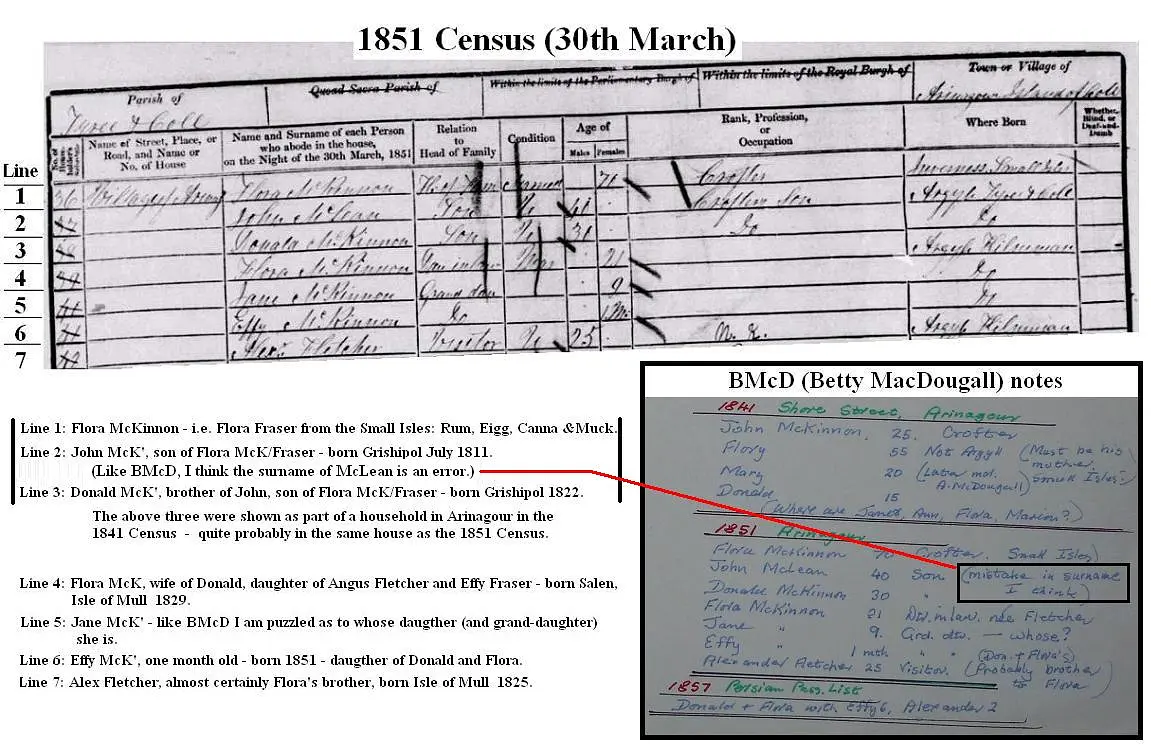
The parish record first finds Malcolm McKinnon and Flora Fraser (born about 1781) at Grishipoll through the baptisms of their children. Mary McKinnon (born 1809) was baptised first, followed by John McKinnon (born 1811), Ann McKinnon (born 1817), Flora McKinnon (born 1819) and Donald McKinnon (born 1822). Flora Fraser was about 28 when Mary was born and about 41 when Donald arrived. Malcolm's birth has not been found.
In 1832, a parish collection recorded a Malcolm Mckinnon of Greseboll paying £1. The spelling and settlement make him likely to be the same Malcolm, still living in the place where his children had been baptised, although the entry gives no age or family details.[2]
An earlier list from 1776 records Hugh McKinnon, Ann Campbell and a young son called Malcolm at Totronald. That boy could be the later father at Grishipoll, but no surviving record joins the two households. The possible relationship is shown with a dashed line in the family tree.[2]
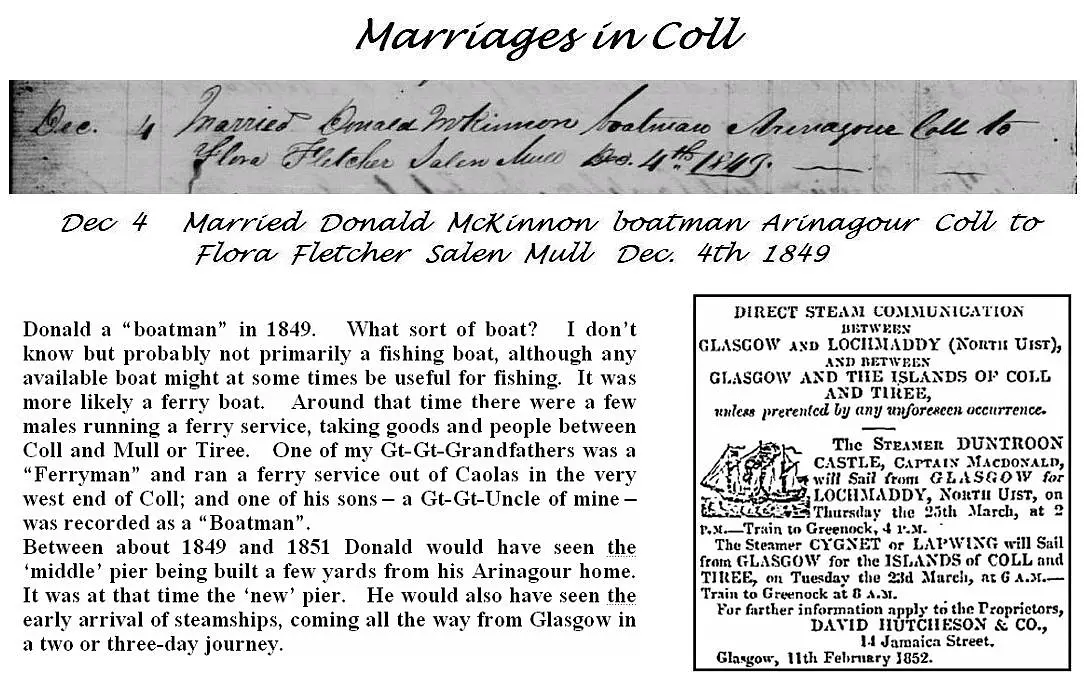
By 1849 Donald was living at Arinagour and had married Flora Fletcher (born 1829), a young woman from Salen on nearby Mull, daughter of Angus Fletcher and Effy Fraser. Donald was 27 and Flora was 20. The marriage register gives Donald's occupation as boatman.[2]
Donald’s older sister Mary McKinnon (born 1809) was building a household of her own at Grimisary with Alexander McDougal. The 1851 census calls Alexander a crofter employing a man and a female servant. Mary was there with their little sons John, age 2, and Malcolm, age 1. It is a brief but vivid sign that the family had put down roots before the voyage pulled them apart from Coll.[2]
The 2 older daughters both called Janet also appear to have made their own marriages on Coll. A Janet of Arinagour married Donald McDonald in 1838, and another married Archibald McDonald in 1841. The dates and settlement fit the 2 Janet daughters baptised to Malcolm and Flora in 1813 and 1815, although the marriage entries do not name their parents. In 1841, the older Janet was at Arivorich with Alexander, age 2, and Mary, age 3 months, while her husband was at sea. A later baptism names a son Neil. The younger Janet's 2 daughters, Isabella and Mary, were living with their blacksmith father at Totronald in 1851, then with a woman recorded as his wife, Catherine.[2]
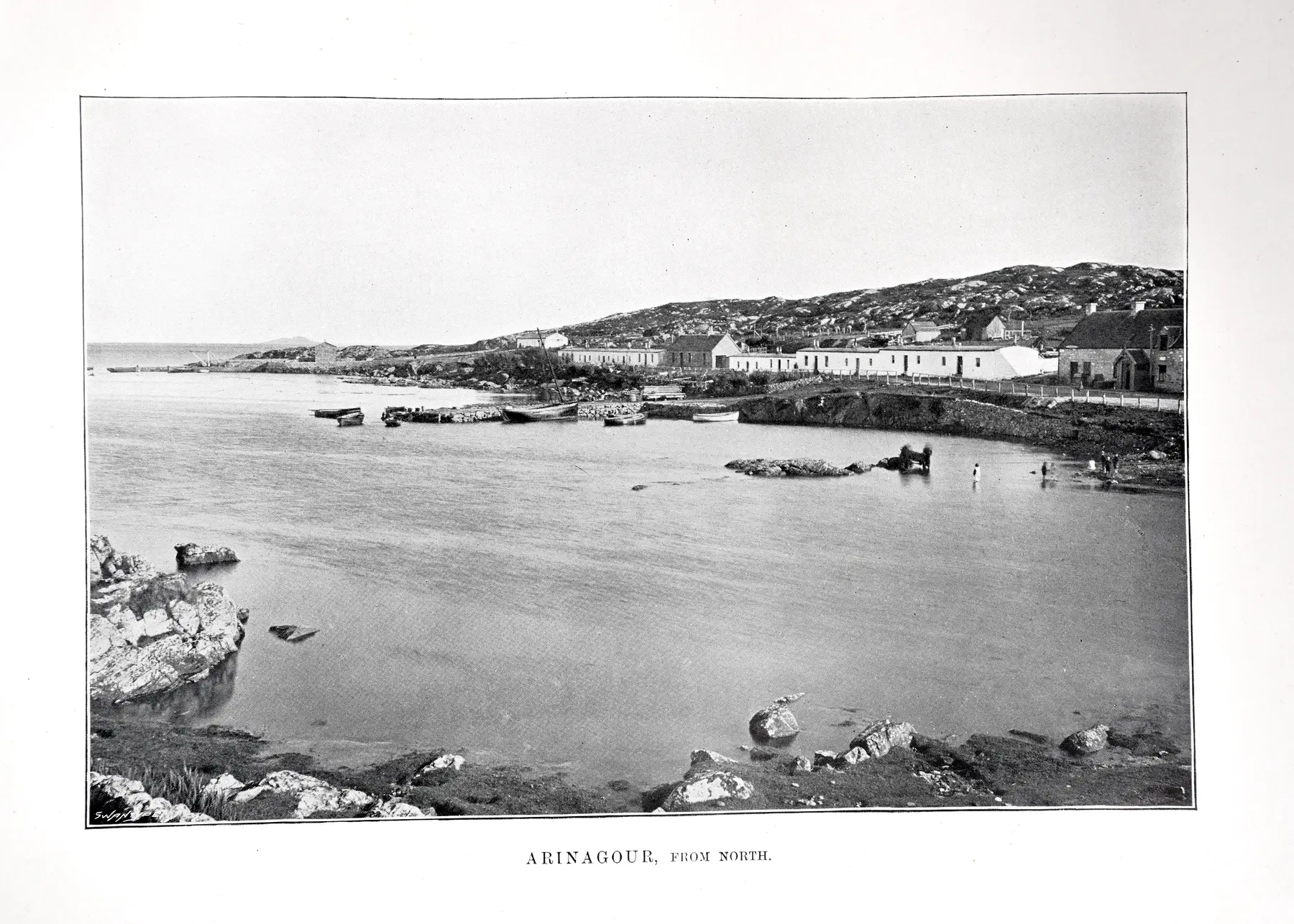
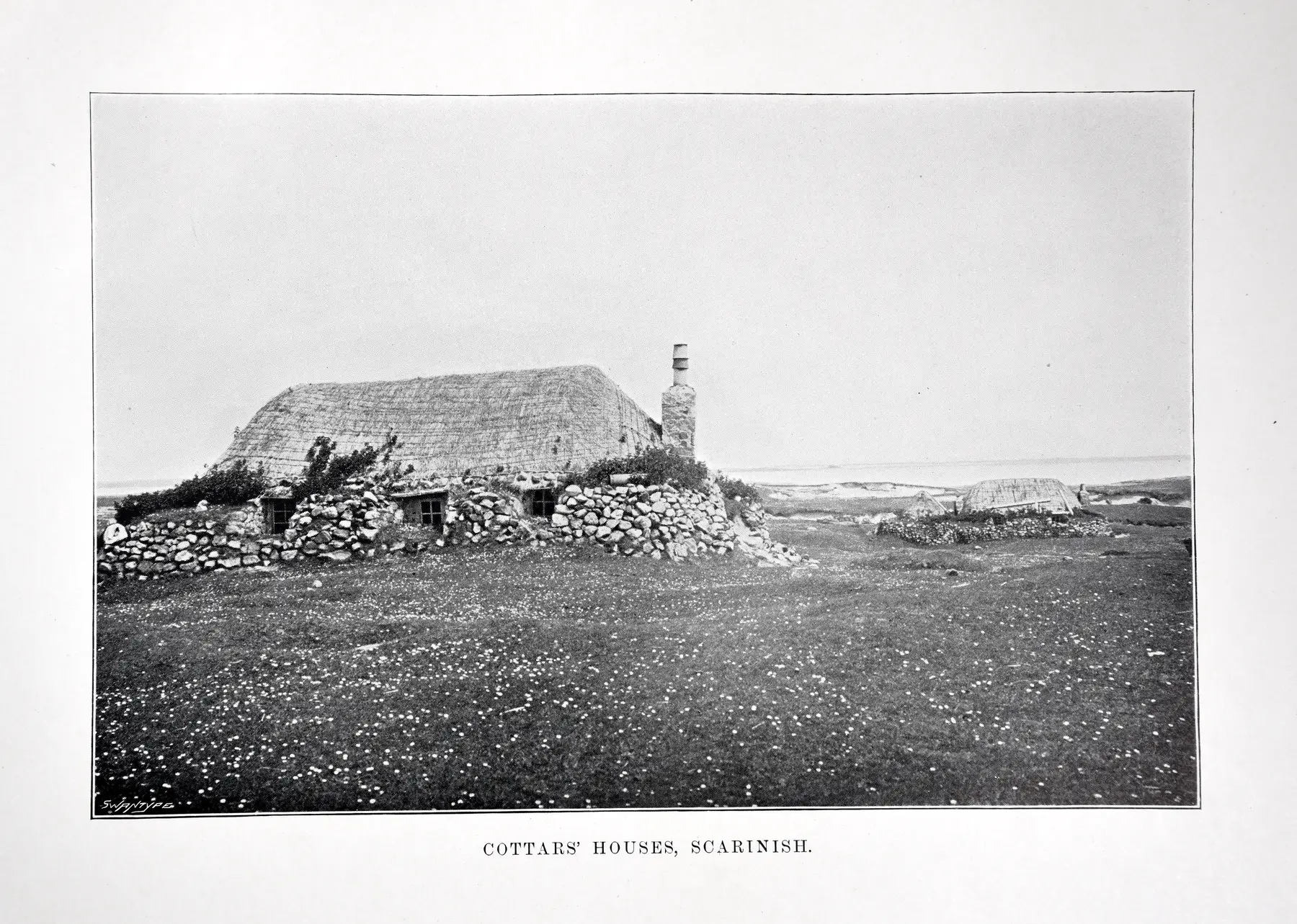
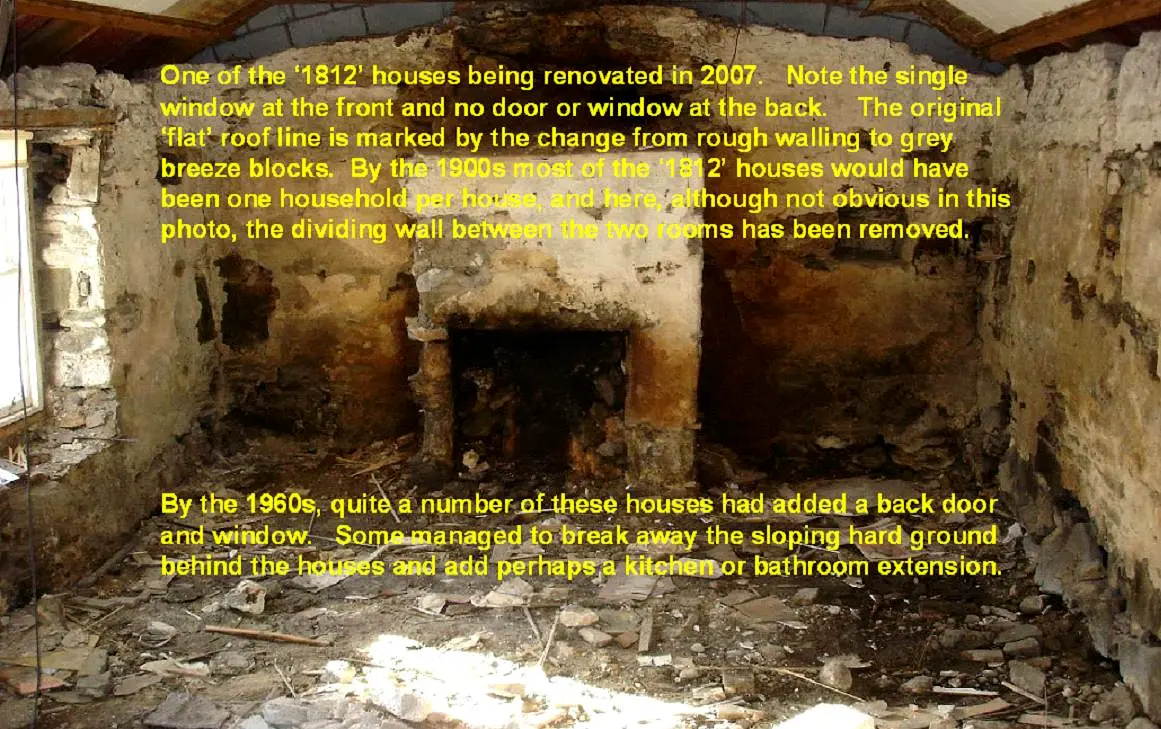
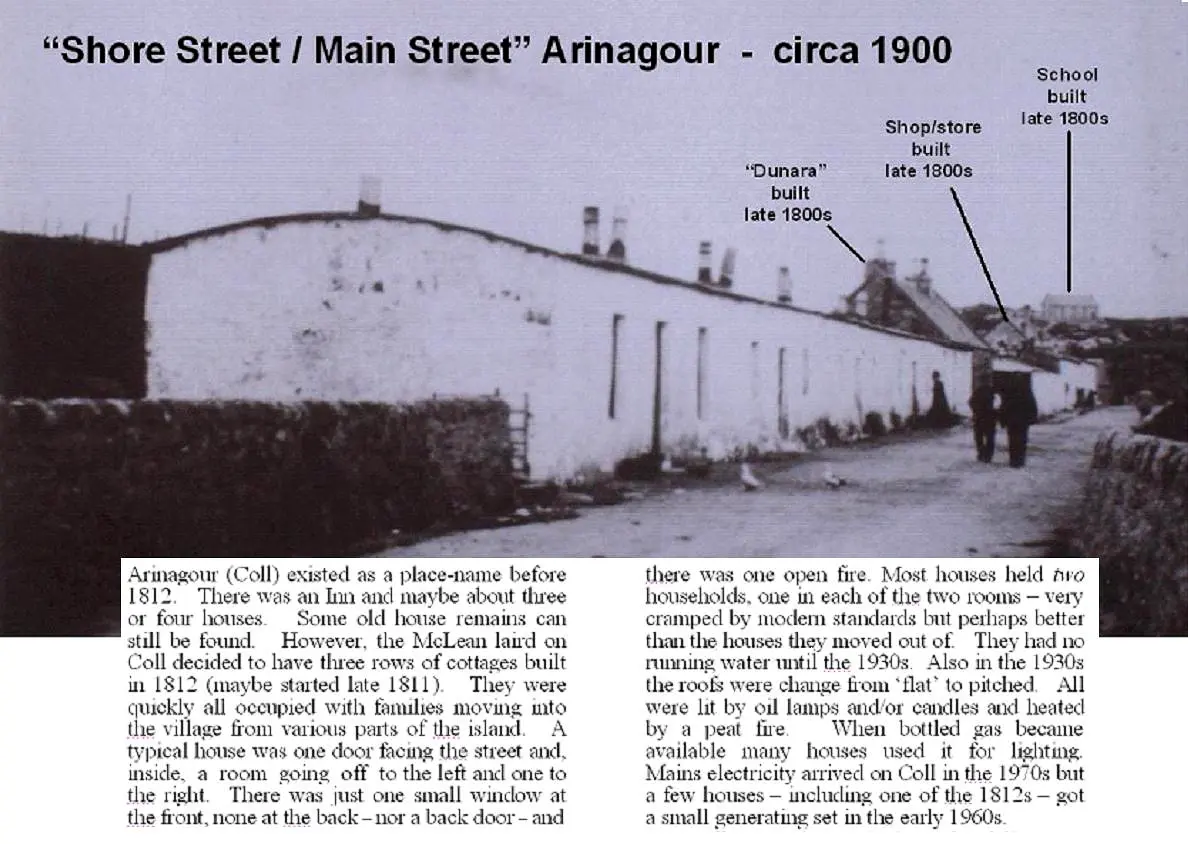
Life followed the land and the seasons. Coll families worked small strips of oats and hardy bear barley, spread seaweed as manure and relied on cattle, sheep, fishing and the potato crop to carry them through the year. At Arinagour, rows of stone cottages built from 1811 placed a room on either side of the front door. A single window faced the street. There was no back door, no running water and only 1 open fire. Oil lamps, candles and burning peat lit the winter evenings.[3]
The island was filling up. Its population grew from about 938 people in 1776 to 1,409 in 1841, while the crofts stayed small and the margin between a good harvest and hunger narrowed. The old runrig fields had been divided into individual crofts from 1811, but families kept subdividing them to shelter landless relatives. Sheep farms displaced more people onto the remaining ground. Then the kelp trade collapsed, the herring shoals failed and the potato blight struck. 2 supports of island life, the potato and the wages earned burning kelp, gave way within a generation.[3]
On Coll, the Highland Clearances arrived through that tightening circle of land, rent and hunger. Hugh Maclean, the island's proprietor, had already removed the population of neighbouring Rum in 1828. He spent heavily feeding Coll during the crisis, yet in 1841 roughly half the islanders were sent away and their small crofts were gathered into larger farms. He described emigration as rescue. To the families leaving ancestral ground, it was still a clearance.
An 1851 census records Flora McKinnon, age 70, as head of an Arinagour household. Her son Donald, age 30, lived there with his wife Flora, daughter Janet, age 9, and Euphemia, 1 month old. Alexander Fletcher was recorded as a visitor.[2] The census records the people but not the address. Arinagour had no house numbers, so the recorder simply moved from one home to the next.
Maclean had imagined moving an entire Highland community to Australia. In 1837 he asked the British Government to finance 3,000 Scots on a new estate in New South Wales, where each family would receive land after working for him. Officials rejected the plan. His efforts and the cost of supporting Coll helped bankrupt him, and he sold the estate in 1856.
A year later, the family joined 81 Collachs bound for Australia aboard the Persian. Their departure ended generations of island life and began a journey to the other side of the world.
The voyage of the Persian
Malcolm was not listed among the passengers when the family left Coll. His death has not been found. If he was the boy recorded at Totronald in 1776, he would have been at least 80 in 1857. Age alone could explain why he stayed, although he may already have died. Flora made the voyage with 3 of their adult children and their families.[4]
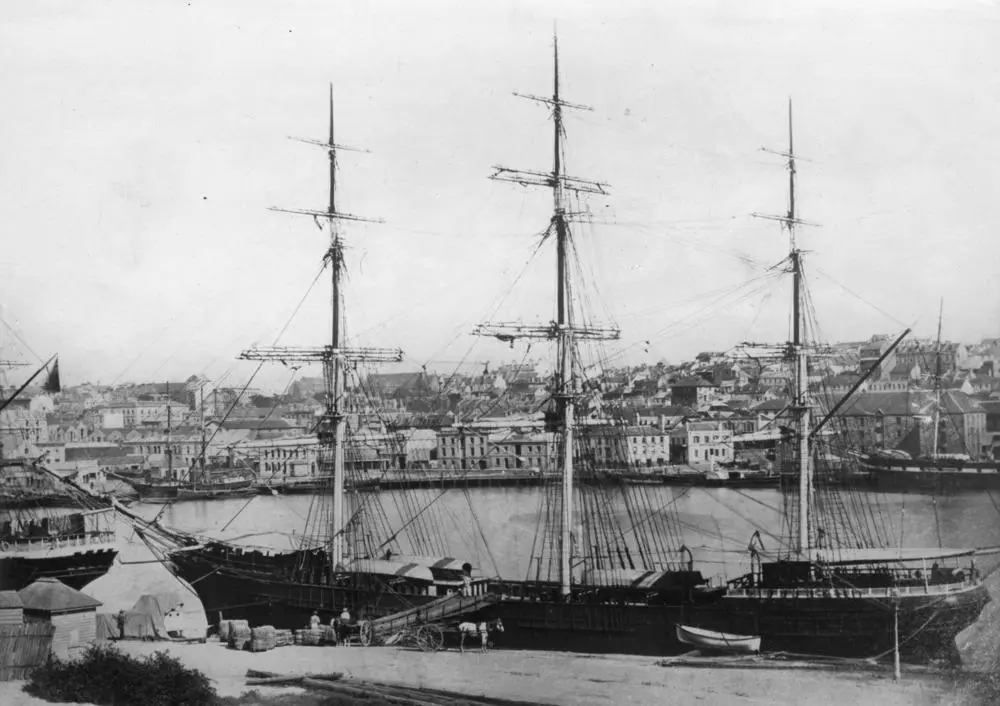
In late July 1857, the new 1,068-ton Persian left Liverpool with more than 300 immigrants aboard. She was a full-rigged sailing ship, built at Saint John, New Brunswick, in 1856 and registered as British ship number 35090. White Star's agents had chartered her for this voyage. Beneath the emigrants she carried a commercial cargo, chiefly salt and coal. The Coll party filled 12 family groups. Donald and Flora travelled as group 954 with their young children Effy and Alexander. Donald's mother, Flora Fraser, was listed with group 953, while his sister Mary and her husband Alexander McDougall followed as group 955.[4]
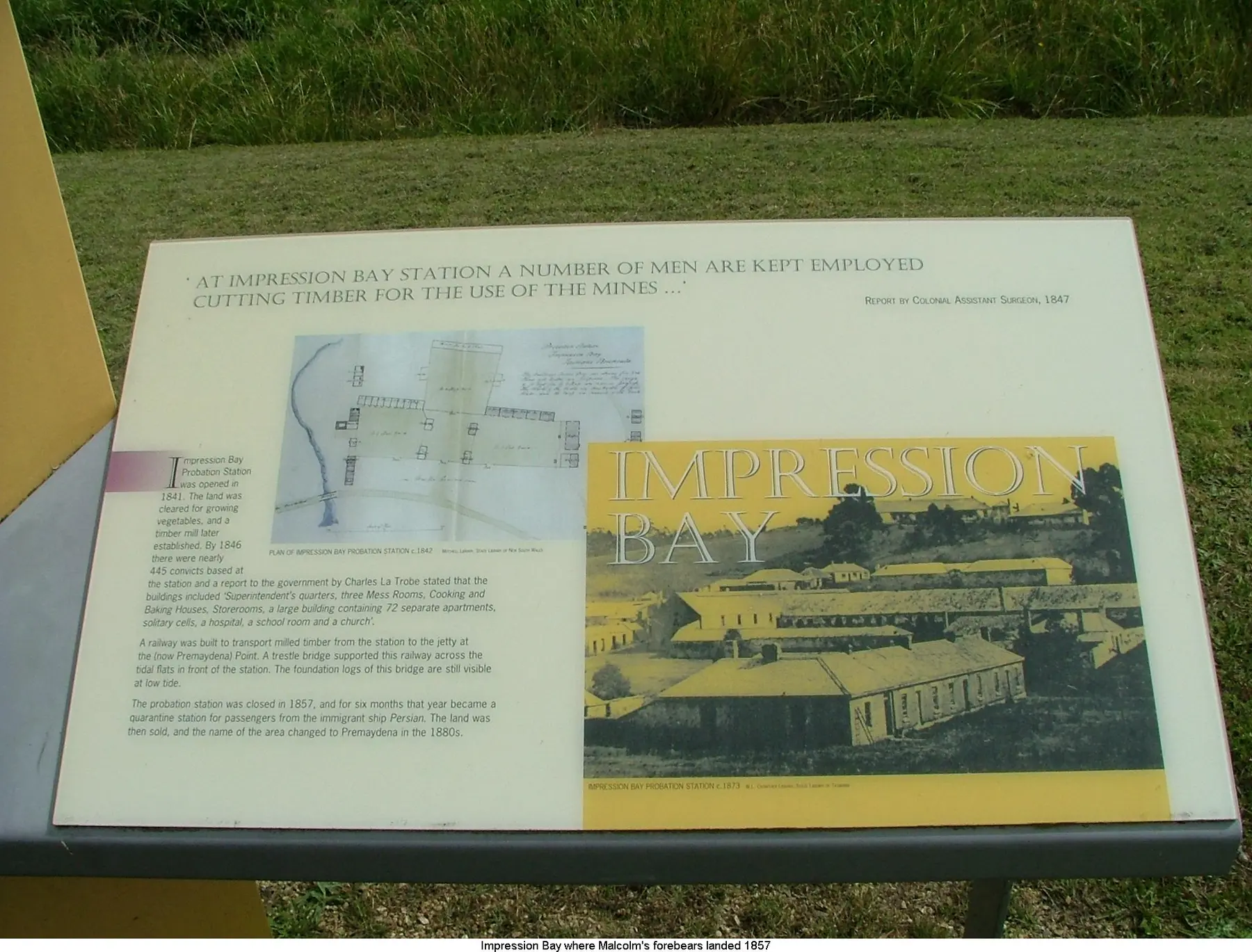
After passengers' complaints reached the Tasmanian Government and House of Assembly, the Immigration Agent spent 9 days at Impression Bay in December 1857 taking statements and examining the conditions aboard the Persian. His report and the immigrants' statements were tabled in Parliament. The inquiry found 277 people berthed in a passenger space about 105 feet long and 33½ feet wide, with 7 feet overhead. There was no proper ventilating apparatus, and the passengers had 716½ square feet less room than the law required. The provisions were plentiful, but the galley could not cope: pea soup burned, rice remained raw in the middle of its bags and baking was hurried or underdone.[4]
The inquiry also catches Donald M'Kinnon in his own words. He said that 2 young children had received only arrowroot and powders. In another passage, the Immigration Agent recorded that Donald's relatives had hired a man named Stevens to attend an ill man, and Donald confirmed that he had paid the charge. The papers do not name the children or the sick man, but they show Donald trying to secure care amid the fever and confusion.[4]
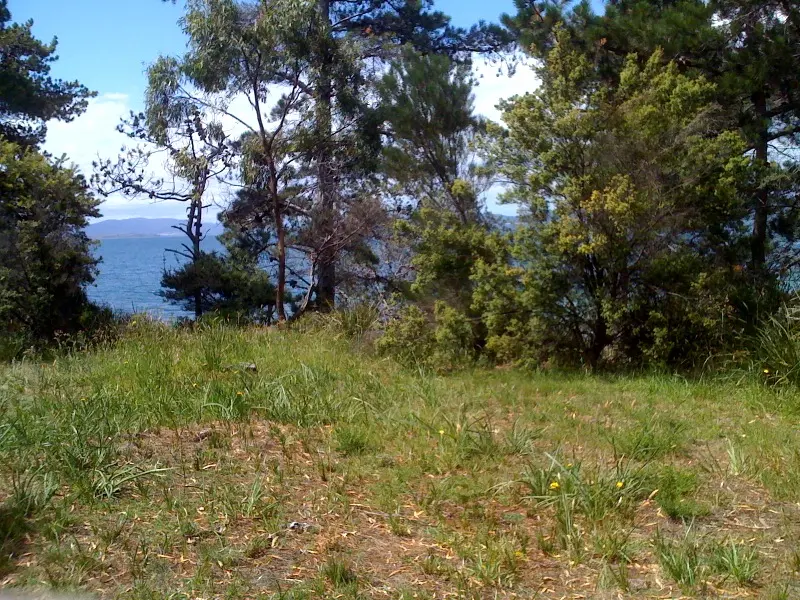
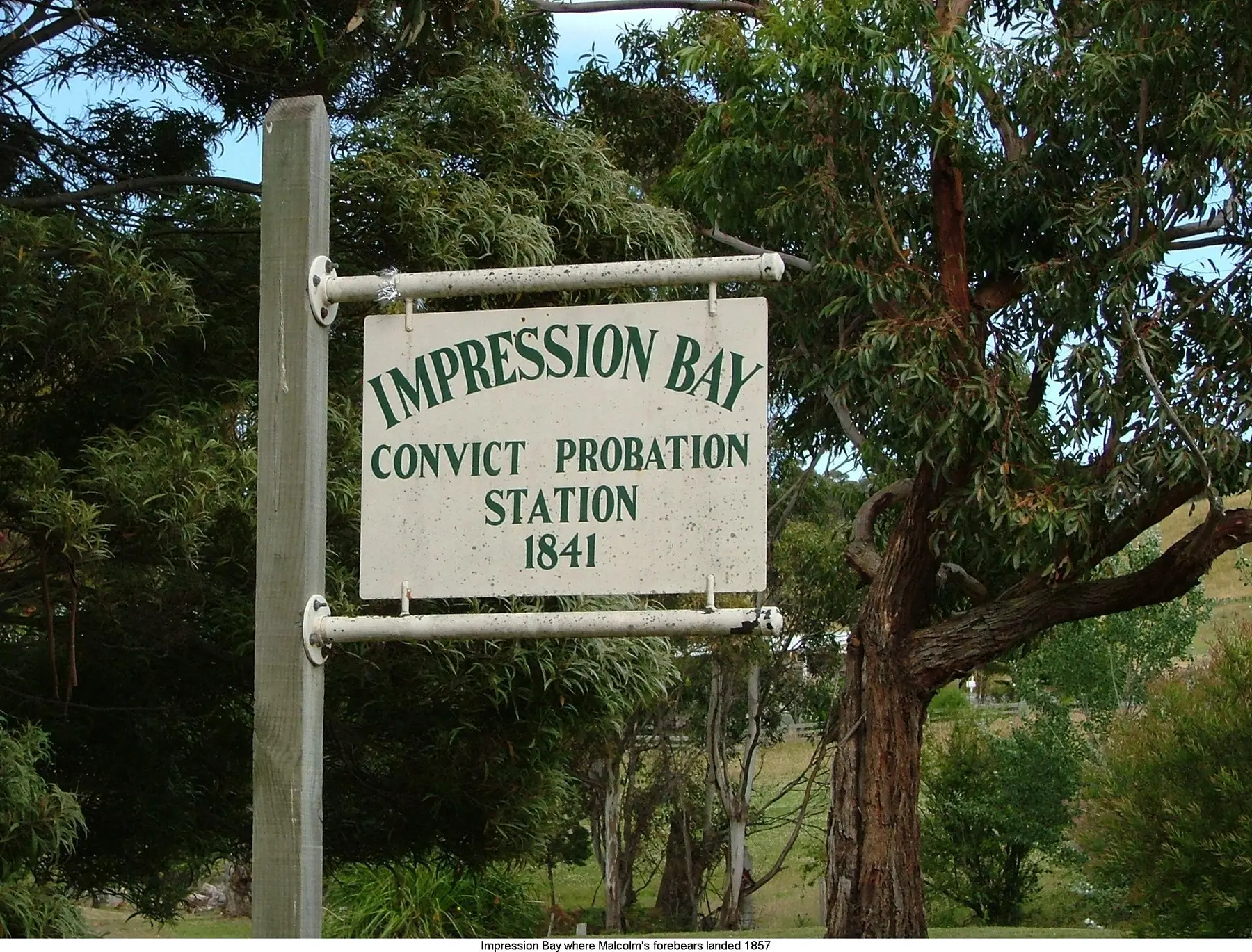
22 days after sailing, Ann MacKinnon of another Coll family became the first recorded fever death. The infection spread. Flora Fraser, probably age 76, died at sea on 22 September. When the Persian anchored near Hobart at midnight on 31 October, the Immigration Agent recorded 14 deaths during the voyage and 29 people then sick with fever. The ship was sent away from the town to quarantine at Impression Bay.
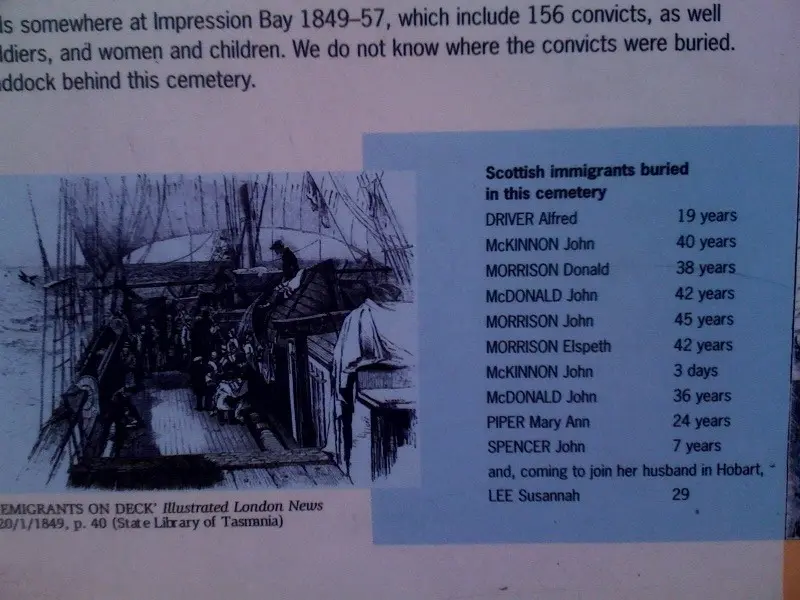
The losses continued. Flora's son John died soon after arrival, age 40. The Colonial Surgeon's report said he had already endured 12 days of severe typhus when he was landed. Donald and Flora's infant John lived for only 3 days in quarantine. Those who survived remained at Impression Bay until January 1858. By the time they were free to cross to Victoria, they had spent nearly 6 months aboard ship and confined in quarantine.[4]
The family did not necessarily change its name on reaching Australia. The same branch appears as McKinnon in its 1849 marriage and 1851 census records, MacKinnon in the ship compilation, M'Kinnon in the 1857 immigration statements, and McKinnon again in early Australian indexes. Coll historian Ewen McGee found the same shifting practice on the island. The spelling seems to have followed the clerk who wrote the record, rather than one moment when the family dropped an a.[4]
Hobart was only one stop in the Persian's working life. Newspaper shipping lists place her back in Melbourne in June 1860 after another Liverpool passage, this time with 21 passengers and mixed cargo that included machinery, ironwork and food. She returned again in July 1862 carrying 4 locomotives, their tenders and more than 1,000 iron pipes. From Melbourne she left in ballast for Callao. By 1863 she was carrying people and goods from London to Port Chalmers in New Zealand. These records establish 3 Australian arrivals, at Hobart in 1857 and Melbourne in 1860 and 1862. A later register says the ship was lost, but the date and place written beside that entry have not been read with enough confidence to repeat as fact.
The family aboard
Flora Fraser crossed with 3 of her adult children, their spouses and 7 grandchildren. The passenger compilation spells their surname MacKinnon. Its ages appear to have been rounded or copied inaccurately, so the chart distinguishes them from ages suggested by parish and census records.
With their daughters
Margaret age 3 and Mary age 1
With Effy age 6 and Alexander age 2
Infant John was born in quarantine
With John age 10, Malcolm age 8 and James age 4
The ship also carried a separate MacKinnon sibling network in groups 956–959 and another Donald MacKinnon household in group 961. No record examined so far connects either cluster to this branch.
John MacKinnon of group 953 did not survive the quarantine ordeal. A Hobart report on 19 November 1857 said that he was the Persian passengers' only death since 12 November. The timing matches his independently recorded death at Impression Bay on 16 November, leaving Mary McLean with their young daughters Margaret and Mary.[54]

A start in Victoria
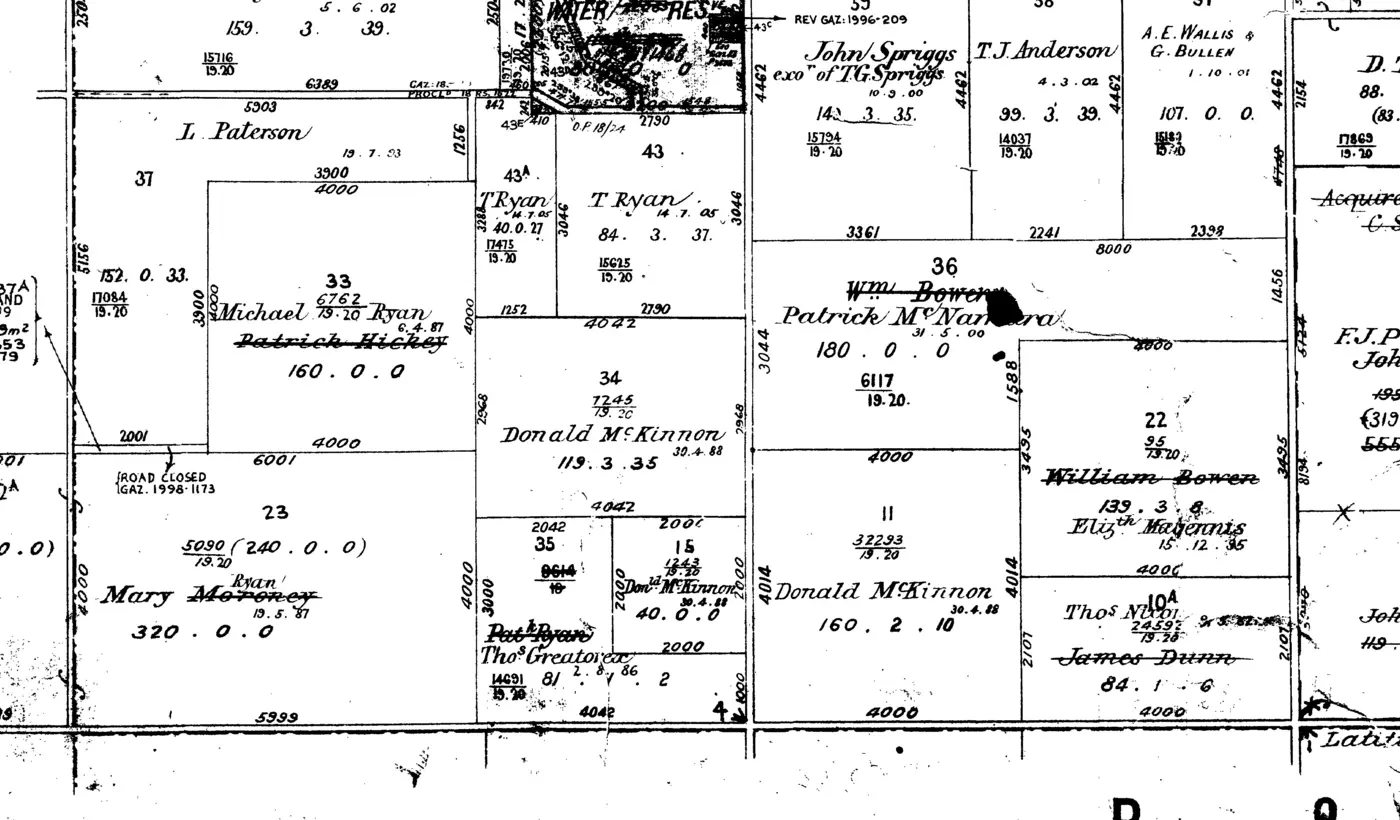
Victoria offered land, though very little came easily. After a first stop at Beveridge, Donald and Flora moved into the farming country around Yabba South, Katandra, Dookie and Benalla. During the 1870s they selected 3 allotments totalling about 319 acres. Donald worked the land long enough to receive the Crown grant in 1888.
An 1882 government-notice summary independently places Donald at Yabba Yabba and records that his licence or lease was transferred under the Land Act 1880. It does not identify an allotment, acreage or tenure type, so it supports the family's district and landholding account without proving every inherited property detail.[21]
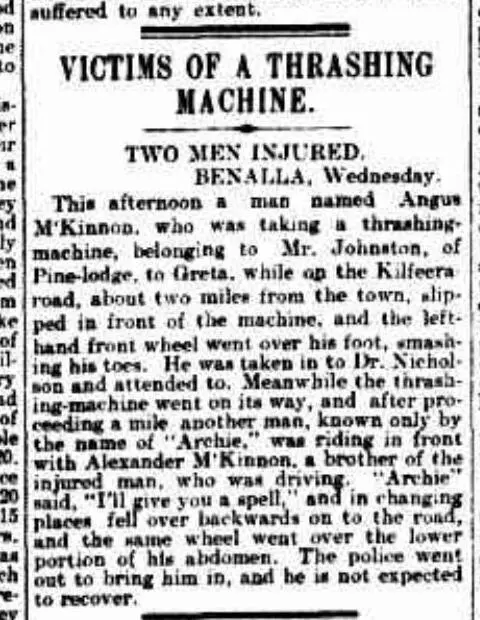
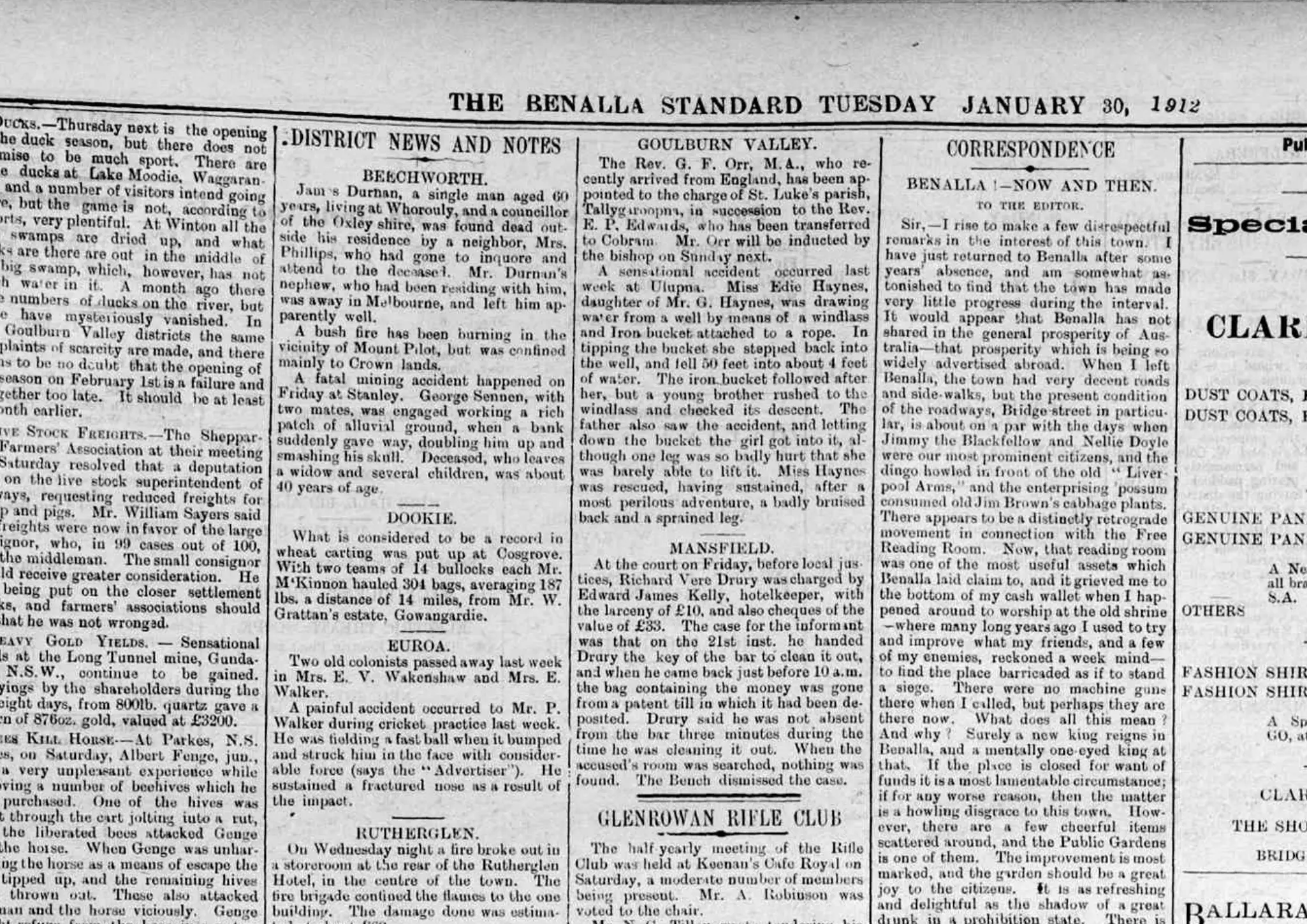
The household grew to include Mary, Alexander, Angus, Malcolm, John, Simon, Euphemia, Florence, Ellen and Catherine. Family stories place Malcolm and John behind bullock teams, clearing ground and carrying timber and wool around Lothbeg and Cosgrove. A 1912 report describes a McKinnon at Cosgrove moving 304 wheat bags from W. Grattan's Gowangardie estate. The load covered 14 miles behind 2 teams totalling 14 bullocks, with the bags averaging 187 pounds. The paper treated it as a local carting record, but did not give the driver's first name.[5]
Their son Malcolm McKinnon (born 1865) spent his later life in the Wagga district and was living at Mangoplah when he died on 4 May 1930. His funeral left Wagga the next morning for burial in the Presbyterian section of Wagga Cemetery. A first-anniversary notice placed by his sister Kitty, Catherine McKinnon Turnbull, and her family remembered him as a dear brother and uncle, independently connecting the McKinnon and Turnbull households.[44]
Malcolm's son Donald Kenneth McKenzie (born 1897) was registered at birth as Donald Kenneth McKinnon, naming Malcolm McKinnon and Isabella McIvor as his parents. He later worked in Sydney bakeries and became a master baker at Bondi. A 1943 bankruptcy examination recorded that unpaid sales tax and a flour mill's bill of sale had cost him control of the bakery. Donald said his mother bought the business from the mill and employed him as its manager, although the report did not name her. The episode preserves both the work and financial risk behind a family bakery.[38]
Their daughter Euphemia McKinnon married David Charles Chilcott in 1881. David had left his family's Cressy home in Tasmania while under age, then crossed to Victoria and became a farmer at Yabba North. After more than 40 years in the district, railway and horse accidents left him badly injured and partly paralysed. He died at Merry Vale in December 1918 after months of care, leaving a farm and estate to Euphemia and their children.[29]
Their daughter Ellen Janet McKinnon and Matthias McGowan's son Hector Malcolm McGowan (born 1895) later lived in South Melbourne. In 1943 he and another man pleaded guilty to riding on the footboards of race trams at Moonee Ponds. The Tramways Board described the practice as dangerous, and each man was fined £1 with £1 1s costs. The small report places Hector in Coventry Street and catches one ordinary wartime-era journey through Melbourne.[55]
Donald McKinnon, the Persian emigrant, died at Tatong in 1892 (age 70) and was buried at Katandra beside the country where the family had taken root. His son Angus Richard McKinnon (born 1863) married Rachael McDonald (born 1870) at Benalla in 1901. Around 1912, Angus and Rachael moved north to Burrandana and the plains south of Wagga.
Rachael's sister Mary Christina McDonald married Mansfield grazier Murdock Campbell. On Boxing Day 1892, their sons aged 7 and 10 drowned after entering a waterhole while making their usual round of rabbit haunts. The report names the boys only by age, but the younger child's Victorian death registration identifies him as Murdock Campbell (born 1885) and names both parents. The family tragedy is retained without repeating the report's speculation about how the accident occurred.[59]
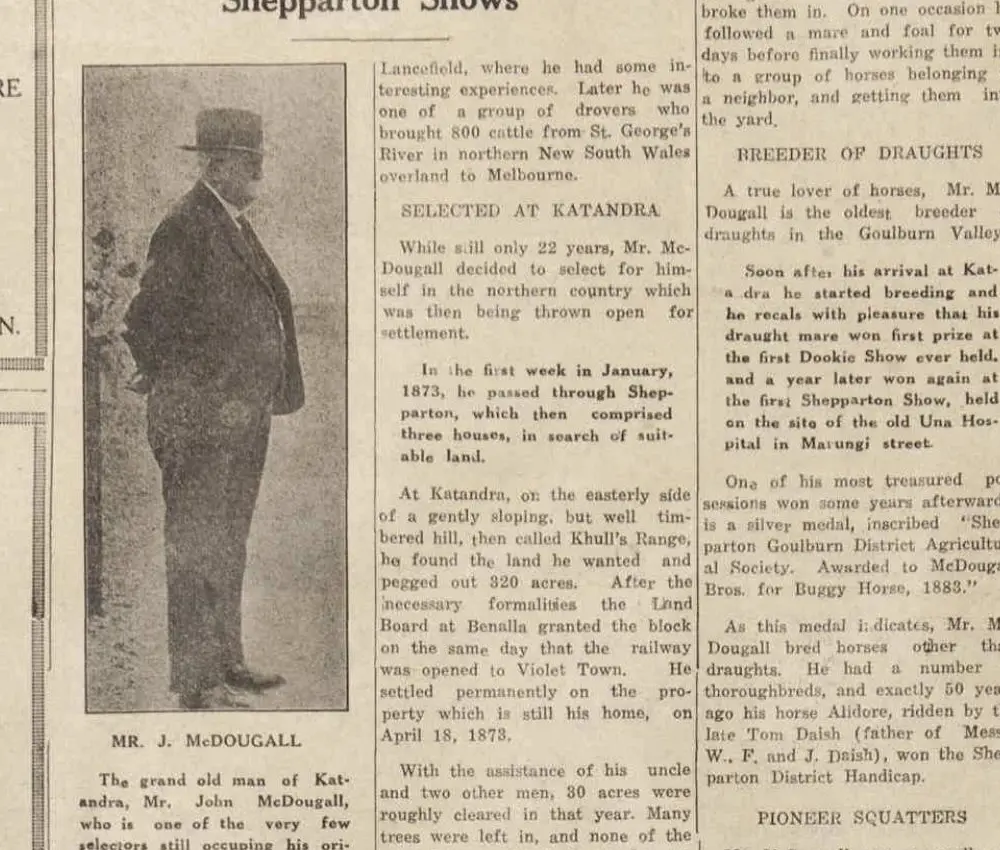
Donald's sister Mary McKinnon (born 1809) sailed on the Persian with Alexander McDougall and their 3 sons. The eldest, John, selected 320 acres at Katandra in 1873 and remained there while the land was cleared and developed. A newspaper profile published 65 years later described him as a horse breeder still living on his original selection.[4]
John's younger brother Malcolm McDougall (born 1849) worked as a drover after earlier station work. He died from injuries suffered near Murchison in September 1901 when his horse fell as he tried to mount. Family notices connect him to his wife Annie, their home at Khull's Range near Katandra and his burial in that district.[4]
The youngest brother, James McDougall (born 1853), settled at Omeo. His estate included the Golden Age Hotel when he died in 1889. Licensing reports show his widow Christina first caring for the premises, then holding its licence. She was recorded as Christina Treacy by the next licensing court. A later notice linked the Treacy family to Omeo, while a 1913 marriage notice placed James and Christina's daughter Christina Isabella McDougall at Ballarat with C. V. Towner.[4]
The Sutherland connection
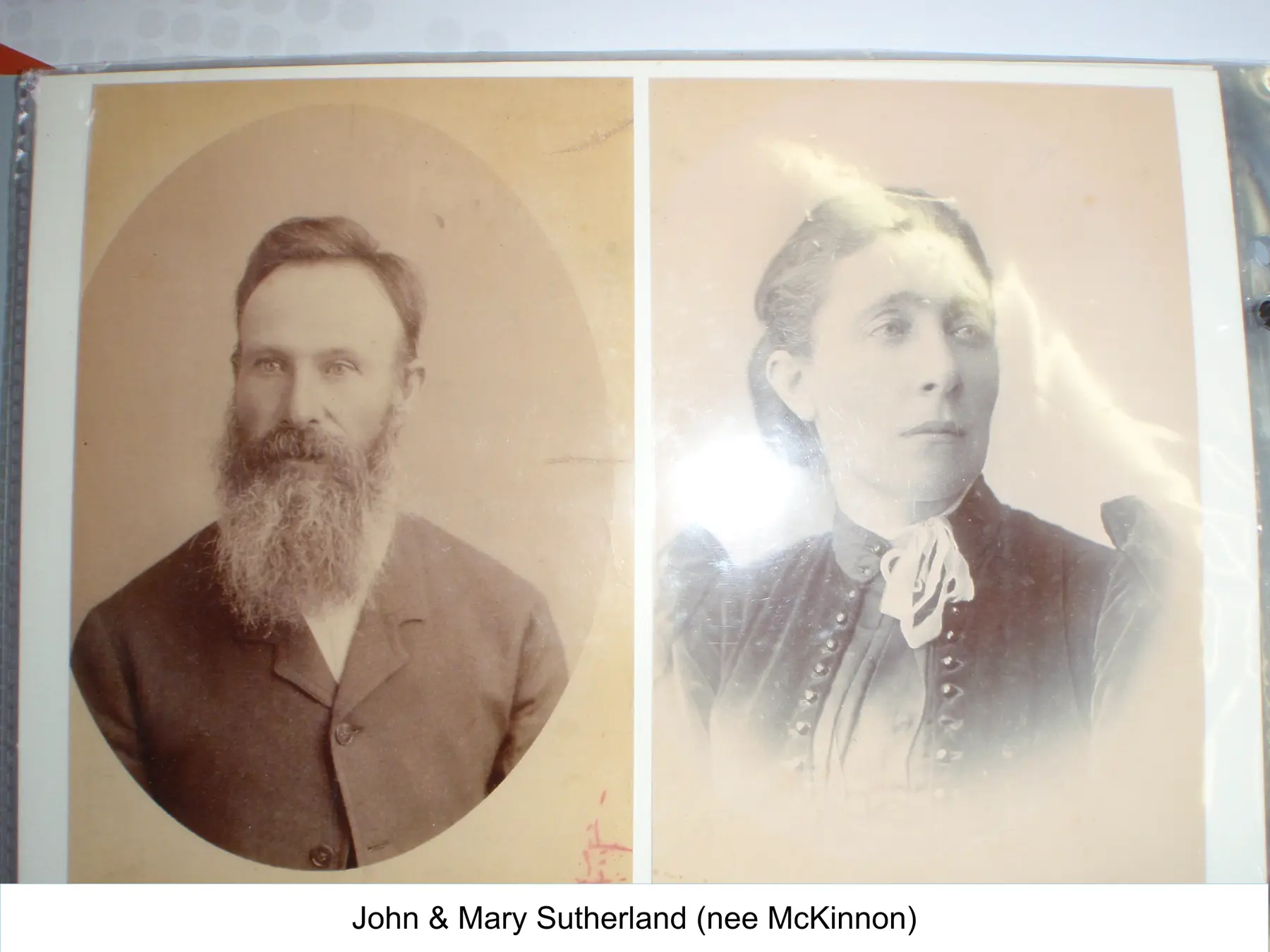
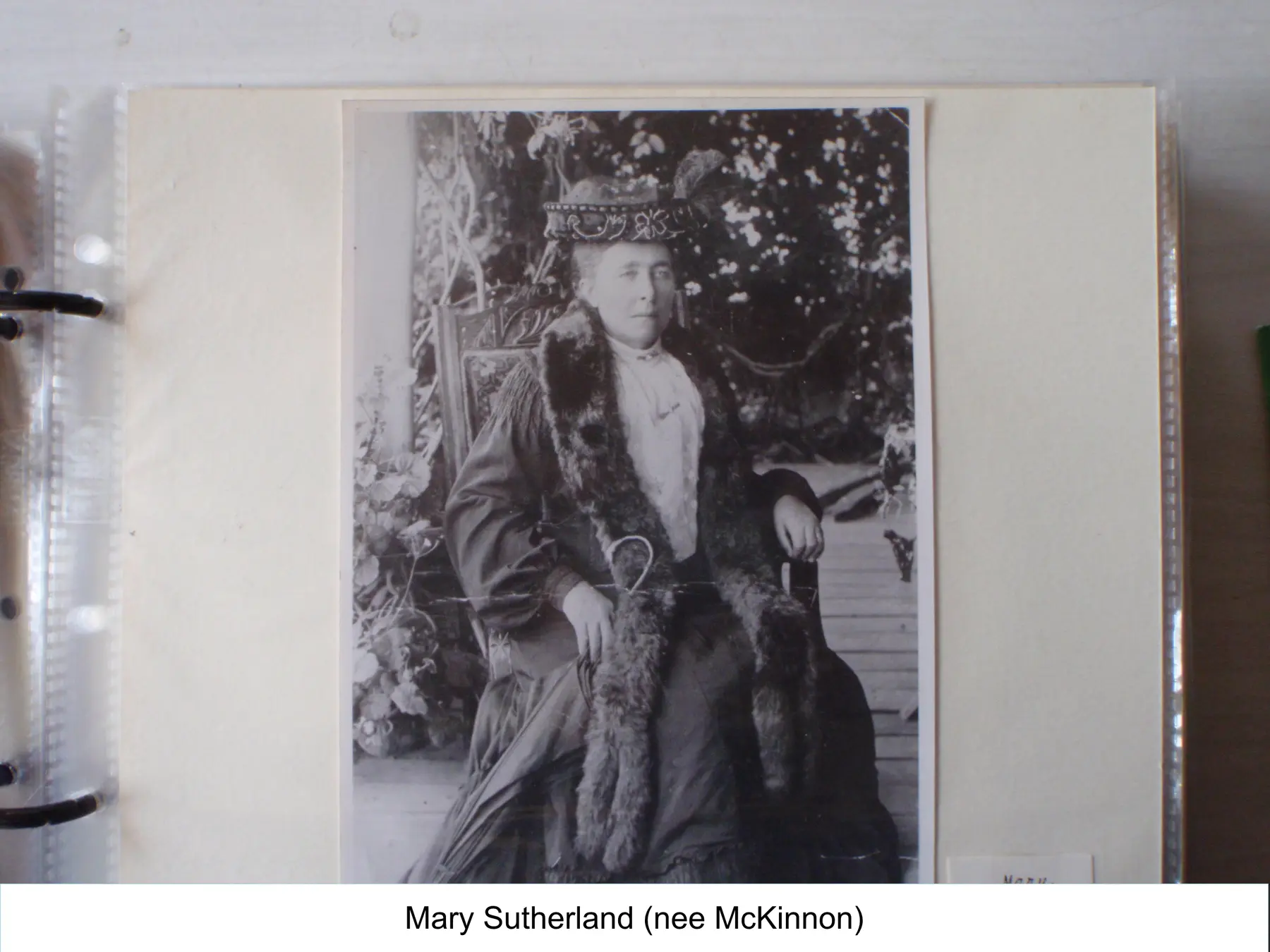
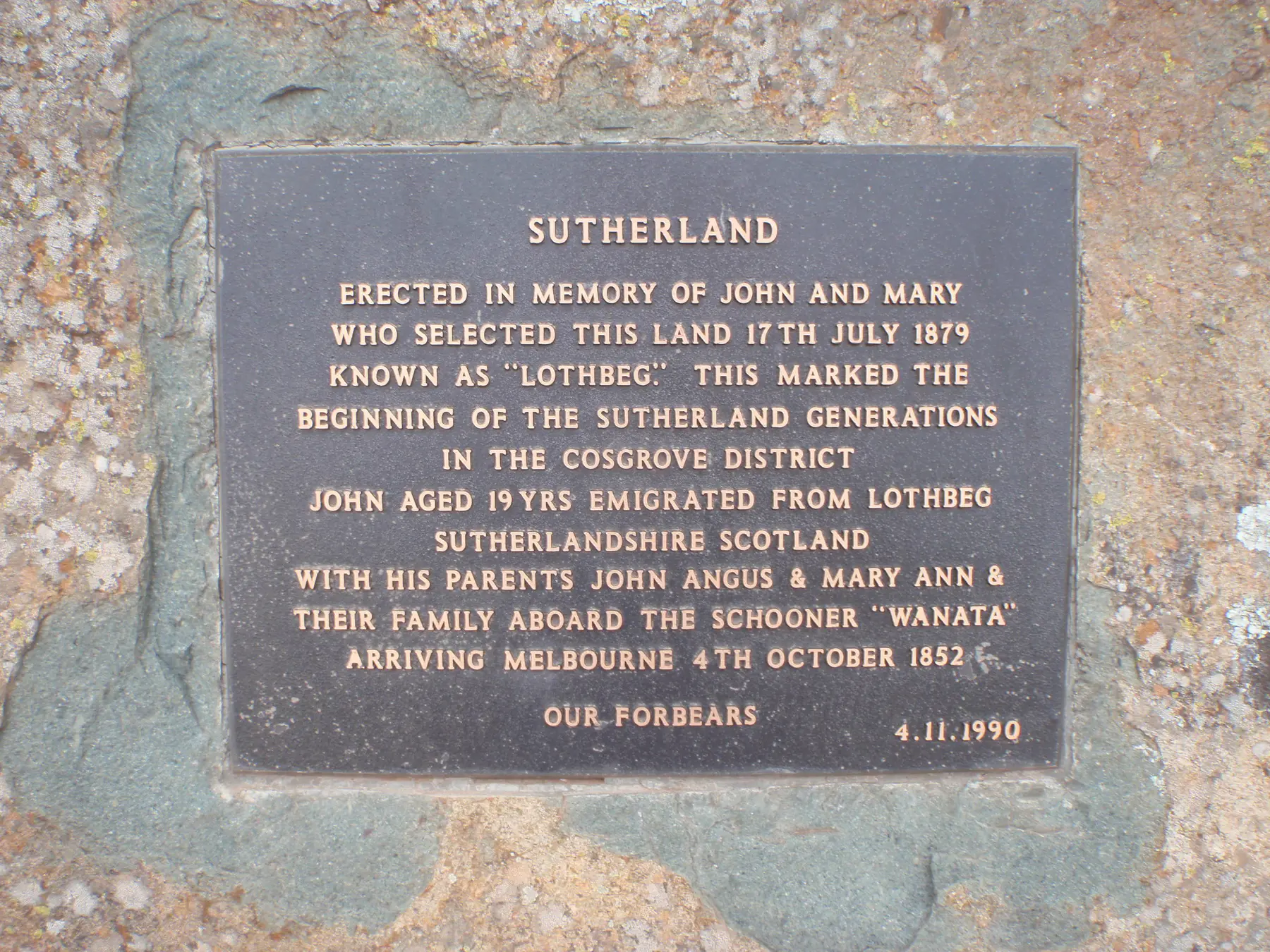
Mary McKinnon (born 1853) had been born on Mull and crossed the world as a small child. At age 19 she married John Sutherland (born about 1832), age 41, in Benalla Presbyterian Church. Their wedding on 13 March 1874 opened another branch of the family around Katandra and Nagambie.
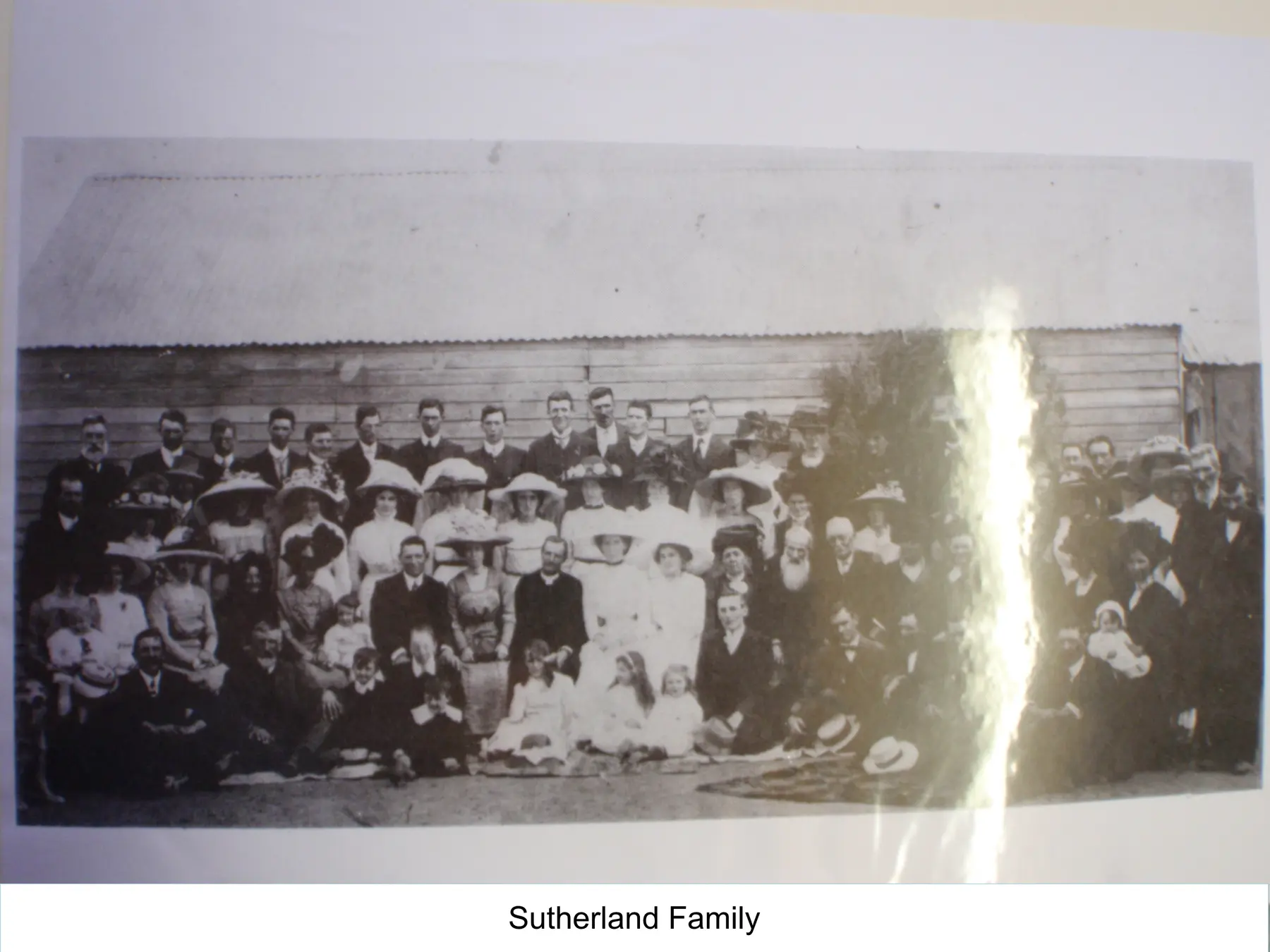
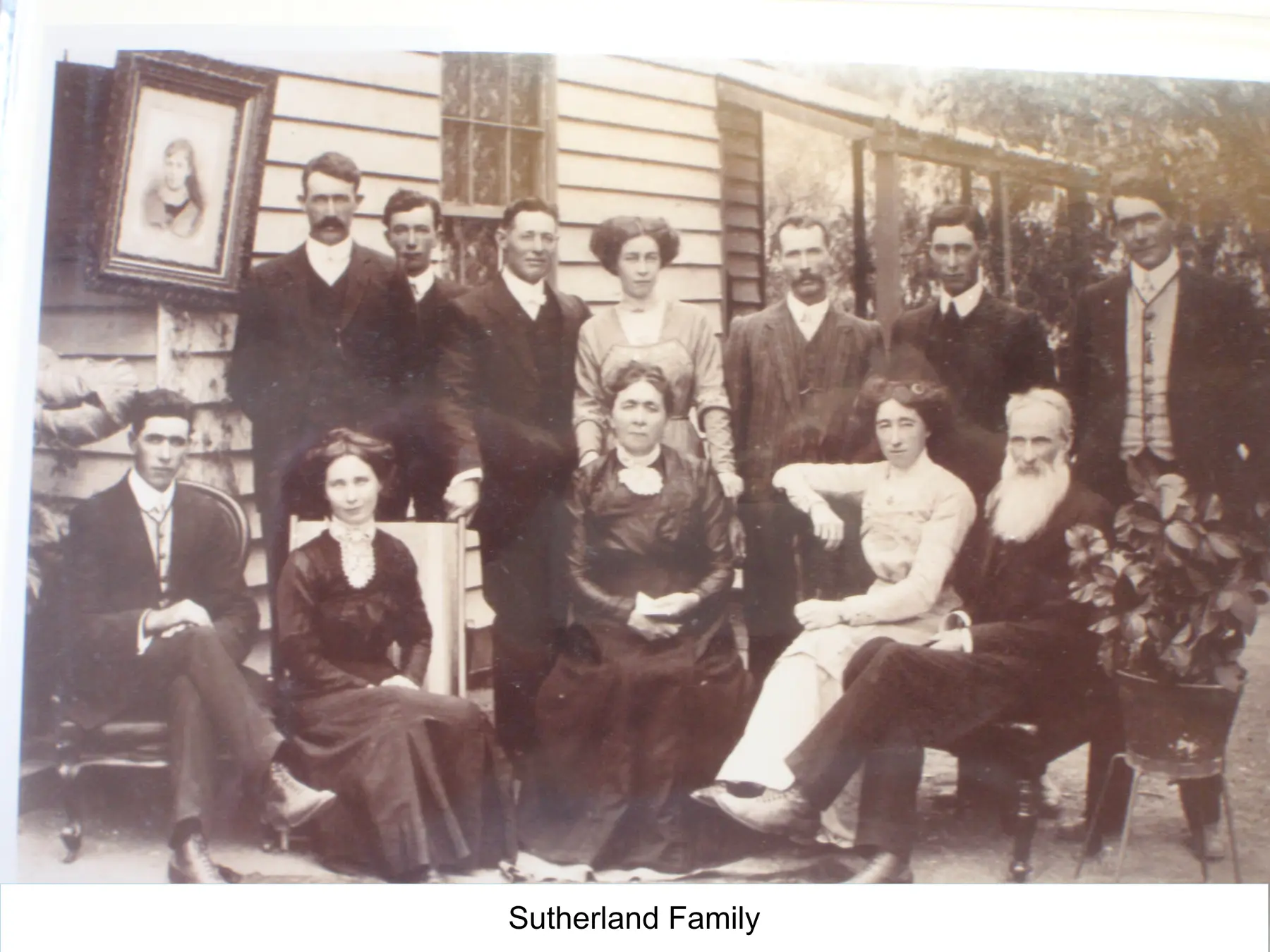
Mary became known as a generous host with a forceful personality. The family album catches what the official records miss: children gathered around a weatherboard house, Sunday clothes, stiff poses and later reunions as the Sutherland family spread through northern Victoria.
Their daughter Mary Ann Sutherland (born 1884) married William Charles Kellow in 1912. William had come to Cosgrove with his parents as a boy and farmed there for many years before moving into Shepparton. He worked on shire contracts and became a council foreman. Contemporary reports remembered a well-known and highly regarded district resident. William died at Shepparton on 7 April 1940, age 58. A later estate notice independently names Mary Ann as his widow and records his last home at 16 Maud Street.[37]
Burrandana
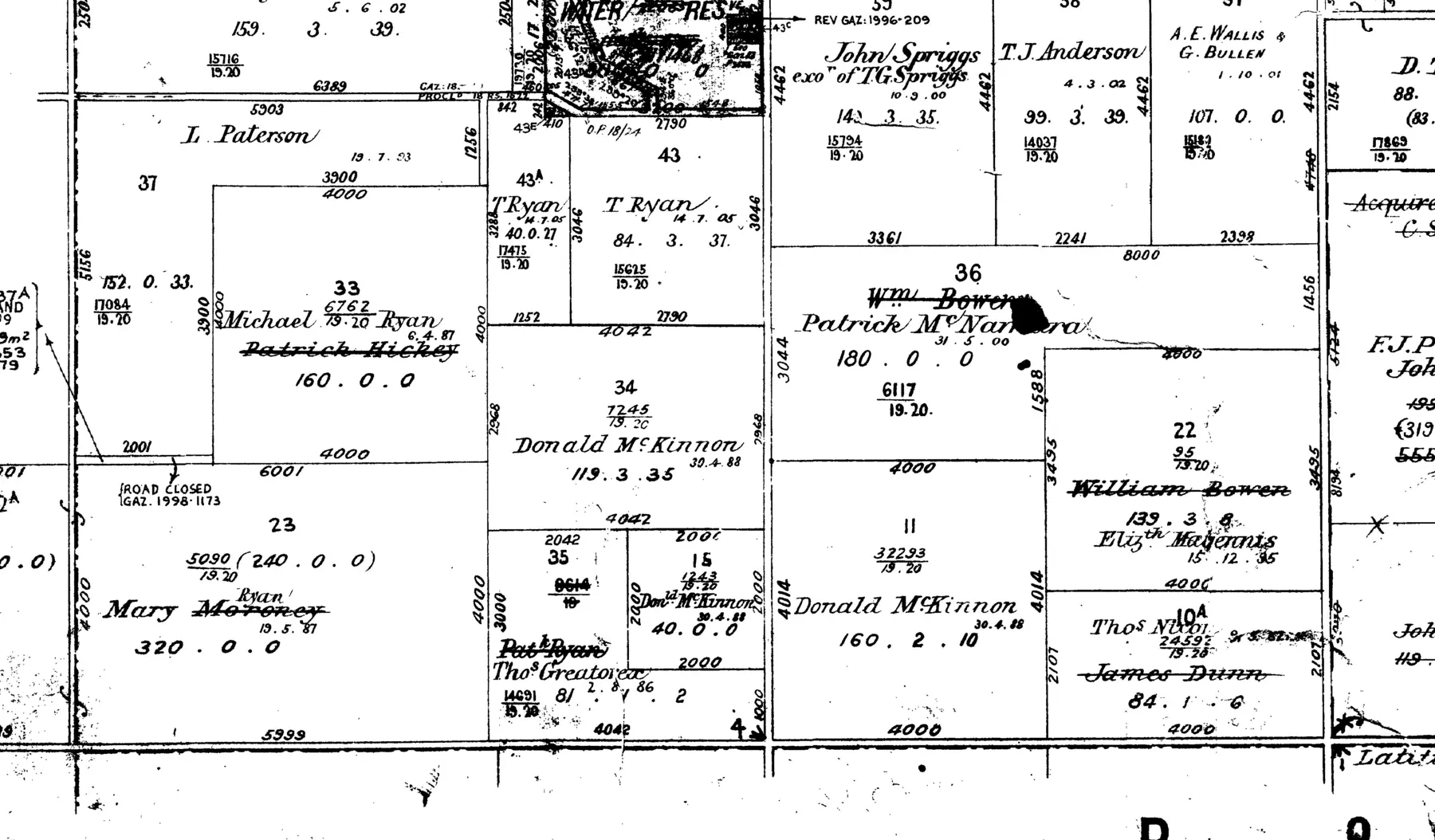
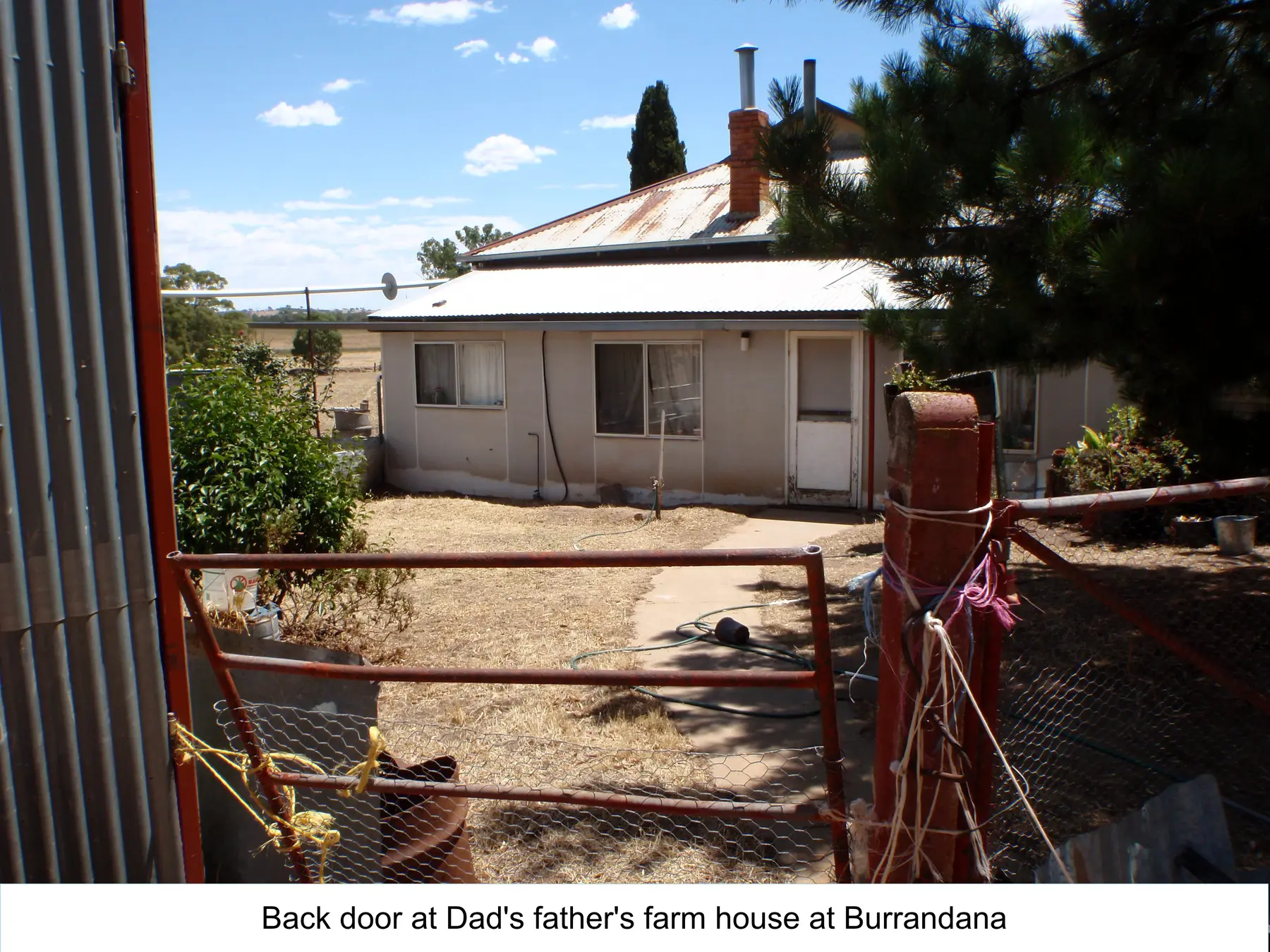
At Burrandana, Angus Richard McKinnon and Rachel started again on a holding of about 37 acres. Their 6 surviving children grew up there, with Angus Norman McKinnon (born 1912) the youngest. The farm was small, and after Angus Richard died in 1934 (age 70), the eldest son Donald helped Rachel keep the household together and support his 3 sisters and younger brother.
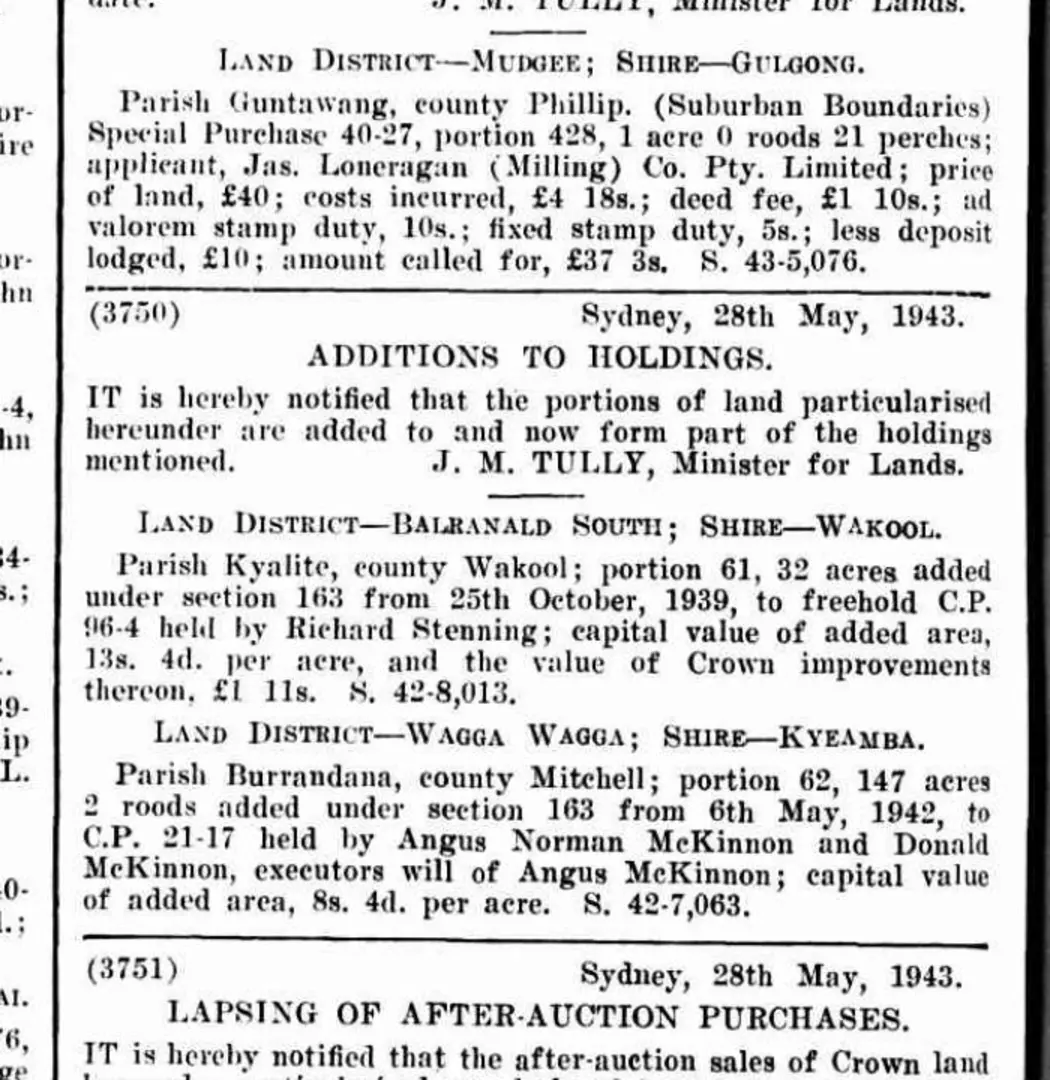
The holding later expanded. A 1943 New South Wales Government Gazette entry added 147 acres and 2 roods at Burrandana in the names of Angus Norman and his brother Donald. They were acting as executors of their father's will, 9 years after his death.[5]
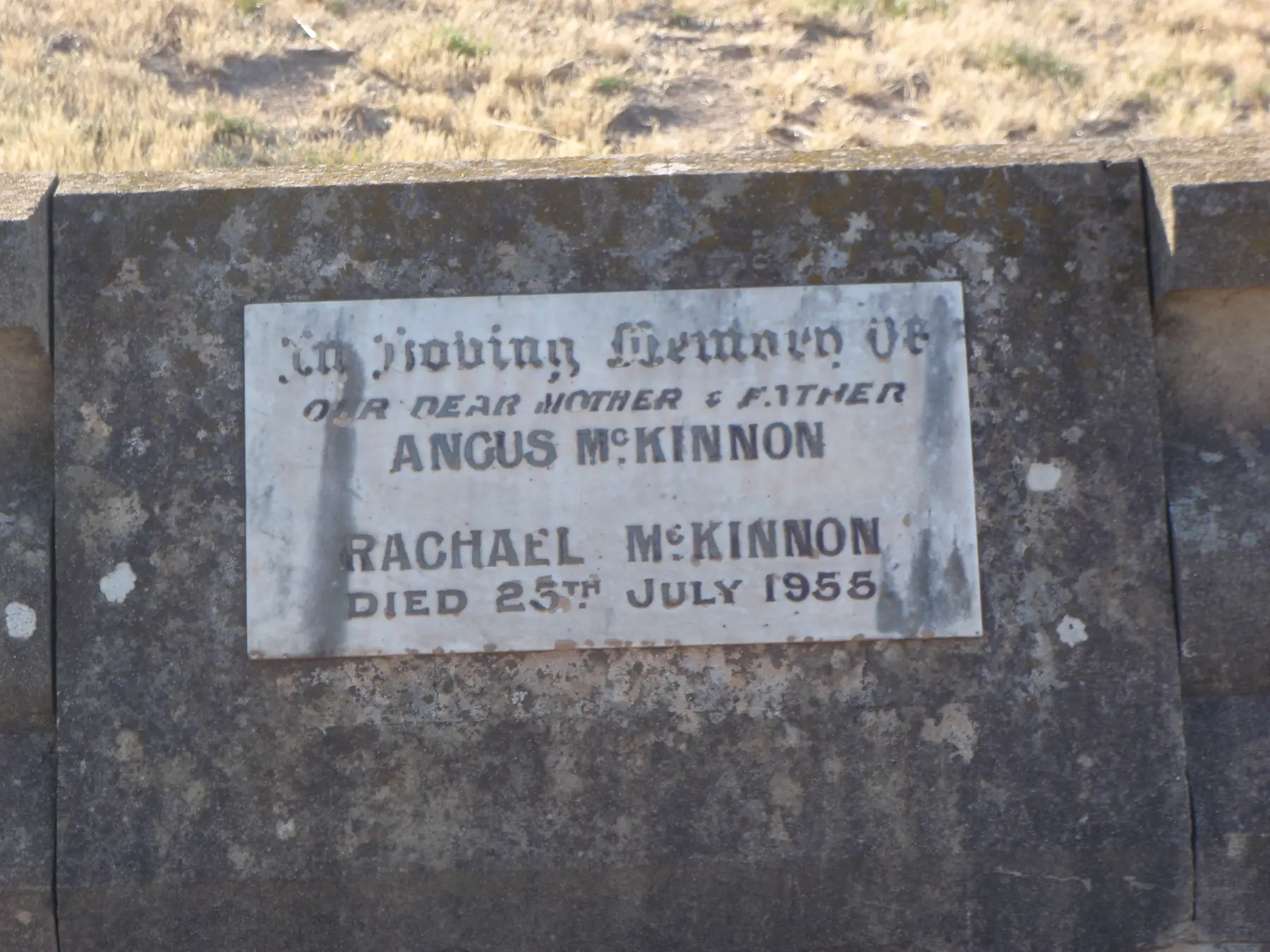
During a recorded return visit on 9 January 1979, Angus Norman spoke from the Burrandana Road and retraced the approach past the old hall toward what he called Mount McKinnon. He remembered laying the floor in Burrandana Hall as his first job after leaving school. He said that his father had owned 52 acres between McKinnon Hill and Burrandana Creek, that Donald later enlarged the property by buying land from Frank Palmer, and that the family built the house themselves. These property details remain Angus Norman's attributed oral testimony until the title, plan and building evidence is fully reconciled.[63]
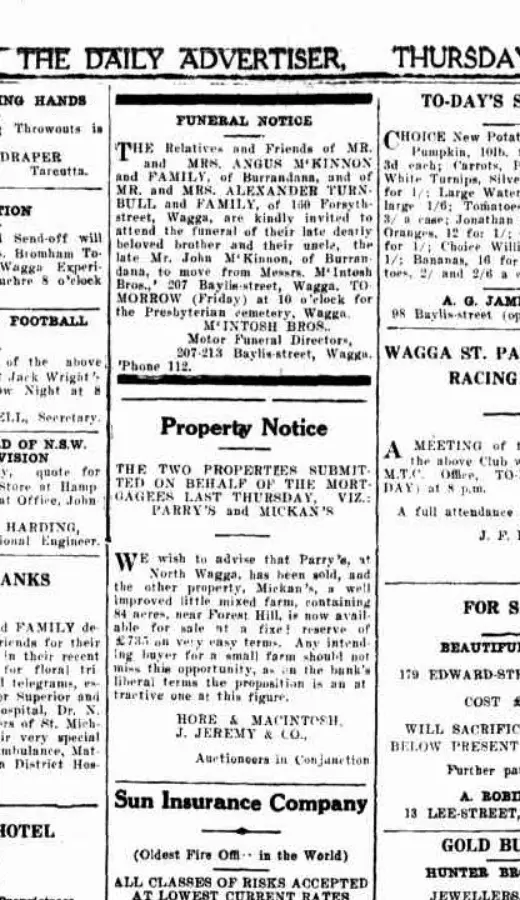
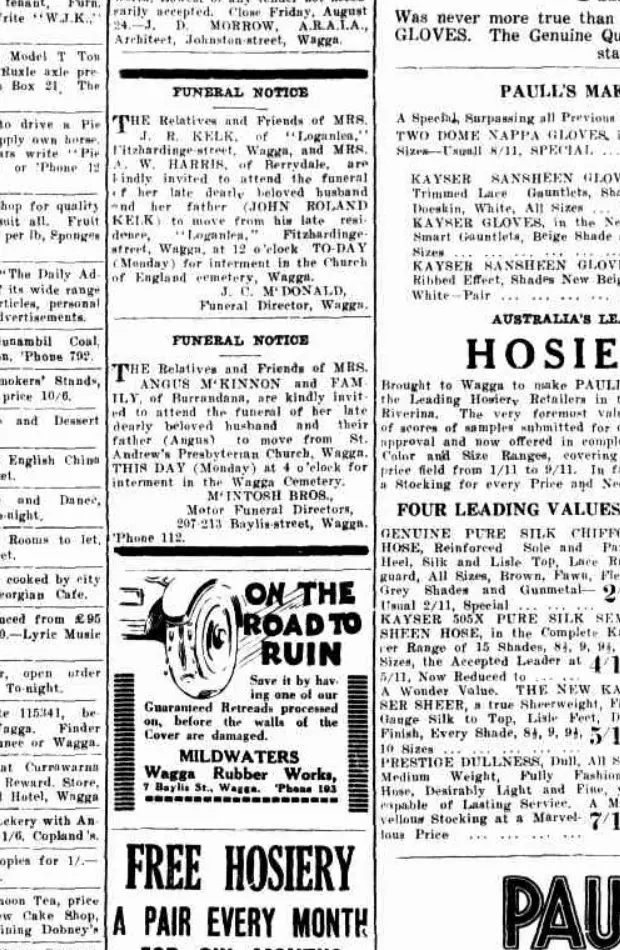
Funeral notices show that John McKinnon, Angus's unmarried brother from the bullock-team years, had also moved north. John's 1932 notice places Angus and his family at Burrandana. It also identifies their sister Catherine "Kate" Turnbull, her husband Alexander Turnbull and their family in Forsyth Street, Wagga. John was buried in the Presbyterian section of Wagga Cemetery. Angus's funeral followed the same church and cemetery route 2 years later.
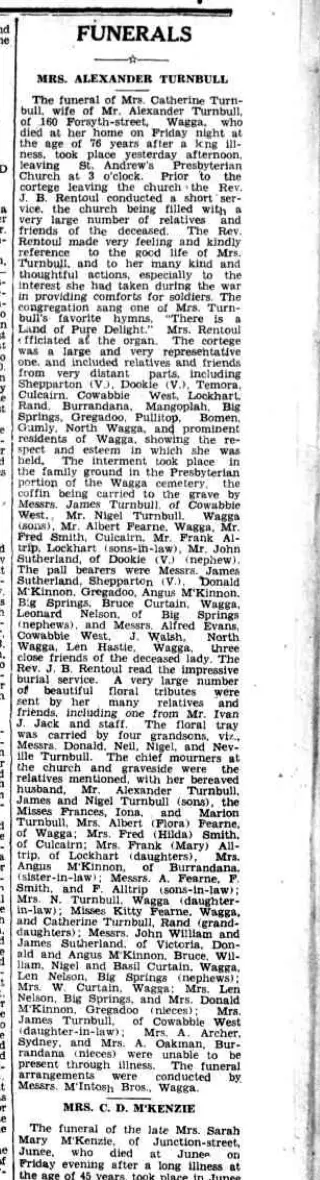
Kate died in 1937 after a long illness, age 76. Her funeral at St Andrew's brought together family and friends from Shepparton, Dookie, Burrandana and elsewhere in the Riverina. The account names sons James and Nigel, daughters Frances, Iona, Marion, Flora Fearne, Hilda Smith and Mary Alltrip, their husbands and a Sutherland nephew in connection with carrying the coffin. McKinnon and Sutherland nephews served as pallbearers, while 4 grandsons carried floral tributes. The service included a hymn she particularly liked, There is a Land of Pure Delight. The minister recalled her kindness to others, including making items for servicemen during the First World War.[5]
Kate and Alexander's daughter Flora Anne Turnbull married Albert Ernest Fearne (born about 1877). Albert spent his life in Wagga and was known as a district shearer when he was younger. In later life he served on the executive of the Wagga Pensioners' Association. Albert and Flora lived at 237 Kincaid Street, and Alexander trusted him to execute his 1937 will. Albert died at home on 9 January 1949, age 71, survived by Flora and their daughter Frances Catherine.[34]
Alexander had been a skilled teamster with bullocks and horses and was remembered for once riding 4 of his own horses to victory in a 5-race Benalla programme. Farming took the Turnbull family through Ganmain, Tumbarumba and Burrandana before retirement in Forsyth Street, Wagga. He died on 4 February 1941 after a short illness. Reports disagree on whether he was 91 or 94, so the newspaper ages remain unresolved.[31]
Their son William Alexander Turnbull farmed before working as a postal linesman. His obituary recorded 3½ years of First World War service, 2 serious wounds and gas exposure, but the evidence does not connect those injuries to his early death. William died at Wagga on 6 August 1929, age 42, leaving his wife Edith and 4 children. Returned soldiers, postal workers, linesmen and relatives from across the district gathered at his funeral.[33]
Another son, Donald Turnbull, died at only 18 after a riding accident on 18 March 1901. A fuller report says he was exercising a racehorse on his father's farm at Ganmain when the horse ran into scrub and struck him against a tree. Donald was taken to Narrandera Hospital but died that afternoon. Another notice placed the accident at Matong, so both nearby locality descriptions are retained. His exact birth date is also unresolved.[43]
Calvin Turnbull (born 1907) was remembered in Wagga newspapers as Kate and Alexander's youngest son. He died at Wagga District Hospital on 24 December 1933 after a period of poor health, age 26. The civil indexes instead name Frances as his mother and display no father on the birth registration. The evidence supports his place in the Turnbull household but does not yet establish whether Kate and Alexander were his biological parents, so that question remains open.[41]
Their elder son James Angus Turnbull (born 1888) was farming at Pulletop when he appeared before Wagga's Military Service Exemption Court in November 1916. His case was postponed for 2 weeks. Other cases on the crowded list concerned harvest work and dependent families, but the newspaper did not record James's argument or the court's final decision, so neither is inferred here. By 1937 family evidence placed him at Cowabbie West.[45]
Another son, Nigal Hector Turnbull (born 1894), wrote to the Albury Banner from Wolseley Park in 1911. His short first-person district report looked forward to a euchre party and dance at the Mechanics' Institute and said that he had reached the Excelsior Tennis Club final, although he was unsure how he would fare. He closed by expressing sympathy to a local bereaved family. The letter preserves Nigal's own teenage voice rather than only an official event in his life.[60]
Kate and Alexander's daughter Mary Ellen Turnbull married the English-born carpenter Frank E. Altrip (born 1905) at Wagga in 1933. A newspaper report from the year before places Frank in Collins Street and records a small piece of everyday life: the fork of his bicycle snapped while he was riding home along Thorne Street with a young woman on the handlebars. Frank suffered facial abrasions and went to Wagga District Hospital; his passenger had only minor injuries. The article spells the surname Alltrip, matching the form used by Mary's family.[52]
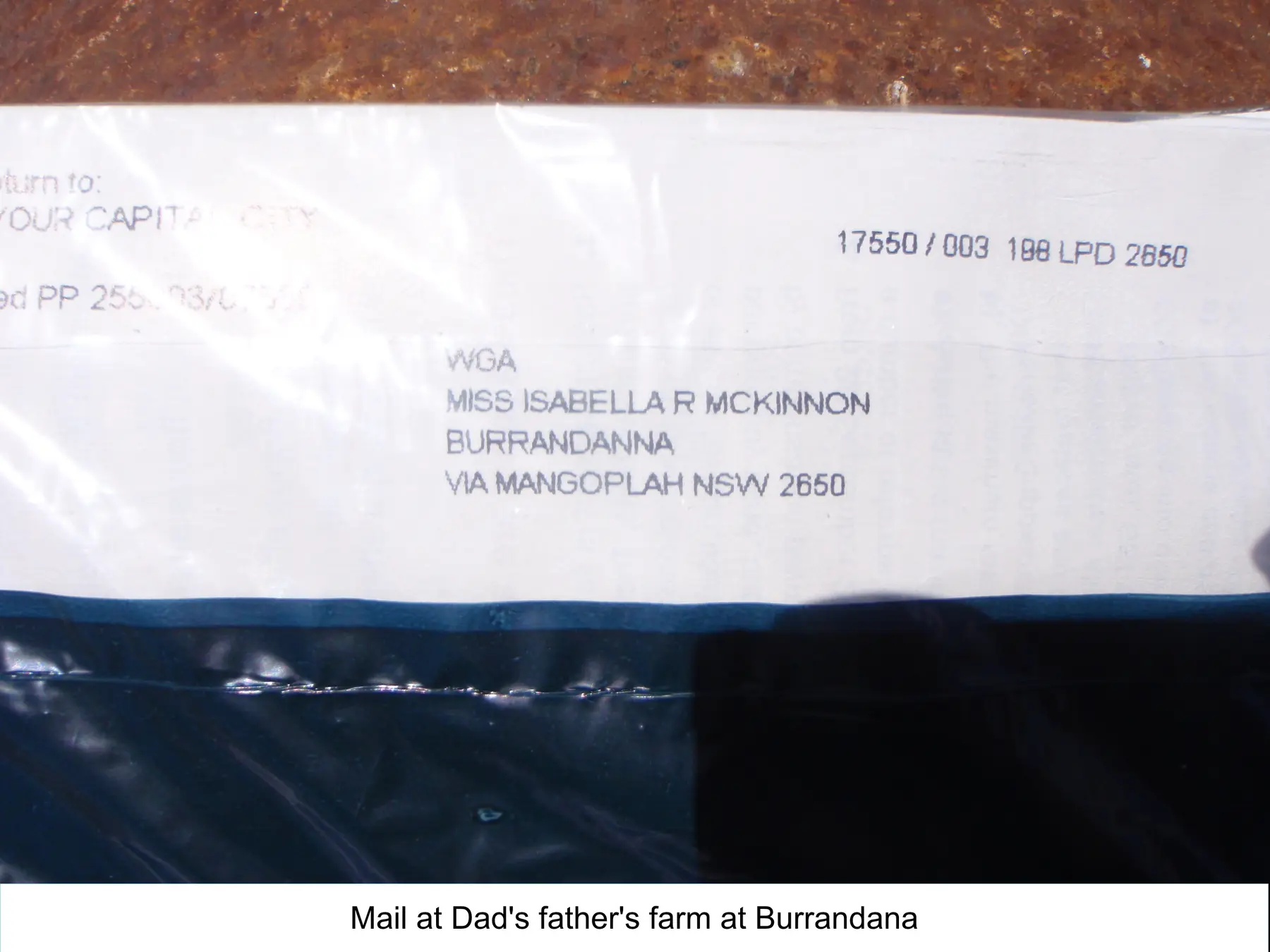
Later recordings remember the old track, the nearby hall and the daily work of the property. Photographs preserve the house and family graves, giving the Burrandana years a clear physical setting.
The Fawcett line
The Fawcett road begins in Westmorland with James Fawcett (born 1781) and Agnes Alderson (born 1785). Their son Richard Fawcett (born 1819) was born at Warcop, then crossed to New South Wales and found his place in the noisy, fast-growing world of colonial Sydney. He became an auctioneer and grazier, but horses made his name.
James and Agnes married at Muker in Yorkshire on 14 October 1807. The parish records call her Nancy, a familiar form of Agnes, and use Nancy again when Richard was christened at Warcop in 1819. By 1851, James was age 70 and described as a retired land proprietor. Agnes was age 67. Their adult daughters Agnes and Margaret still shared the Sandford household, along with a young servant named Ann Parker. James died at Sandford Hall on 17 September 1853. Australian notices described him as being in his 75th year, but his 1781 christening and later family evidence place him at about 72, so the age conflict remains unresolved. The move to Australia had taken Richard far from a family that remained rooted in the Westmorland countryside.[6]
Richard's Sydney business can be traced from 1843, when he advertised auctions from rooms beside the Bank of New South Wales. By the late 1840s his Commercial Sale Rooms were at 481 George Street. The catalogues ranged from imported cloth, glass and drapery to cheese, potatoes, property and livestock, capturing the variety of goods moving through a growing colonial city.
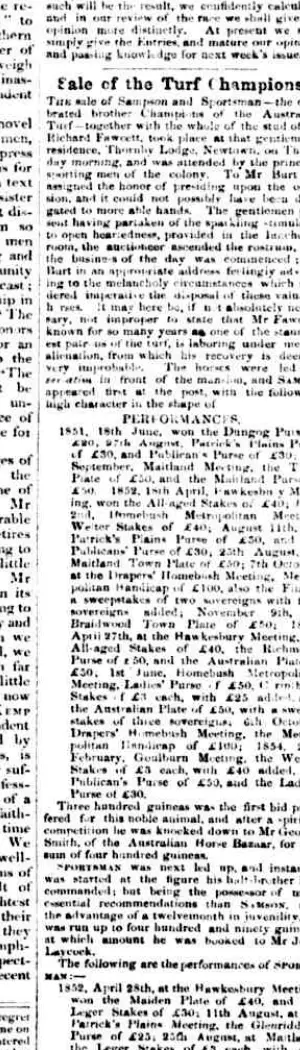
The newspaper account links Richard's 1854 horse sale at Thornby Lodge, Newtown, with serious illness. It drew attention to Sampson and Sportsman, champion brothers sold for 400 and 490 guineas, and described Richard as a long-time supporter of colonial racing. He died on 5 May 1857. His death notice reported that he was 39. A probate notice instead identifies him by his late home at Tarban Creek and names Euphemia as executrix.[6]
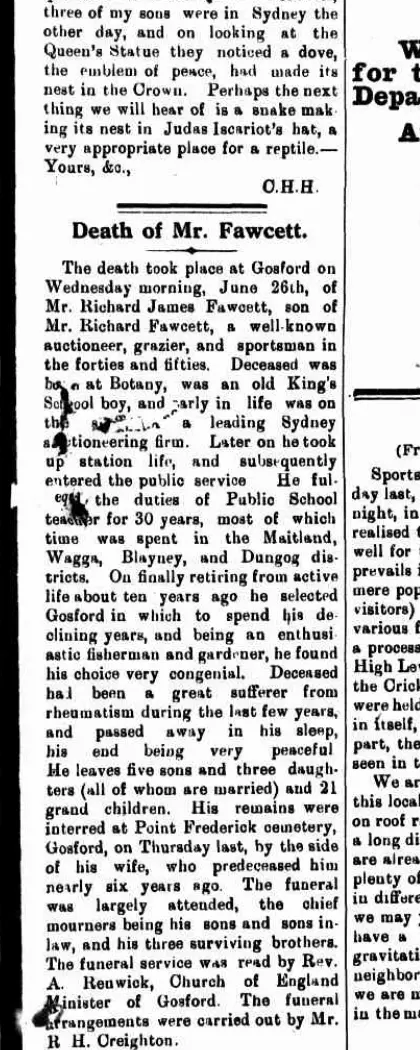
His son Richard James Fawcett (born 1843) worked on pastoral stations before joining public education. His 30-year teaching career took him through the Maitland, Wagga, Blayney and Dungog districts. A later obituary says that retirement at Gosford gave him time for gardening and fishing.
Richard James later named his sons Richard Sandford and Frederick Alderson Fawcett (born 1874), with William Martin Steuerwald, as executors of his will. The probate notices show Frederick sharing responsibility for the estate and its creditors after his father's death in 1918. Frederick built his own life at Wellington as a carrier, married Eva Offner in 1915 and died there in 1928. His exact birth year remains conflicted between civil and church evidence.[49]
At Howe's Valley in 1872, Richard and his pupils helped erect a marquee for the opening celebration of the provisional school. Pupils joined their teacher's side in a cricket match before the district gathered for a meal, children's races, music and dancing. Richard ended the day by thanking families for supporting the new school, presenting him as a teacher helping an isolated community establish both a classroom and a social centre.[19]
Richard James married Susannah Maria Williams (born 1850), whose family carried another colonial beginning. Family records trace Susannah through her parents, Frederick Williams (born 1821) and Elizabeth Paton Hughes (born 1829), to Elizabeth's parents, Samuel Griffith Hughes (born 1789) and Anne Fitzpatrick (born about 1797). Samuel arrived in New South Wales as a convict on the Glory in 1818, after waiting in the Bellerophon prison hulk. Anne had come from Ireland. They married at St John's in Parramatta in 1824. The family was already tied to the colony a generation before Susannah met Richard James.[6]
Two of Richard James's uncles built pastoral lives elsewhere in New South Wales. Thomas Alderson Fawcett (born about 1854) worked around Glenridding near Singleton as a grazier, livestock breeder and honorary magistrate. He was remembered as an early district cricketer and long-serving Northern Agricultural Association member, and died in 1922 leaving 7 sons and a daughter. His brother Thornborough John Fawcett (born about 1854) held grazing land near Narrabri before moving to Muswellbrook, where his property “Thornbro” supported grazing and dairying. He never married and died in 1941 after years of support for local patriotic causes.[28]
Another uncle, George Fawcett (born 1844), moved from Singleton to the Gunnedah district and spent about 20 years at Burburgate station. He managed a property then described as covering about 190,000 acres and carrying up to 136,000 sheep, before becoming a Gunnedah livestock salesman. His obituary also remembered an early cricketer, keen shot and billiards player, and the owner of the racing pony Tom Tit. George died at his Elgin Street home on 27 October 1916, age 72.[32]
Their elder brother Edmund Lamb Fawcett (born 1845) also spent part of his youth around Singleton. In 1883 he appeared among the Narrabri freeholders petitioning for municipal government, although the notice does not identify his property. Edmund later lived for many years at Manly and died there on 30 November 1925. His obituary gave his age as 80 and named Thomas and Thornborough as his brothers; one death notice instead printed 50, a conflict retained rather than used to revise his life.[35]
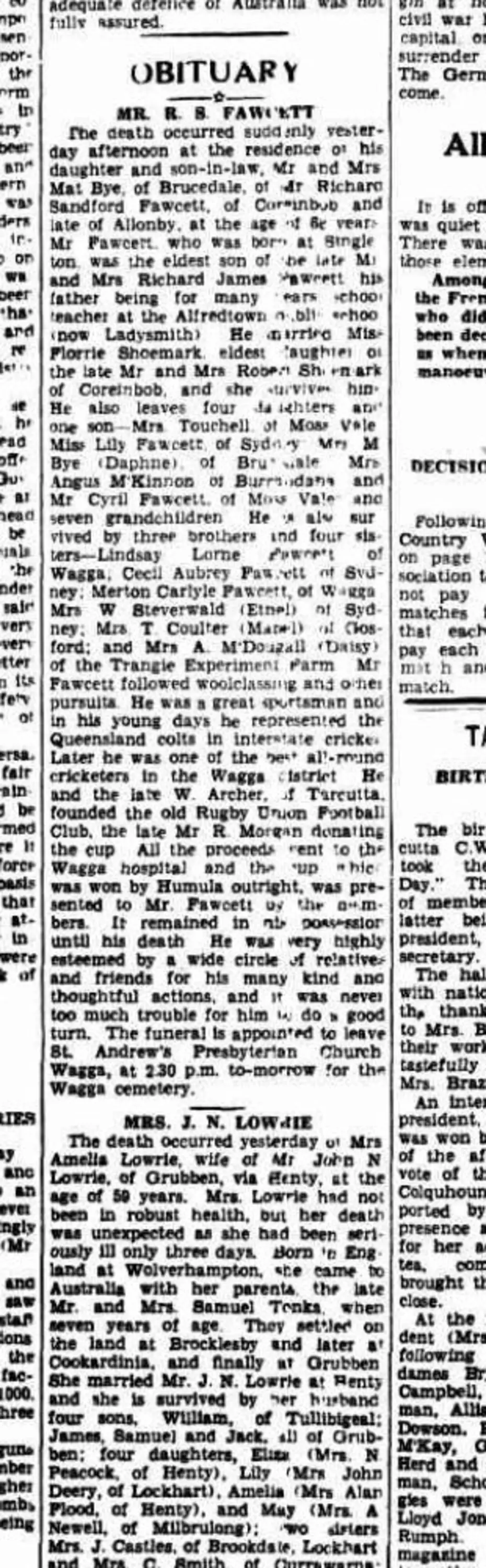
The next Richard followed wool and sport. Richard Sandford Fawcett (born 1870) worked as a wool classer around Coreinbob and Allonby. His obituary credits him with interstate cricket for the Queensland colts, then with becoming a leading all-rounder in the Wagga district. It also says that he and W. Archer of Tarcutta helped establish Wagga's old Rugby Union Football Club. The club competition raised money for Wagga Hospital. When Humula secured the cup outright, the team gave it to Richard, who kept it.
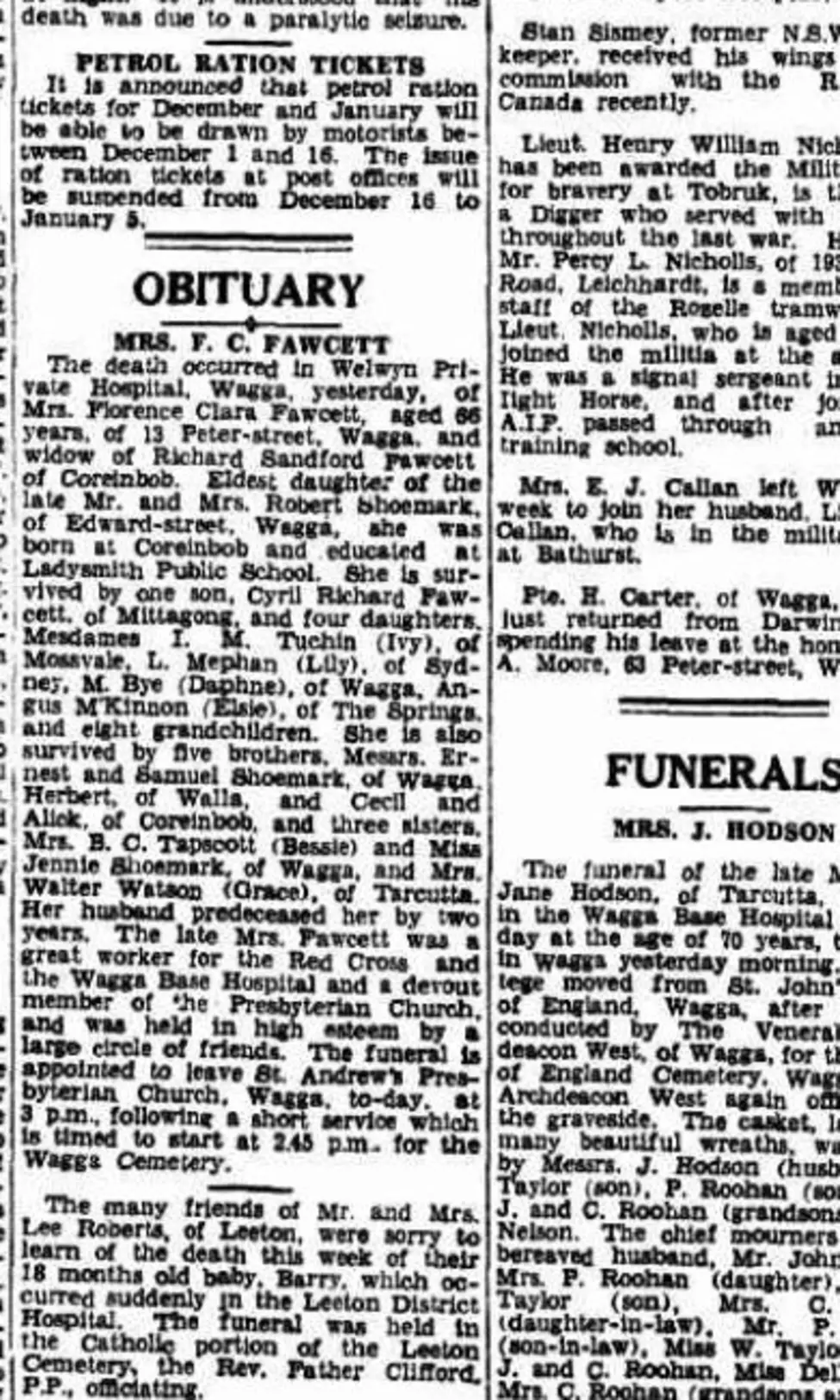
Richard married Florence Clara Shoemark (born about 1875) at Wagga on 22 May 1897. Their published notice names him as the first son of Richard James Fawcett of Alfredtown and Florence as the eldest daughter of Robert Shoemark of Coreinbob. Florence had grown up there and attended Ladysmith Public School. A 1941 obituary records her support for the Red Cross, Wagga Base Hospital and the Presbyterian Church. Their home also held a family secret that lasted for years.[22]
Florence's father, Robert Shoemark (born about 1853), was born at Street near Glastonbury in Somerset. His family brought him to Australia when he was 3 and settled at Camden. At 17 he moved to the Wagga district, where his later life connected Coreinbob with a large family spread across the Riverina. Robert died at 265 Edward Street, Wagga, on 9 February 1939. His obituary recorded 5 sons, 4 daughters, 45 grandchildren and 16 great-grandchildren.[6]
Robert's daughter Jennie Evelyn Rose Shoemark (born 1892) grew up around Coreinbob and Wagga. Newspaper reports place her in a school-reunion race, as a bridesmaid at her brother Walter's wedding, completing home-nursing training and appearing in a Methodist Christmas pageant. Jennie later lived with Robert at 265 Edward Street. His will named her with 2 brothers to administer the estate, entrusting her with creditors and probate after his death. She remained in Wagga until her death in 1973.[46]
A 1927 court report probably catches Richard and Florence's son Cyril Richard Fawcett (born 1900) among about 50 members of the Indian Motor Cycle Club riding to Windsor. A car swerved while passing a horse and sulky at Rouse Hill, throwing Cyril's motorcycle into the air and injuring his foot and ankle. He sued the driver and a jury awarded him £110 9s 3d. The distinctive name and compatible New South Wales life support the identification, but the report gives no relative or address, so it remains probable rather than certain.[27]
Elsie Myrtle Fawcett (born 1915) grew up believing Richard and Florence were her parents. They were really her grandparents. Ivy Myrtle Fawcett (born 1897), presented to her as an older sister, was her mother. Ivy was age 17 when Elsie was born in January 1915, and probably age 16 when the child was conceived.[6]
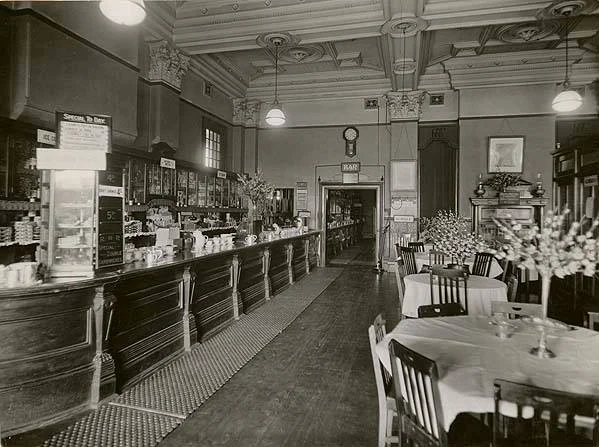
After Ivy had become Ivy Tuchin, the New South Wales railway staff return for the end of 1935 named her as the rest-house attendant at Moss Vale, earning 41 shillings a week. Angus later remembered that Ivy had worked at the Moss Vale Tea Rooms and circulated an official 1935 photograph of the station's Railway Refreshment Room. The photograph captures her workplace setting, but it does not identify Ivy among the people shown, and the official return labels her employment section as the Rest House rather than the Refreshment Rooms.[67]
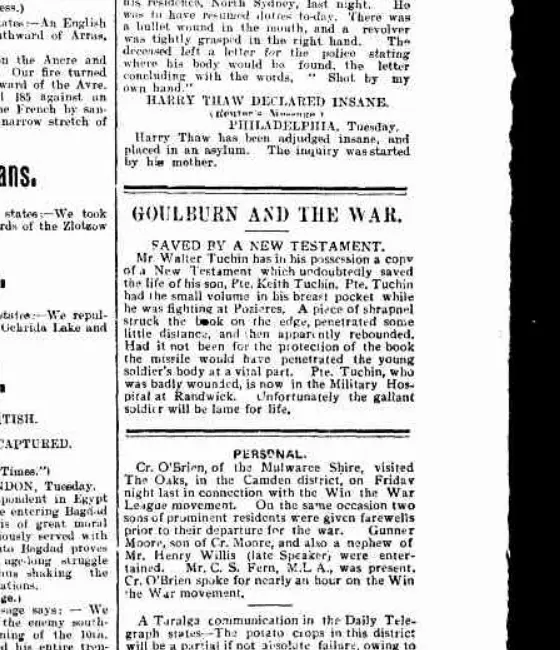
Ivy later married Keith Walter Dixon Tuchin (born 1897), a railway signalman and First World War veteran. At Pozieres, a piece of shrapnel hit the New Testament in his breast pocket and lodged partway through it. Keith was badly wounded and doctors expected lasting damage to his leg, but the book had stopped the fragment from travelling farther. His father Walter kept it.
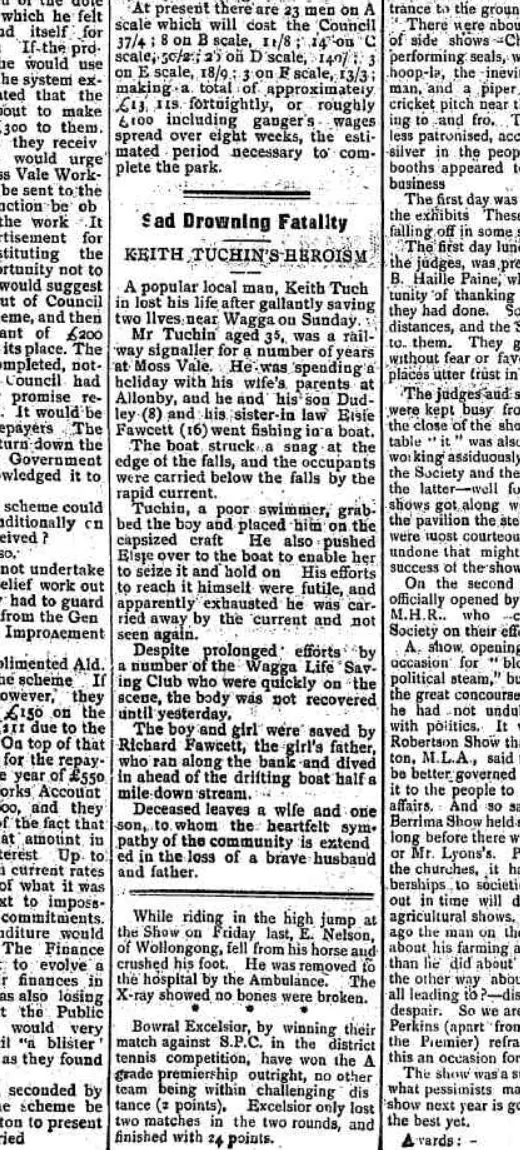
Keith died during a family outing near Borambola 15 years later. A boat hit a snag and overturned, throwing Keith, his 8-year-old son Walter and 16-year-old Elsie into the Murrumbidgee. The surviving account describes Keith getting both children onto the upturned boat before he drowned. Richard Fawcett entered the river downstream and brought them ashore. Searchers recovered Keith's body 2 days later.[6]
Elsie married Angus Norman McKinnon (born 1912) at Wagga in 1939. With that marriage, the Fawcett road met the McKinnon one. After Florence died in 1941, her probate notice named Angus Norman and Matthew Norman Bye as the executors of her will.[22]
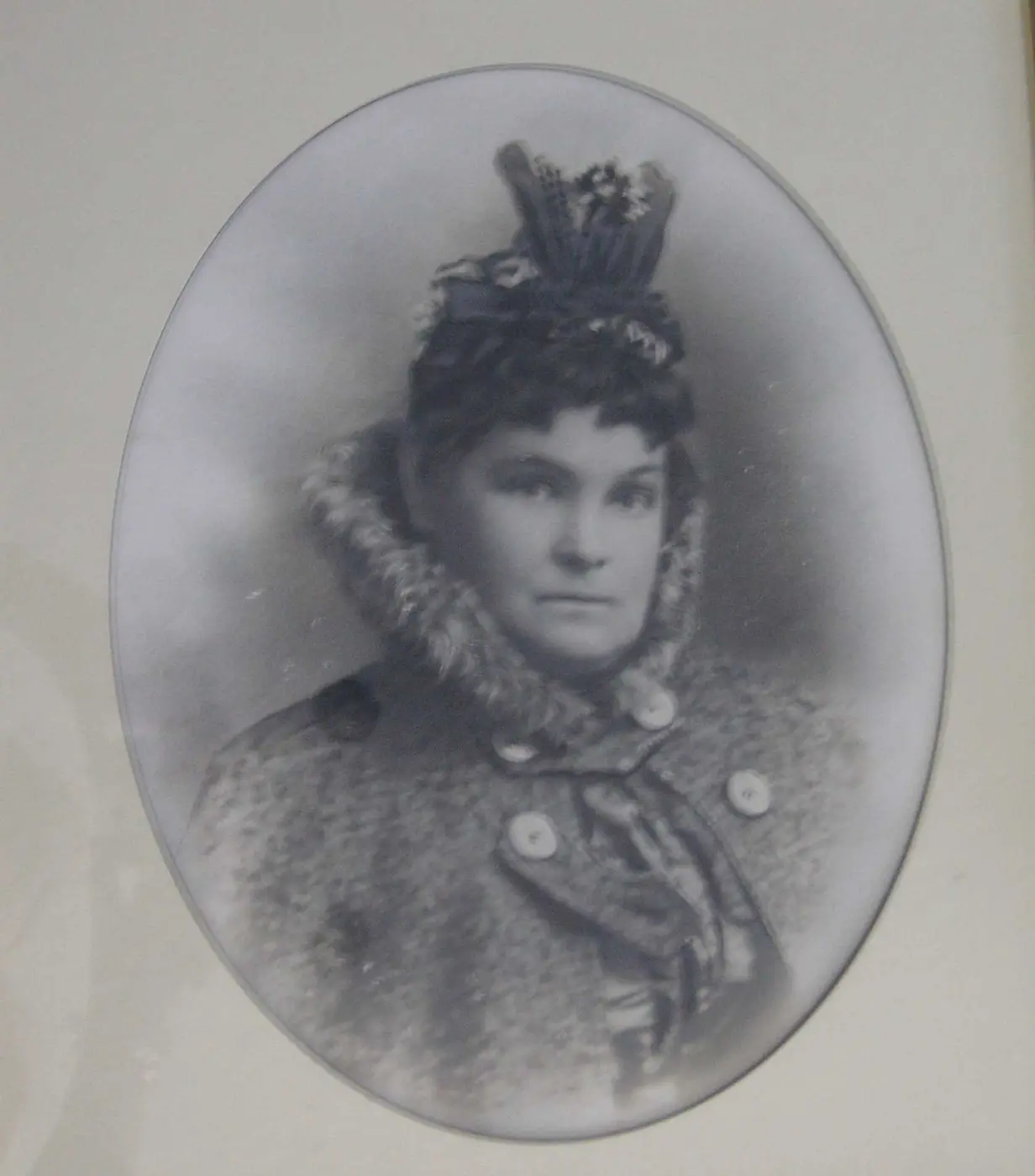
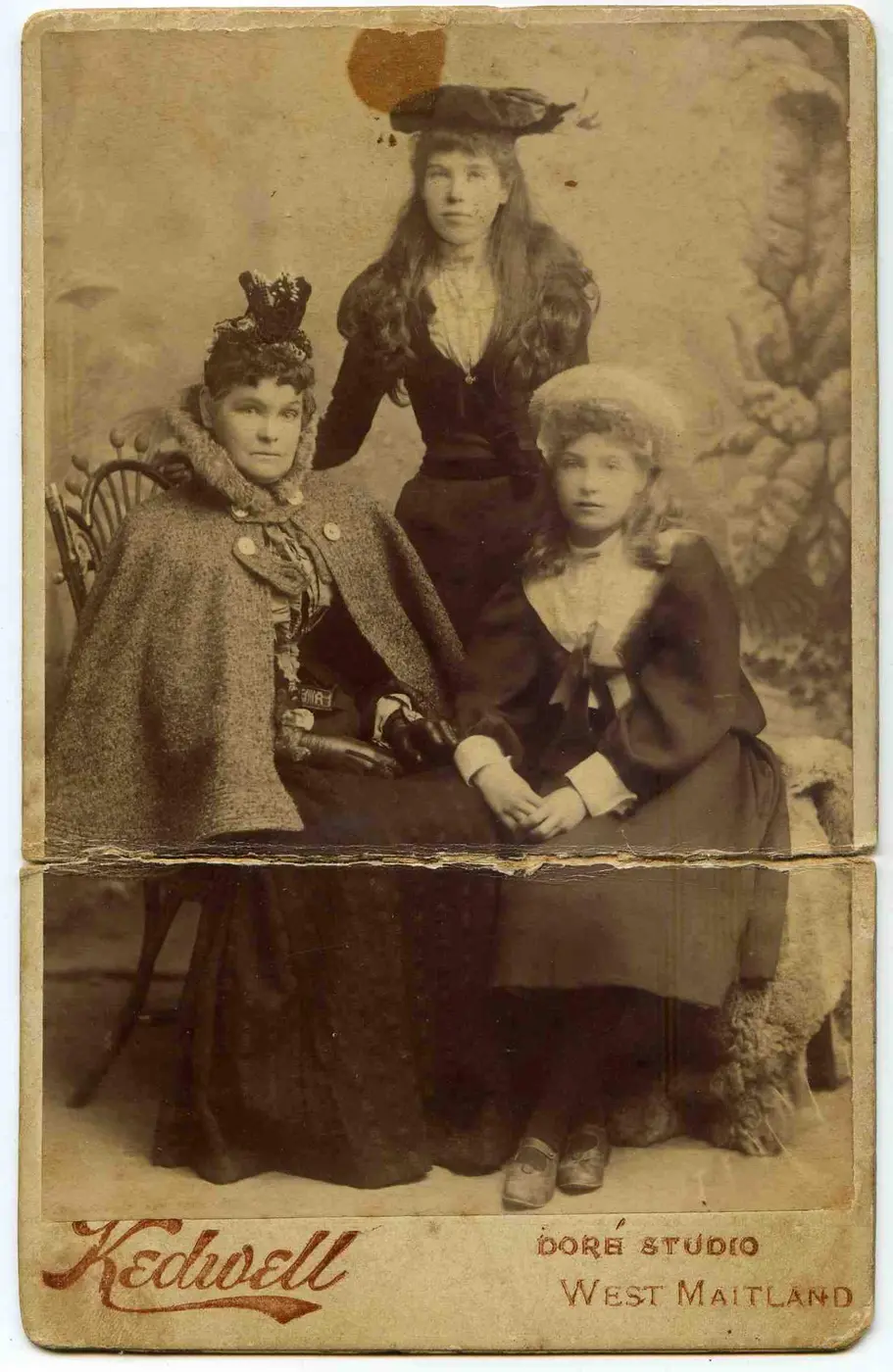
Malcolm's early years
Malcolm recorded that Angus Norman McKinnon (born 1912) left school after grade six, worked first on the Burrandana farm and later found work at Pulletop and Brunskill's. He described Angus as skilled with horses and said he played cricket and tennis when work allowed. Elsie Myrtle Fawcett (born 1915) belonged to the same social set; Malcolm wrote that horses and dancing were shared interests during their courtship. They married at Wagga in 1939 and, according to Malcolm, both worked at Brunskill's while money was scarce. The marriage is independently supported by their retained certificate; the personal details remain Malcolm's attributed account of what Angus told him.[64]
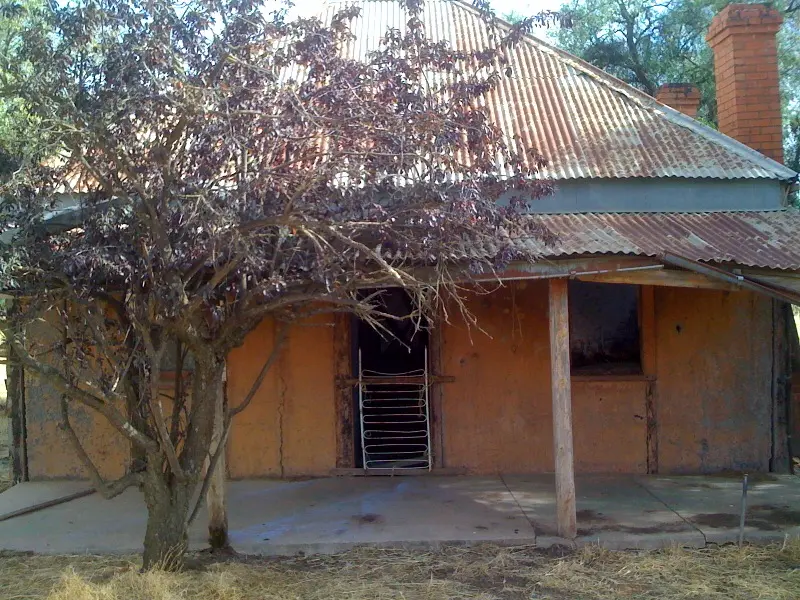
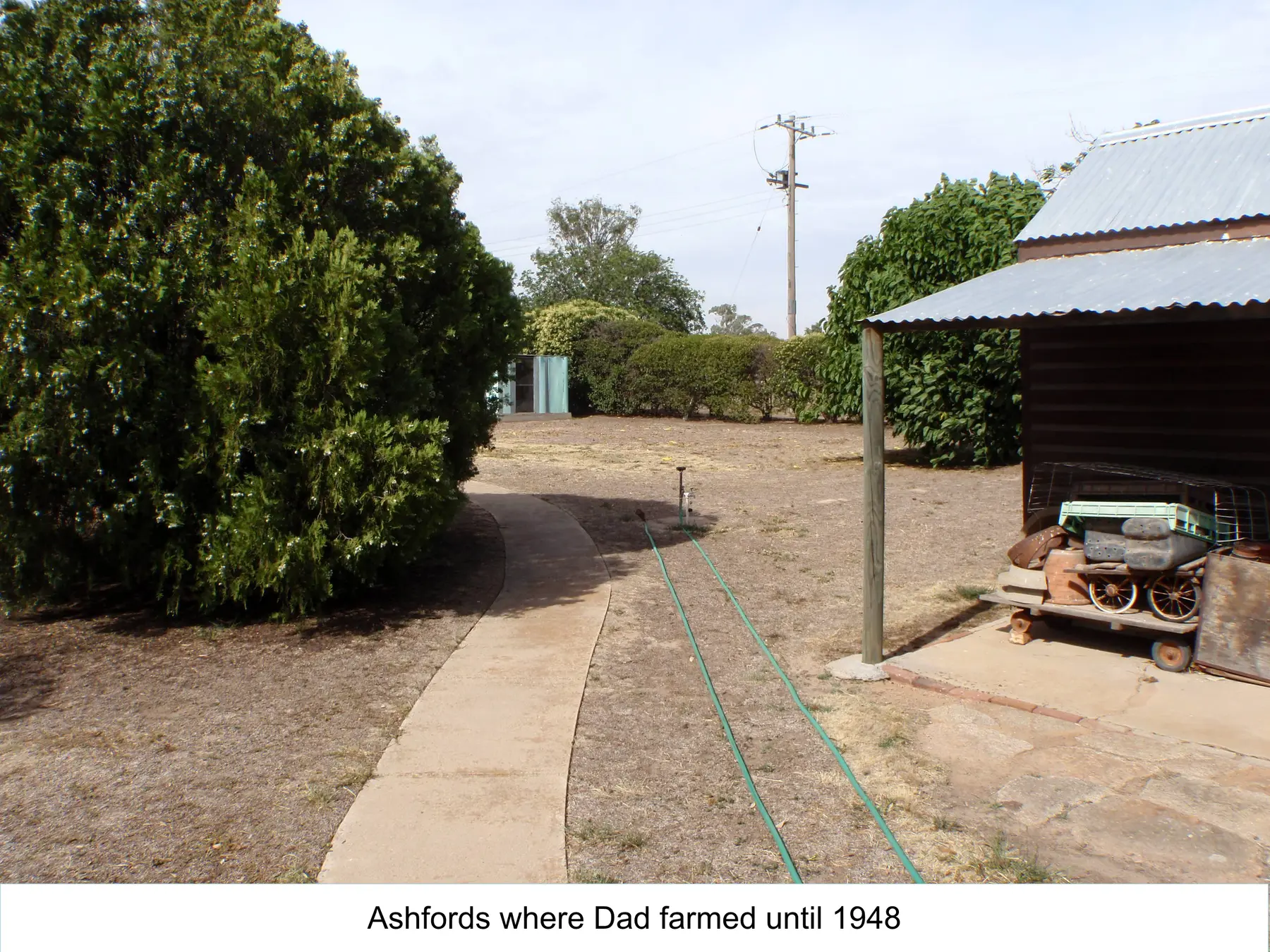
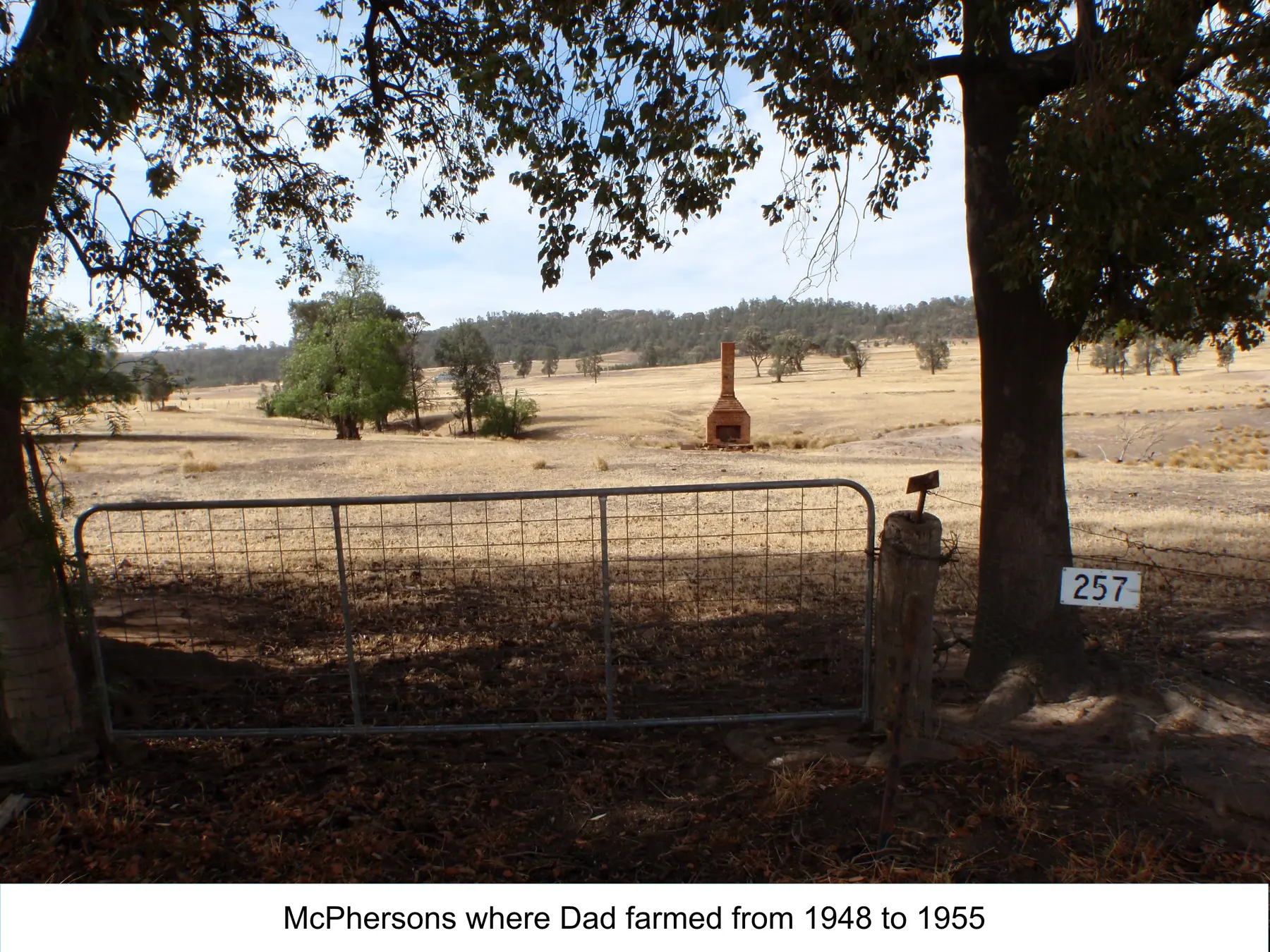
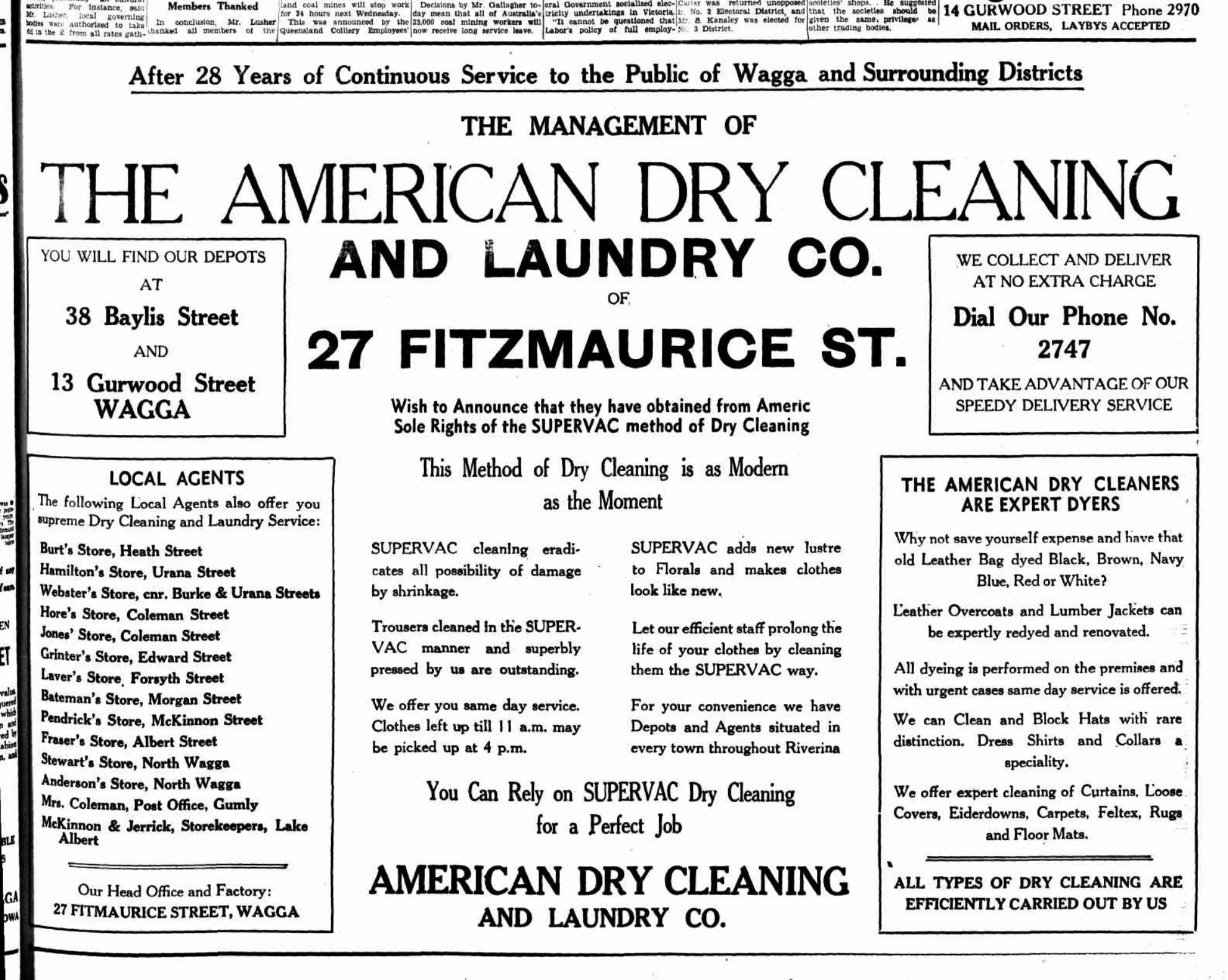
Their daughter Deirdre Rachael McKinnon (born 1941) arrived first, followed by Angus Malcolm McKinnon (born 1942) at Wagga the next year. The family moved with the work, first to Ashfords, then McPherson's, then a store at Lake Albert. Malcolm's captioned family photograph identifies Angus's partner as Bill Jerrick, and a 1949 advertisement independently lists McKinnon & Jerrick as storekeepers and local dry-cleaning agents at Lake Albert. Because the advertisement gives only the partners' surnames, the identification of this McKinnon as Angus Norman remains grounded in Malcolm's attributed family account rather than the newspaper alone.[62]
In 1954 the road turned south to Campaspe Park near Goornong and then Wipplegong near Axedale. Malcolm went to Bendigo Junior Technical College and the Bendigo School of Mines. He became president of the students' representative council and earned a Diploma of Electrical Engineering. Those years prepared him for work that would take him across Australia and the Pacific.
Part 2
The second line begins among the mines of Cornwall and the schools and chapels of England. It reaches South Australia through the Faulls, Waddys and Drakes, then continues west to Gordon and Charmian Faull and their daughter Christina.
The Faull and Rodda lines
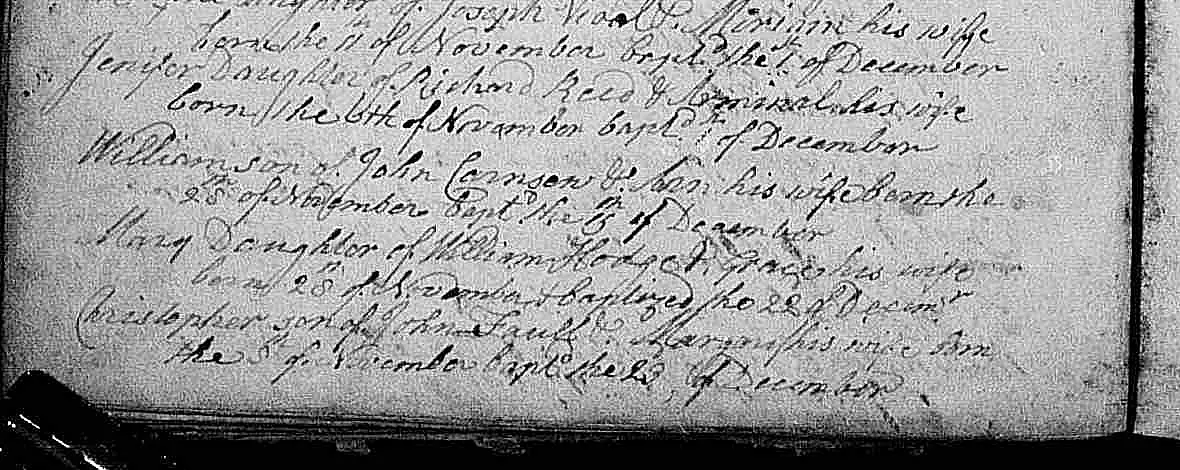
The direct Faull line can be followed through the Crowan parish registers to Christopher Faull (born 1734) and Tabitha Williams, who married in 1756. Their son John Faull (born about 1770) married Margaret Jenken (born about 1770) at Crowan on 20 October 1794. The same register records their son Christopher Faull (born 1799) arriving on 5 November 1799 and being baptised on 23 December. That original page corrects the 8 November date in the inherited family tree and clearly names his mother as Margaret.[8]
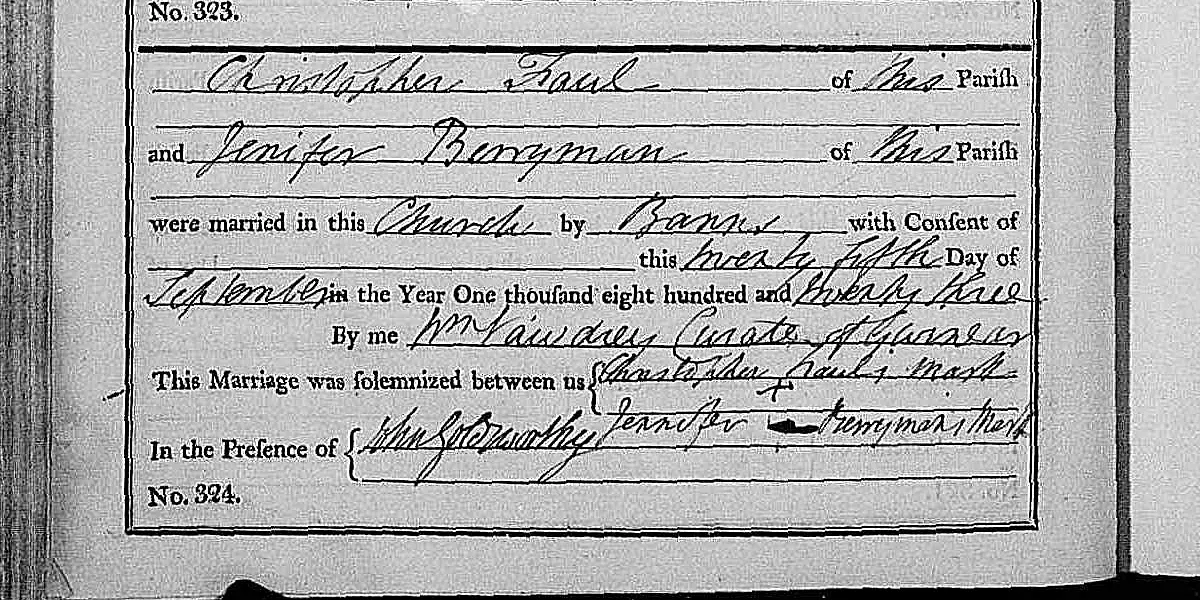
Christopher married Jenifer Berryman (born 1798) at Crowan on 25 September 1823. They both made their marks in the register rather than signing their names. Jenifer had been born in Crowan on 17 February 1798 to George Berryman (born about 1764) and Eleanor Poolly, whose marriage there in 1788 carries this branch of the family back another generation.
Jenifer appears as Jennifer and Jane in later records. She was buried at Crowan on 14 September 1840 (age 44). Five months later, Christopher married the widow Ann Toy (born about 1801). Their 1841 census household at Boletho brought Christopher's children and Ann's Toy children under one roof. Christopher remained at Crowan and was buried there in January 1855 (age 56). The next likely Faull father beyond Christopher, born 1734, is Thomas Foale (born 1705), but that final step remains possible rather than proved.[8]
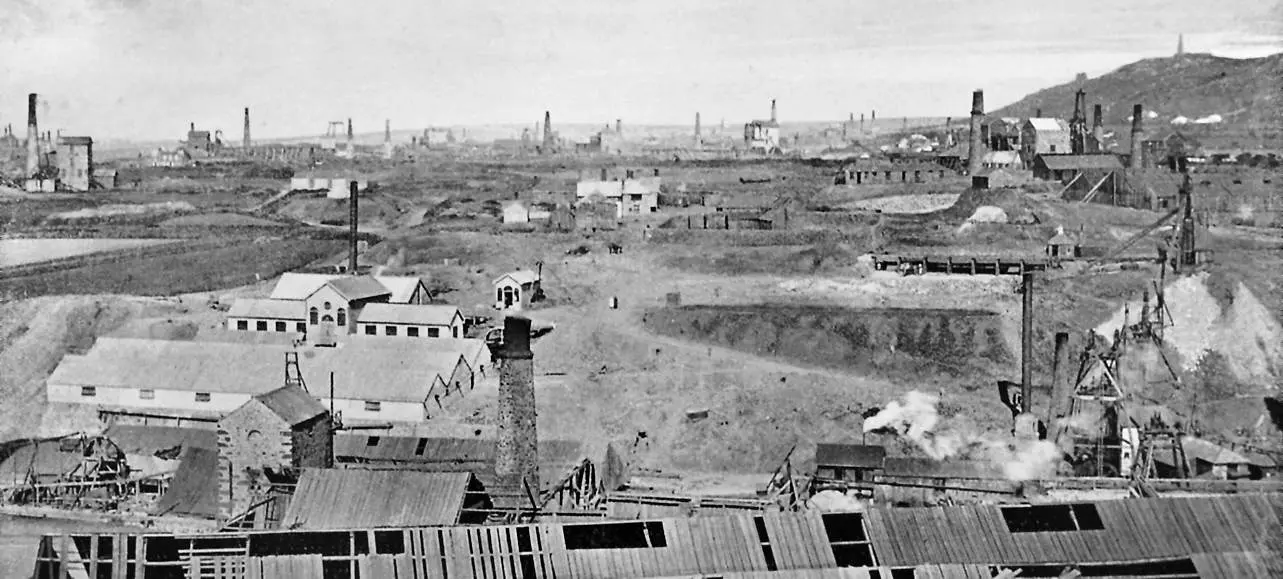
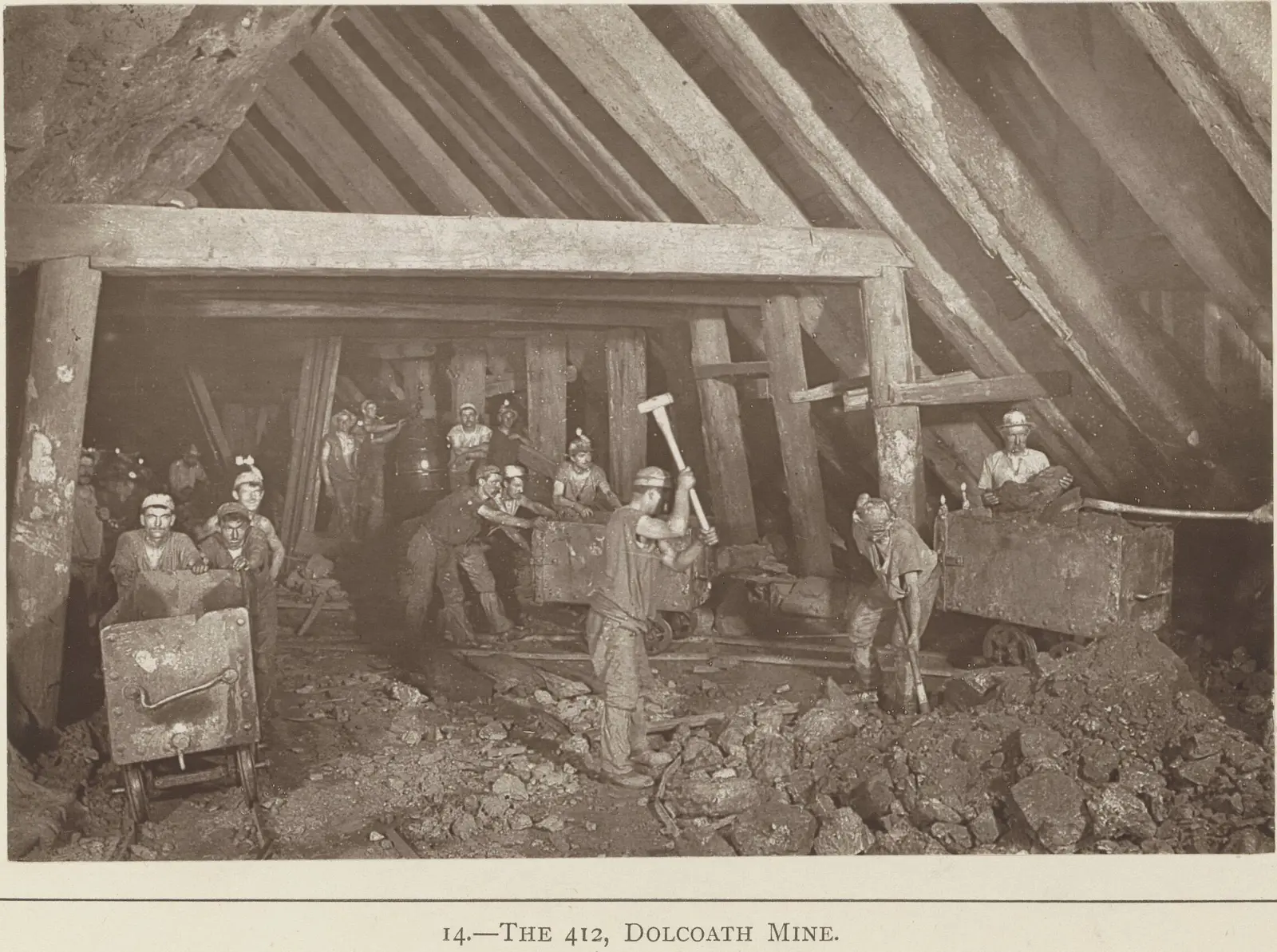
Christopher's son Samuel Faull (born about 1834) was already a copper miner at age 15. A shift might begin with a long walk, continue down hundreds of yards of ladders and end after 8 hours in heat, darkness and water. The miner bought his own candles and tools. Above ground, mining families drew water from a pump, grew potatoes, kept a few hens or a pig when they could and cooked over the only fire in a cramped cottage.[7]
Samuel married Elizabeth Ann Rodda (born in the 1830s) at Crowan on 11 October 1856. Elizabeth's father, James Rodda, worked underground too. Within a year Samuel and Elizabeth had left Cornwall aboard the Caucasian, carrying those mining names into South Australia and then Victoria.[8]
By 1863 they were at Donkey Hill near Campbell's Creek, where their son Samuel Faull (born 1863) was born. His birth record described his father as a Cornish-born miner who signed with a mark. Two years later a Samuel Faull applied for 3 acres near Strathloddon. A further notice placed Samuel at Yapeen in 1871, applying for 20 acres in the parish of Guildford. In 1878 the Mining Board nominated him as manager of the Clunes United Common, and the appointment was later gazetted. The sequence places him within the goldfields' move towards land selection and shared grazing, but does not prove that he continuously occupied either allotment.[20]
The mine remained a dangerous inheritance. Samuel and Elizabeth's son William Faull (born about 1868) was killed at age 18 or 19 in 1887 when rock fell from the roof of the South Clunes United Company mine. He had been working in a tribute party, a small working group paid from the gold it won. The report said William lived with his widowed mother in North Clunes, bringing the danger of the workings directly into the family home.[8]
William's brother Christopher Faull (born 1861) remained in the Clunes district and married Mary Snell “Polly” Rowe. When Mary died at their Angus Street home in 1913, the family notice named Christopher and their children George and Minnie. Christopher died at Clunes in 1922. Their son Samuel George Faull later lived at 14 Gattera Street, Coburg, and belonged to Transit Lodge No. 342. Lodge members were invited to follow his funeral to Fawkner Crematorium in March 1942.[53]
Two of Christopher's sisters also left sharply different newspaper traces. In 1872, when Mary Jane Faull (born 1859) was 12, she was robbed and tied to a tree in bush near Yapeen. A warrant was issued, but the report does not record the outcome. Their younger sister Mary Grace Faull (born 1876) married at New Chum in Western Australia in 1899. The newspaper calls her husband William Henry Wilcox, while the inherited tree records Will Woolcocks, so the groom's surname remains unresolved rather than silently changed.[56][57]
Their sister Annie Faull married Maurice Rudwick (born 1867) and lived in the Coolgardie district. Maurice died on 2 February 1910. Three years later, an in-memoriam notice from his wife and children described him as still dear to their memory, preserving the family's continuing remembrance even though it adds little biographical detail.[58]
Another son, James Faull (born 1873), remained in Victoria. Elizabeth's 1908 death notice names Samuel and James as her sons and connects them with their sisters in Boulder and Kookynie. James later lived at 14 Gordon Street, Fairfield. He died in October 1932 and was buried at Heidelberg Cemetery. A Victorian birth index also identifies James and Mary Anne Nutman as the parents of Harry Nutman Faull, although the child relationship still awaits a controlled addition to the working tree.[50]
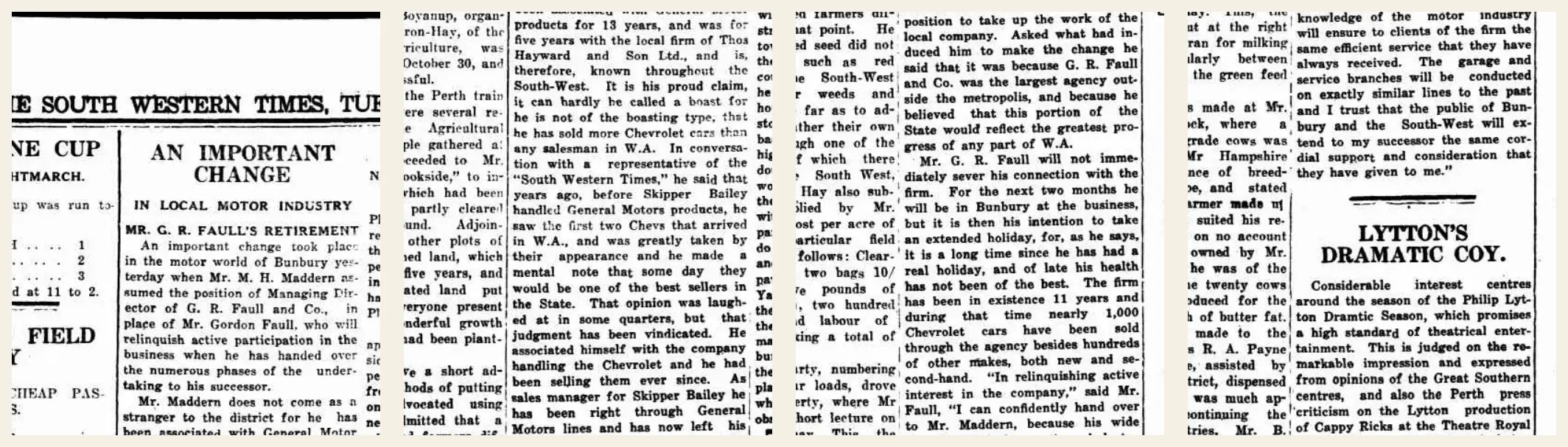
The younger Samuel married Elizabeth Jane Rodda (born 1858) in 1890, when their marriage record described him as an iron moulder. His funeral left the family home at 342 Clarke Street, Northcote, on 29 September 1934 for Heidelberg Cemetery.[23] Their son Samuel James Gordon Rodda Faull (born 1891), known as Gordon, carried the Faull and Rodda names through Lauriston and Boulder to Bunbury as motoring took hold. He developed a workshop into G. R. Faull and Co. over 11 years, added General Motors agencies and opened a lit showroom in Wellington Street. Newspaper accounts from 1924 and 1929 describe the firm's growing regional reach and report sales of almost 1,000 Chevrolets, plus hundreds of other cars. In 1929 Gordon transferred day-to-day management to motor salesman M. H. Maddern.
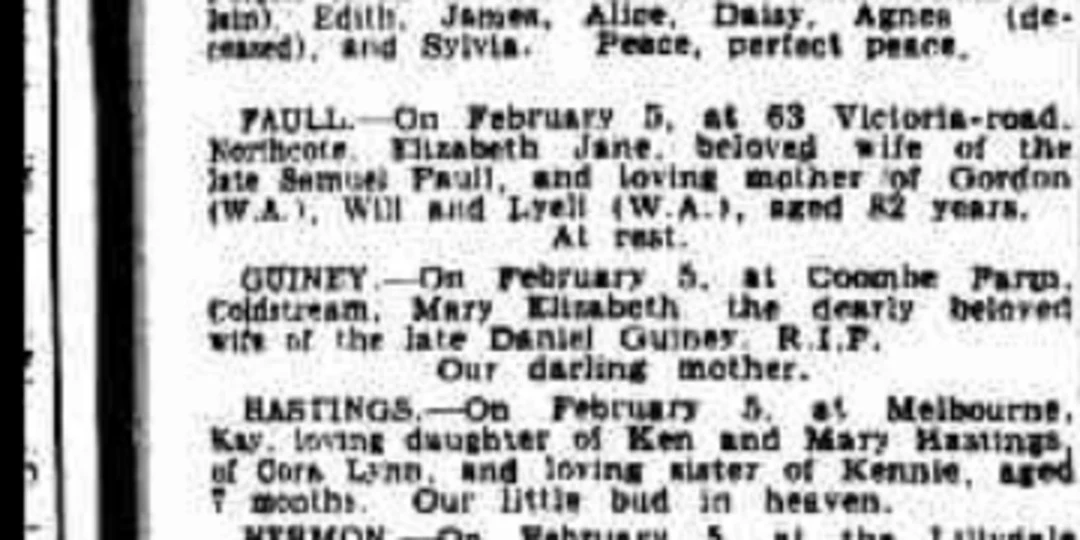
Elizabeth lived long enough to see that western move take hold. She died at her Northcote home on 5 February 1941, age 82, after Samuel. Her death notice records sons Gordon, Will and Lyell in Western Australia.[9]
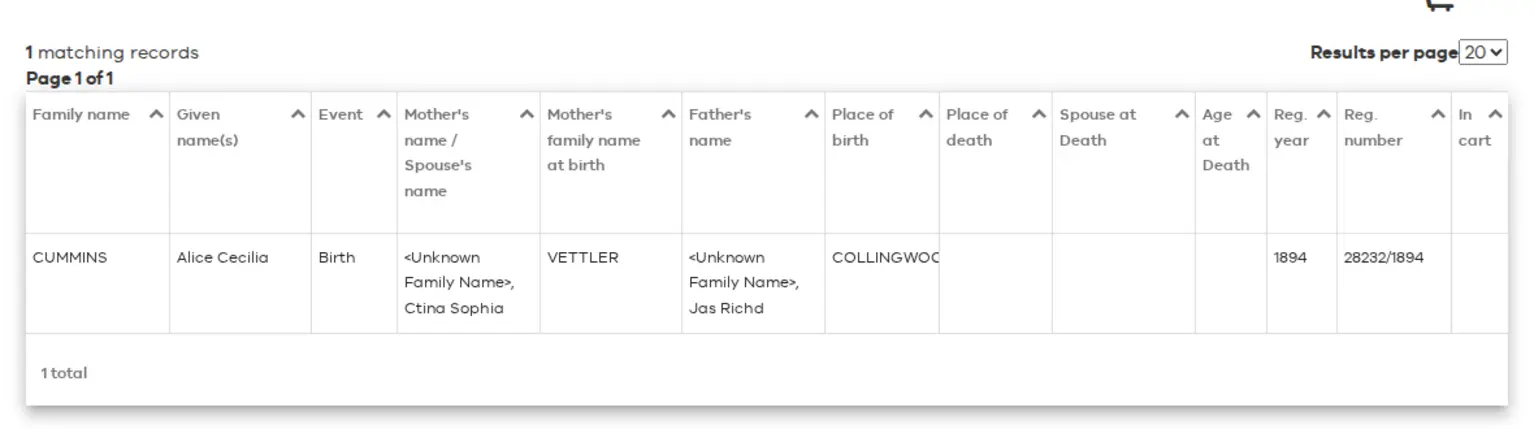
Gordon married Alice Cecilia Cummins (born 1894) in Perth in 1916. Alice had been born in Collingwood to James Richard Cummins (born about 1867) and Christina Sophia Vettler (born 1870). The official birth index resolves both of their names and corrects the older family tree's Vittler spelling. Gordon and Alice's son, Gordon Cummins Faull (born 1917), arrived the following year.
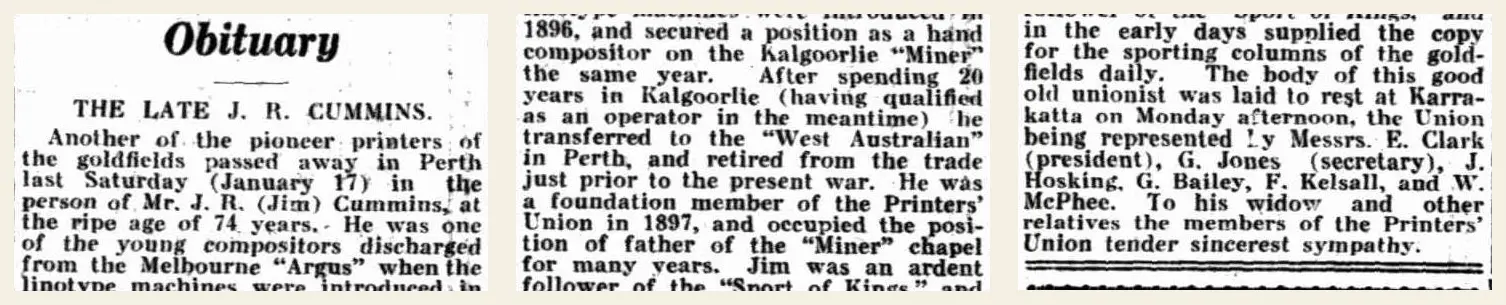
James made his career in newspaper composing rooms. He lost his job as a young hand compositor at the Melbourne Argus when linotype machinery arrived in 1896. That year he moved to the Kalgoorlie Miner and learned to operate the new machines. A printers' union obituary credits him with helping form the union in 1897, serving for many years as father of the Miner chapel and contributing early racing notes.
After 20 years in Kalgoorlie, James moved to the West Australian in Perth. He retired shortly before the Second World War and died in 1942, age 74. The Western Australian death index identifies his parents as James Cummins and Catherine. Catherine's surname and the couple's earlier lives remain unresolved.[9]
Christina's birth index opens another Victorian chapter. She was born at Echuca to John Vettler (born about 1836) and Agnes Turner Paterson (born about 1840). Their marriage notice fills in the missing origins: John was formerly of Bonn on the Rhine in Prussia, while Agnes was the fourth daughter of William Paterson, a Glasgow warehouseman. They married at 11 Nicholson Street, Fitzroy, on 30 May 1863. Agnes died in 1878 (age 38), leaving Christina without her mother at about age 8.
John brought Rhine winemaking experience to Victoria. At a St Kilda garden fete in 1861, wine he had made locally earned an additional prize. Soon afterwards he explained in the Argus that smoke from damp plant material could protect vines from frost, drawing on a method he knew from the Rhine.
By 1867 John held shares in the 30-acre Echuca Vineyard Company and managed it. He used newspaper letters to encourage German agricultural families to settle near the Murray and Goulburn rivers and develop vineyards and farms.
John's 1871 vintage report recorded 14,276 gallons of grape must. It attributed an average of 2,248 gallons per acre to 2.5 acres of Mataro vines. His Grenache and Hermitage wines later received a Medal for Progress at the Vienna Exhibition in 1873.
Newspaper advertisements then follow John from the vineyard into the wider life of the district. By 1876 he was associated with the Yambuna Hotel opposite Echuca Vineyard, received entries and subscriptions for a local race meeting, and helped organise district affairs. When Agnes died in 1878, a probate notice named John as her Yambuna widower and executor. He married Ella Nora Forde in 1881, and a family notice recorded the birth of an unnamed son the following year.
By early 1883 John was advertising himself as proprietor of Echuca's Bridge Hotel. He promoted renovated accommodation for travellers and farming families, a dining room, free stabling and rooms for public meetings. The Terrick Terrick mail also left from the hotel twice a week. John sold Victorian champagne there, joining his earlier winemaking experience to a hotel that served as an inn, meeting place and transport stop.
John was still defending Australian wine in 1892. After a Moet and Chandon representative questioned the country's suitability for champagne, John replied in print. He based his answer on 37 years as an Australian vigneron and predicted that local champagne would eventually reach France. He died at Elsternwick in 1898, age 62.[9]
John's parents also ended their lives in Victoria. Anna Maria Schwan (born about 1811) died in 1877 (age 66). Her death index names her parents as Johann Schwan and Sibele Morenhoven, resolving the Swhan spelling recorded on her son's death index. Her husband, Johan Vettler (born about 1813), died at Balwyn in 1899 (age 86). The family tree now reaches another generation, although the details of their earlier lives in Germany remain to be found.

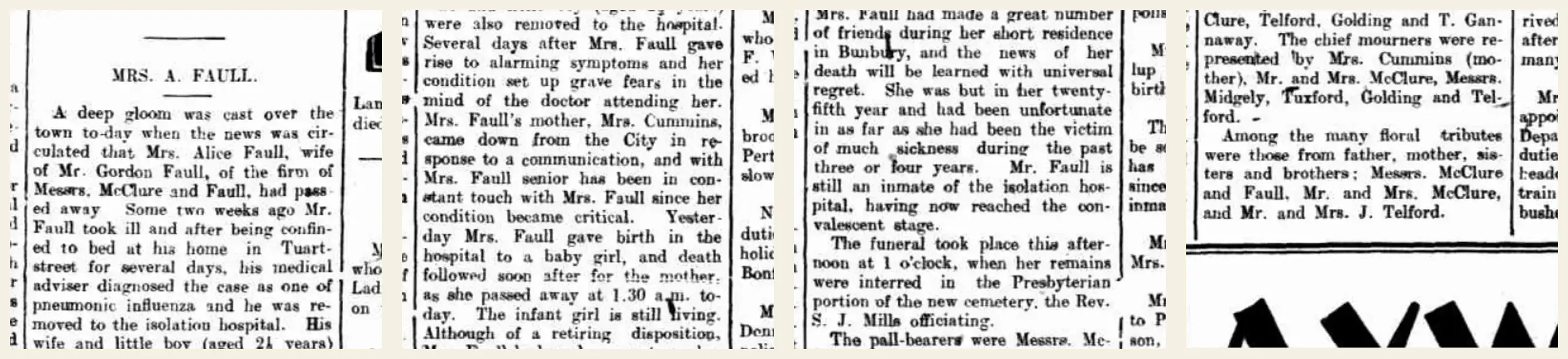
In August 1919 the family was living in Tuart Street, Bunbury, when pneumonic influenza sent Gordon to the isolation hospital. Alice and their 2.5-year-old son were admitted too.
Alice became critically ill. She gave birth in hospital to Lila Alice Faull (born 1919) on 1 September and died at 1:30 the next morning, age 24. Her mother came from Perth to be with her. Gordon recovered, their young son was reported out of immediate danger, and Lila survived. Local reporting noted the friendships Alice had made during her short time in Bunbury. Gordon later married Marjorie Eleanor and settled at Mount Lawley. His son Gordon would meet Charmian Waddy during the Second World War.[9]
The Waddy line
Long before the telegraph reached South Australia, Richard Waddy (born 1733) was a schoolmaster at Nun Monkton in Yorkshire. His son, Rev Richard Waddy (born 1769), entered the Wesleyan ministry in 1793 and spent 60 years travelling, preaching and serving its circuits. He also wrote A Vindication of the Methodists in 1804.
Rev Richard's son, Rev Dr Samuel Dousland Waddy, was the father of Samuel Danks Waddy (born 1830). Samuel became a New South Wales judge and remained closely associated with Methodism. At his funeral in January 1903, mourners sang his own paraphrase of the 23rd Psalm; the report said it was intended for the denomination's new hymn book as a lasting memorial to him.[61]
Family records identify another of Rev Richard's sons, Alfred Waddy (born 1826), whose working life unfolded in South Australia through reporting, printing and business. In 1860 a bolting horse dragged him by a stirrup and broke his leg while he was travelling to report a public meeting near Langhorne Creek. He recovered, published the South Australian Wesleyan Magazine in 1866 and later ran a Leigh Street printing office with several apprentices. By 1870 he was also working as a commission agent. Alfred died at his East Adelaide home on 23 March 1898, age 73.[24]
Alfred's son John Wesley Waddy (born 1861) married Mary Ann, known as Polly, in Adelaide in 1899. They later lived at “Elland”, 180 Whitmore Square. Polly died there in January 1933. John died at a private hospital in Mile End on 6 August 1937, age 77, and was buried at West Terrace Cemetery. His notices described him as formerly associated with the Public Library, but do not state his position or length of service.[36]
Alfred's daughter Maud Alice Clinch Waddy (born 1851) married William Henry Starnes of Kent Town at Adelaide's Stow Memorial Church on 5 July 1876. The notice names Alfred as her father. Later English censuses follow Maud and William with their daughters through Hampstead and St Pancras, connecting her Adelaide childhood to a family life in London.[42]
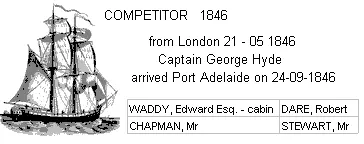
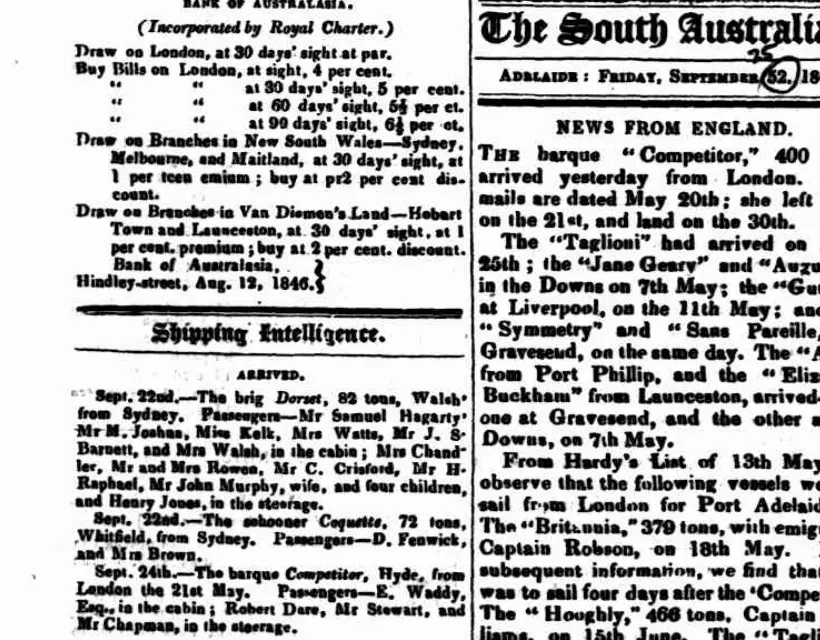
Rev Richard's son Dr Edward Waddy (born 1815) sailed from London on the 400-ton barque Competitor on 21 May 1846. The passenger records name Edward alone in the cabin, with Robert Dare, Mr Stewart and Mr Chapman in steerage. An Adelaide shipping report places the vessel at Port Adelaide on 24 September after 126 days. Edward married Jane Russell (born about 1829) in 1847. He became the first doctor at the Kapunda copper mines and later spent 21 years as clerk of the Strathalbyn Local Court. Their eldest child carried the Waddy name into the colony's postal service.[10]
Edward and Jane's daughter Ann Eliza Waddy (born 1850) took a trusted public role of her own. In January 1881 the Governor approved her appointment as Savings Bank agent at Mallala, where the new agency operated from the telegraph office. The notices establish the appointment but do not state her duties or how long she served. Ann died at Adelaide in August 1892; civil and cemetery evidence differ by 1 day.[47]
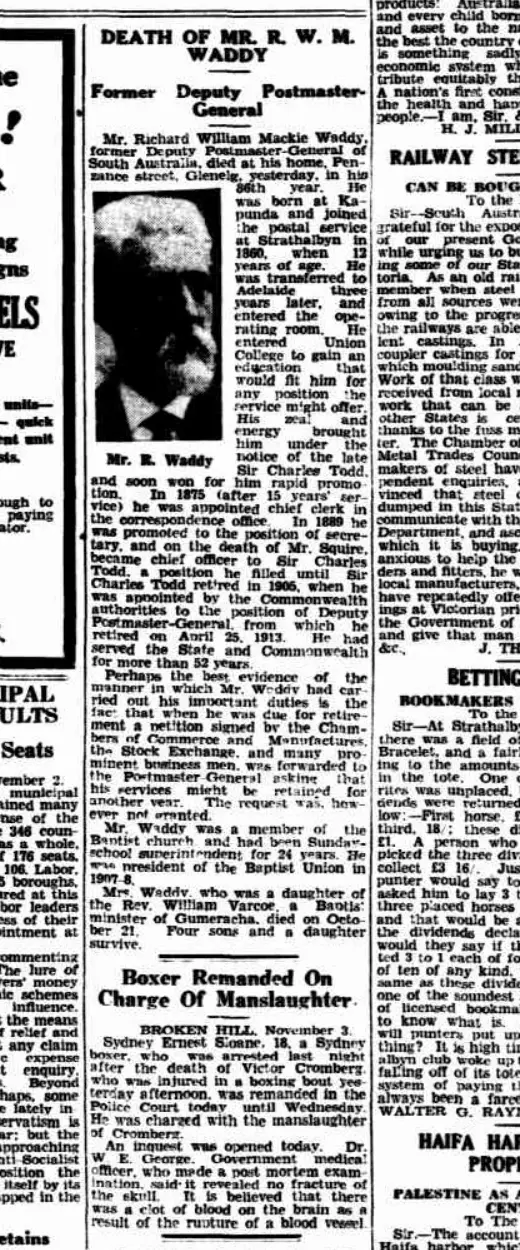
Richard William Mackie Waddy (born 1848) was age 12 when he entered the postal service at Strathalbyn in 1860. 3 years later he transferred to Adelaide, studied at Union College after work and caught the attention of Sir Charles Todd, the man building South Australia's telegraph network.
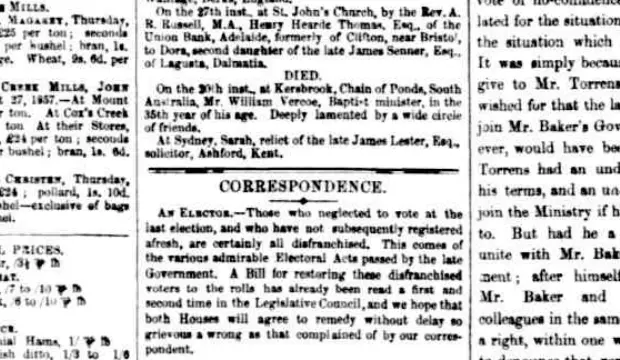
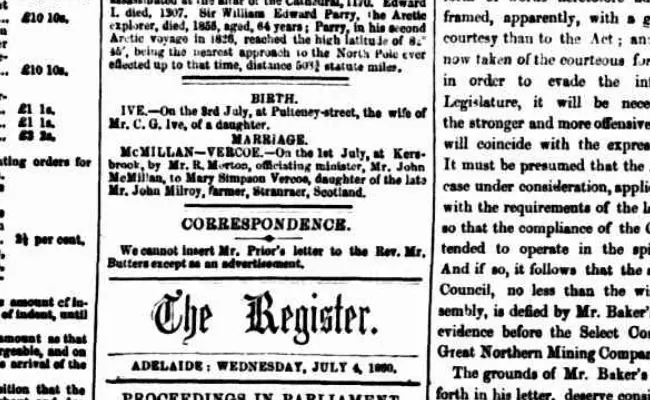
Alice Mary Simpson Vercoe (born 1850) had her birth registered at East Stonehouse, Devon. The 1851 census records 10-month-old Alice with her parents, 29-year-old William and 21-year-old Mary, before the Hydaspes brought them from Plymouth to Port Adelaide that November. Her father, Rev William Vercoe (born about 1823), served as the ship's schoolmaster. In South Australia he became clerk and treasurer of the Para Wirra District Council, a Baptist minister at Chain of Ponds and was authorised to issue marriage licences.[10]
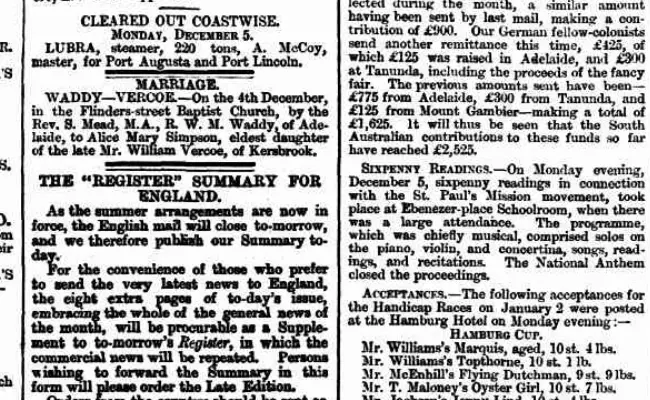
William died at Kersbrook in 1857, age 34, leaving Alice's mother, Mary Simpson Milroy (born about 1829), a widow. Mary married John McMillan (born about 1825) 3 years later. Their published notice identifies Mary's father as John Milroy, a farmer at Stranraer in Scotland. In 1870 Alice married Richard at Flinders Street Baptist Church. That notice calls her the eldest daughter of the late William Vercoe, connecting the child in the passenger record with the minister at Kersbrook. Their son Ernest later married Eva May Drake.[10]
John McMillan had won the £24-a-year mail contract between Chain of Ponds and Kersbrook just before marrying Mary. By 1867 he was Kersbrook's storekeeper and helped form a committee to raise money for a needed schoolroom. He died at his Kersbrook home on 4 September 1869, age 44.[30]
Richard advanced from correspondence work to secretary and chief officer under Sir Charles Todd. He succeeded Todd as South Australia's Deputy Postmaster-General in 1905. When Richard reached retirement, business organisations petitioned for him to remain another year. The request was unsuccessful, and his postal career ended after 52 years.
Outside the postal service, Richard spent 24 years as a Baptist Sunday-school superintendent. He also served as president of the Baptist Union and as a justice of the peace. He died at Penzance Street, Glenelg, in November 1933, age 85. Alice had died 13 days earlier. Their 4 sons and 1 daughter survived them.
Their daughter Ethel Alice Waddy (born 1885) appears in two Adelaide examination records. At 15 she passed the University of Adelaide preliminary examination in 1900. Five years later she passed the university's junior theory of music examination in the first class under teacher W. R. Pybus. The records do not name her parents, but her distinctive full name, age and Adelaide setting align with Richard and Alice's daughter.[39]
Family records name Egbert Harold Waddy (born 1882) among Richard and Alice's sons. His newspapers trace a practical education in geometry and commercial law into bank management at Port Pirie and Orange. In 1918 he helped expose a forged savings-bank withdrawal after checking the passbook and ledger, appearing as a witness rather than the accused. At Orange he became a trustee and active secretary of Bloomfield Park, helping organise improvements to the grounds. Egbert died there on 5 April 1945 after a long illness, age 62.[25]
Another son, Francis Edward Waddy (born 1873), farmed and later worked as a civil servant in South Australia. In 1912 the Governor appointed him to Saddleworth's school Board of Advice, placing him among local residents entrusted with public-school affairs. Later records place him at Gawler and Plympton. Francis died on 17 February 1964 and was buried at Centennial Park.[48]
Eva May Drake Waddy
Eva May Drake (born 1877) married Richard and Alice's son Ernest Winthrop Waddy (born 1875) in 1898, but domestic life did not quieten her. Her granddaughter Gabrielle Hewison remembered her as a pianist, singer, writer and watercolourist who swam in the sea each day. Gabrielle said Eva had studied under South Australian artist James Ashton, participated in the campaign for women's votes and crossed the Nullarbor with her eldest daughter Thelma. The Ashton and suffrage details remain attributed family testimony; Eva's many surviving newspaper letters independently establish her as a persistent public advocate.[65]
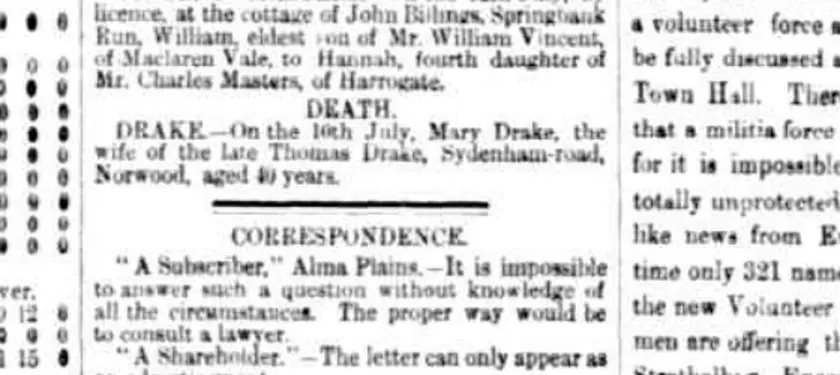
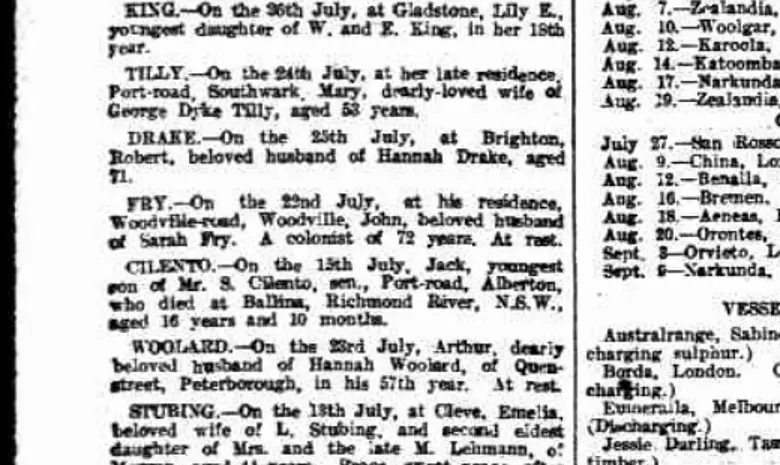
Eva was the only daughter of Robert Drake (born about 1847) and Hannah Rich Taylor. Family memory recalled that Robert came from England at age 10. The records now show that he was slightly younger. In 1851 he was living at Rockland St Peter in Norfolk with his parents and 3 siblings. His father, Thomas Drake (born 1819), was a master shoemaker. Thomas had married Mary Standley (born about 1822) at Shoreditch in 1839.
Three years after the census, all 6 members of the household sailed from Southampton aboard the Medway. They arrived at Melbourne on 22 February 1854, with Robert listed as age 7. The voyage brought them to Victoria, but the next surviving records place the family in South Australia. Robert's 1876 marriage notice calls him the third son of the late Thomas Drake of Norwood. A South Australian land application names Mary as Thomas's widow and identifies Charles and Robert as their sons. Thomas died in 1856. Mary remained at Sydenham Road, Norwood, until her death on 10 July 1866. Her death notice says age 40, but the 1851 census and passenger register both indicate that she was about 44.[12]
Thomas's 1819 baptism takes the family back another generation in the same Norfolk village. His parents were Thomas Drake (born about 1766), another shoemaker, and Mary Lincoln (born about 1776). Both had been married before when they wed at Rockland St Peter in 1809. More than 40 years later, the 1851 census found them still there, Thomas age 85 and Mary age 75.[12]
By the end of the century Robert had a shop in Murray Street, Gawler, and the family later worked orchards at Hectorville. It was Eva and Ernest's married household, not Eva's childhood household, that Gabrielle remembered shifting with the seasons between Adelaide, the hills and the coast, sometimes taking its own cow along. Brian Waddy reportedly attended 16 schools because of the moves. A 1929 newspaper item independently records Mr and Mrs E. W. Waddy and their family returning to 191 Melbourne Street, North Adelaide for the winter, supporting the remembered pattern without proving every house or school.[65]
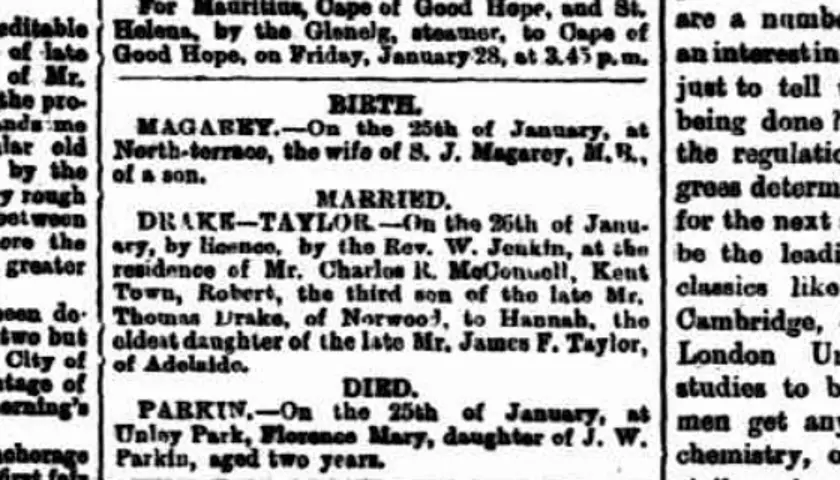
Hannah's mother, Bridget McCarthy, had made a harder journey. Family research identifies her as one of the young Irish women who reached Adelaide aboard the Inconstant on 7 June 1849. The ship carried 209 female migrants, including 186 workhouse orphans sent under the Earl Grey scheme during the Great Famine. Many entered service as maids, seamstresses, teachers and nannies. Bridget married James Francis Taylor (born 1828), who died while Hannah was still a child. Contemporary notices place his death at Mount Barker on 10 March 1864, age 36; one later reprint gives 11 March. Because the notices name no relatives, the family connection continues to rest on the separate Taylor research and family evidence. One family memoir remembered his first name as Henry, but the later Taylor investigation and family grave identify him as James Francis.[11]
From the Esplanade at Glenelg, Eva wrote to editors about daylight saving, education, diet, wildlife and South Australia's coat of arms. Her 1933 case for 8 months of daylight saving drew on her own summers with young children and the extra evening time available for outdoor activity. She also pointed to the Housewives' Association as an interested public constituency. In a later letter she proposed supervised camps and cabins for motorists, arguing that safer holidays could also bring visitors and trade to country towns.
She also wrote books. The Wonderland Australia, Those Shades of Earliest South Australia, Australia and Radiant Health and the religious booklet Armageddon all found their way into library catalogues. The family archive remembers another devotional booklet, Gems from His Book. Her letters and books made her a persistent public voice on health, education, travel and religion.
Gabrielle also remembered a strongly Methodist or Congregational household, an early newspaper that Eva and Thelma intended largely for women, and Eva campaigning to continue the beachfront road from Somerton to Glenelg. No retained record yet confirms the newspaper or road campaign, so both remain family-history leads rather than established facts.[65]
The Waddy children
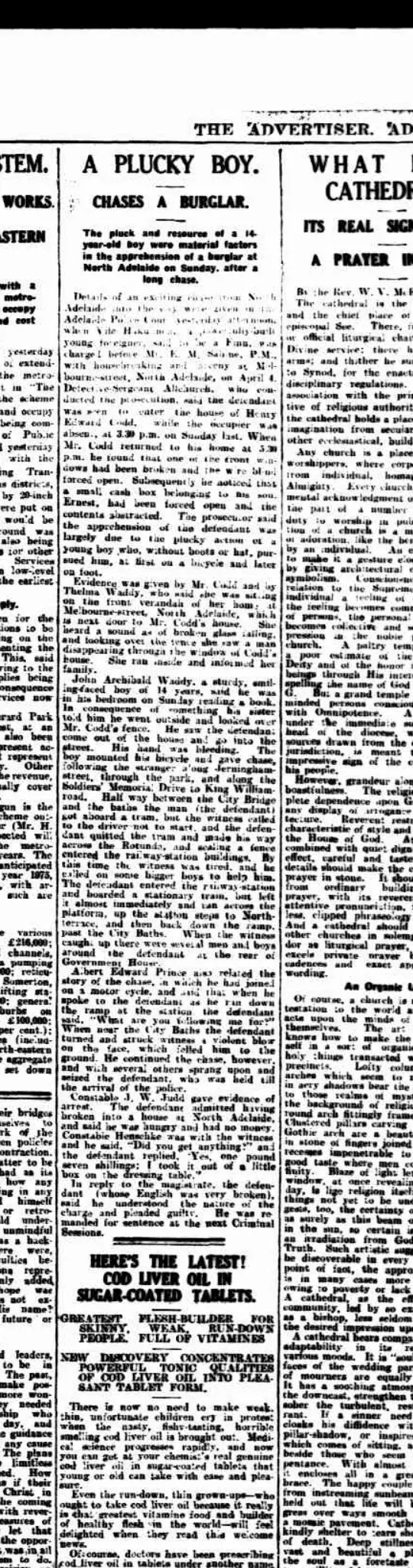
Ernest and Eva's children inherited their parents' appetite for the world. A 1926 court report says Thelma Alicia Vercoe Waddy (born 1899) heard glass break at a neighbour's Melbourne Street home and saw a man leave through a window. Her 14-year-old brother John Archibald Waddy (born 1912) followed the man first by bicycle and then on foot. Other young men joined him near Government House, where they detained the suspect for police after a long chase through North Adelaide. John later became a doctor.
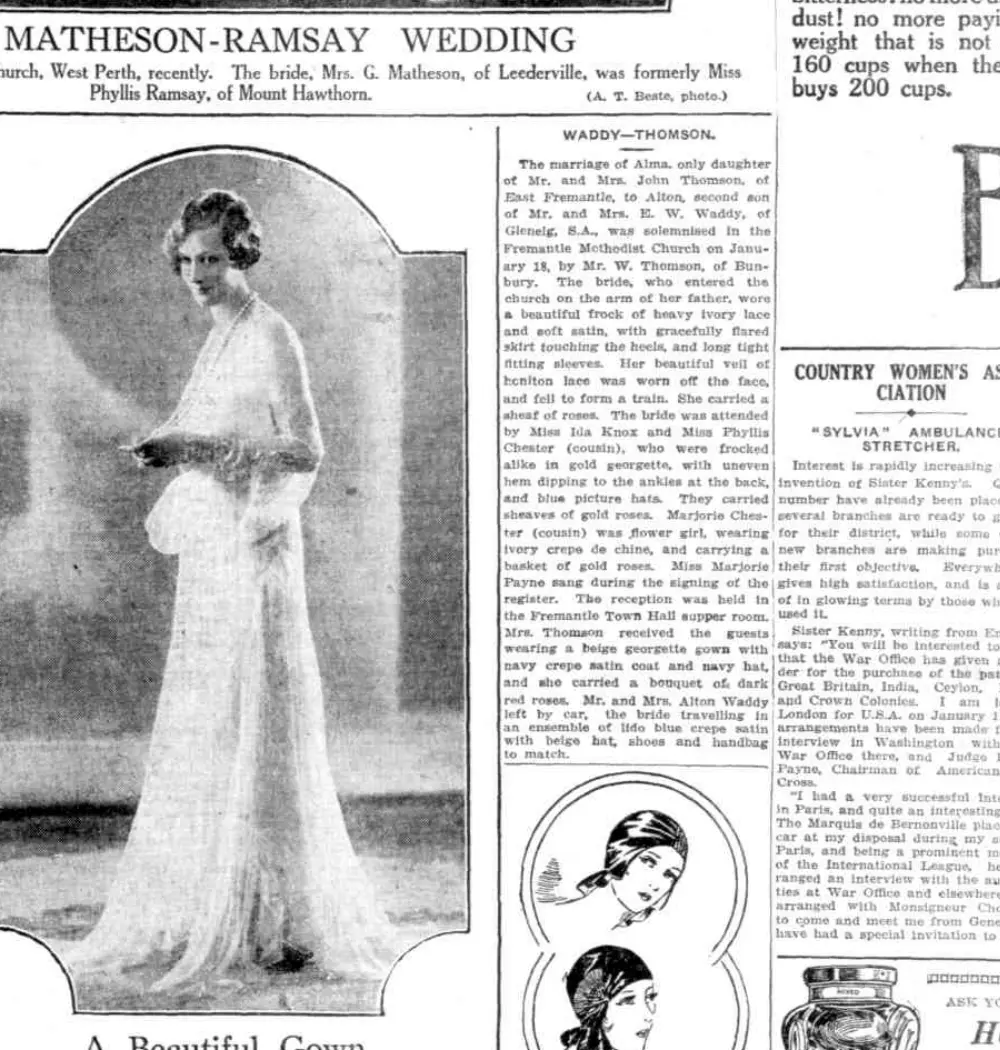
Alton Francis Drake Waddy (born 1904) worked around Streaky Bay, visited the United States and later gave talks about the country. He also compiled an illustrated newspaper souvenir about the upper Murray before moving west. On 18 January 1930 he married Alma, the only daughter of John Thomson of East Fremantle, at Fremantle Methodist Church. A newspaper account preserves a photograph of the couple.[10]
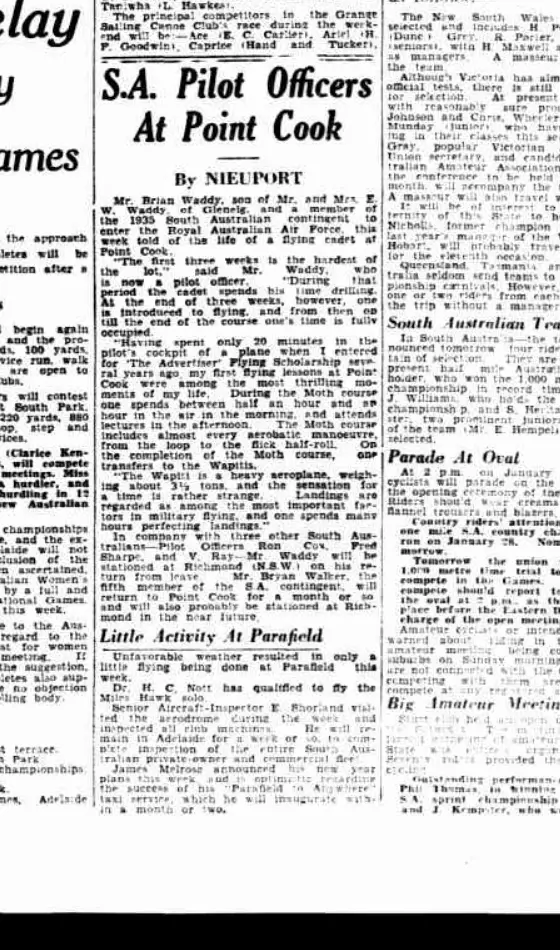
Brian Cadwallader Waddy (born 1916) joined the 1935 South Australian intake at Point Cook. In a 1936 interview he described 3 weeks of drill followed by daily flying and lectures. Training progressed from Moth aircraft to the much heavier Wapiti and included aerobatics and military landings. He left for Richmond as a pilot officer with 3 other South Australians. During the war Brian rose to Wing Commander and was mentioned in dispatches. He married Dorothy Jean Pinch (born 1916) in Western Australia in 1942. A 1951 examination list records his final medical passes at the University of Adelaide, after which he became a doctor.
Their brother Colin Taylor Waddy (born 1900) first appeared in print as a schoolboy commended in a 1913 Wattle Day poetry competition. He later worked as a salesman and sales manager, stood as a Labor candidate for Sydney City Council in 1937, and owned a Hawkesbury house that burned down while he and 2 guests were fishing in 1951. Later land and probate notices place Colin and Evelyn Waddy at Terrigal. He died in 1973, 3 months after making his will. Family records disagree over his wife's earlier identity, so the notices are not used to resolve that question.[26]
Another brother, Lionel Ernest Waddy (born 1906), was driving on Fullarton Road in February 1927 when his car and another collided with enough force to wreck both vehicles. The 3 people travelling with Lionel suffered shock. A passenger in the other car was thrown onto the road and seriously injured. The report identifies Lionel by his full name and Esplanade, Glenelg address, but does not assign blame for the collision.[40]

A Waddy cousin at The King's School
Percival Stacy Waddy (born 1875) returned to his old school at Parramatta as Headmaster in 1907. He established its junior school, created the house system and reshaped the curriculum for boys from rural families. He was also an Oxford cricketer, an Anglican priest and, after leaving the school during the First World War, an army chaplain who served in France and Palestine.
The school still remembers him in Macarthur Waddy, one of its senior boarding houses. Percival belonged to a cousin branch rather than Charmian's direct line. Malcolm's large Waddy chart places both branches in the same extended family.[10]
War service and a new life in Perth
Gordon Cummins Faull (born 1917) entered wartime service in Western Australia in July 1940. He began as a sergeant at Naval Base, was commissioned as a field-artillery lieutenant in January 1941 and joined the Second AIF that August. Charmian Dousland Waddy (born 1921) left school for voluntary-aid work, then enlisted at Wayville in January 1942. They met while she was working at a South Australian military hospital.[13]
Charmian was among the first 4 Australian Army Medical Women's Service members posted to troop trains between Adelaide and Perth. A 1944 profile says she completed 60 journeys in 15 months, each about 1,600 miles. The train carried an aid-post compartment and separate sleeping space for the women, but no shower. Their patients had illnesses ranging from influenza and malaria to suspected appendicitis and chickenpox. Nurses at Tarcoola and Cook supported trips made without a doctor. The profile used the rank corporal, while the official nominal roll records Charmian as a private on discharge in July 1944.[13]
Charmian's own memoir explains how she reached that work. She and Thelma joined the Voluntary Aid Detachments at Glenelg and volunteered at Kapara, a home for servicemen returning from the Middle East. Charmian remembered first-aid and hospital training, the improvised wards at the Wayville Showgrounds staging camp and 105 Australian General Hospital at Colonel Light Gardens. Her account adds the texture of blacked-out walks to early shifts, injured servicemen, sick German prisoners of war, and staff accommodation moving from a house to a farmhouse and tents as the hospital grew.[66]
She dated her first meetings with Gordon to December 1942, while he was helping move the 2/10th Armoured Regiment back to Western Australia. Charmian initially thought him rather ordinary when he appeared during an evening with a packet of pig's trotters and ate them under a piano. About two weeks later they met for a swim at her family's beach home. While Charmian changed upstairs, Gordon played the Warsaw Concerto on the piano, and she wrote that she began to be impressed. The 1944 profile independently confirms that they met while she was a voluntary aid at a South Australian military hospital, while the personal details remain Charmian's own remembered story.[66]
Charmian married AIF Lieutenant Gordon Faull at St Peter's Church, Glenelg, in April 1943 while both were serving.
The wedding report describes Charmian's embossed-organdie gown, lace veil and flowers. Private Elizabeth Richardson attended in AAMWS uniform, and Charmian's brother Wing Commander Brian Waddy supported the groom. The small reception was held at the Waddy family home on the Esplanade.
Gordon rose to captain in the 11th Australian Movement Control Group. After his discharge in December 1945, he and Charmian flew to Perth with their baby son Richard Waddy Faull (born 1945). They stayed with Gordon's family at Mount Lawley while looking for a home, then raised Richard, Christina Vercoe Faull (born 1947), Catherine Rodda Faull (born 1951) and Elizabeth Charmian Faull (born 1957) in Western Australia.
The Army remained part of Gordon's life. He returned to the Citizen Military Forces in 1951 as a captain in Royal Australian Engineers Movement Control and became a provisional major in December 1952. A February 1953 newspaper photograph places him at a 10-day Leighton course with other citizen officers. Its caption identifies him as an accountant and says the men trained for 3 hours after their civilian work.[13]
The Faull children in the west
An undated family memoir written by one of Richard's sisters, probably Christina, remembers the siblings' postwar childhood moving through relatives' homes, Swanbourne Hill and Mount Hawthorn before the family settled opposite Claremont School. Their Bay View Terrace house was said to have been the former stables for Minderoo. Near the Swan River, Richard and his sister fished, sailed, built trolleys and rafts, played long games of Canasta and Monopoly, and learned the world through a large coloured map. Richard collected stamps, coins, model trains, maps, rocks and minerals, and developed an early interest in the share market. The document displays neither author nor date, so its vivid detail remains a sister's attributed family testimony.[14]
Richard did not move in a straight line towards a career. A Commonwealth Scholarship took him to the University of Western Australia, but science could not hold him. He left, jumped trains and hitchhiked around Australia, returned to try again, then set out once more. Summer work on country wheat bins paid for some of the wandering. He studied most of a geology course, drove a taxi and prospecting drew him into the outback before he finally completed an economics degree.
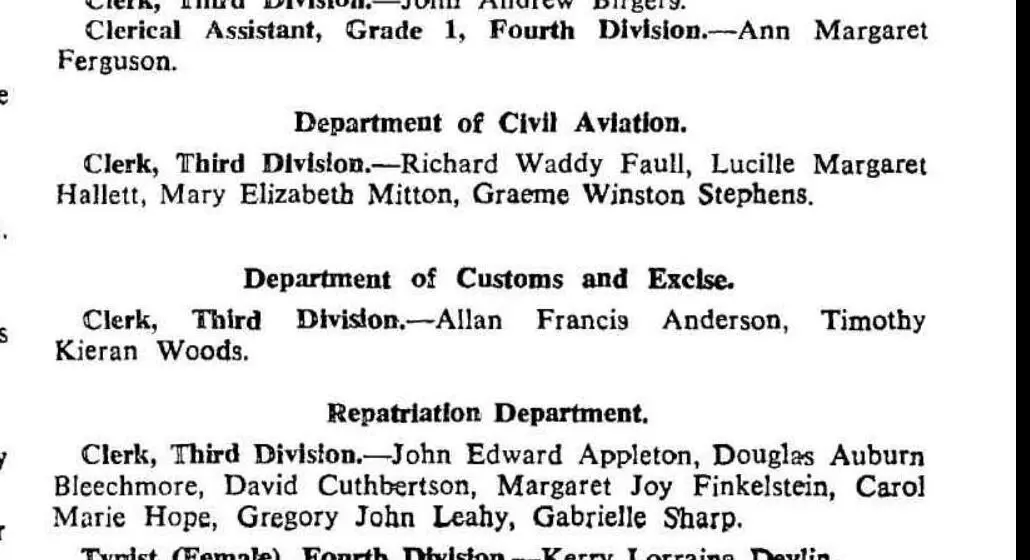
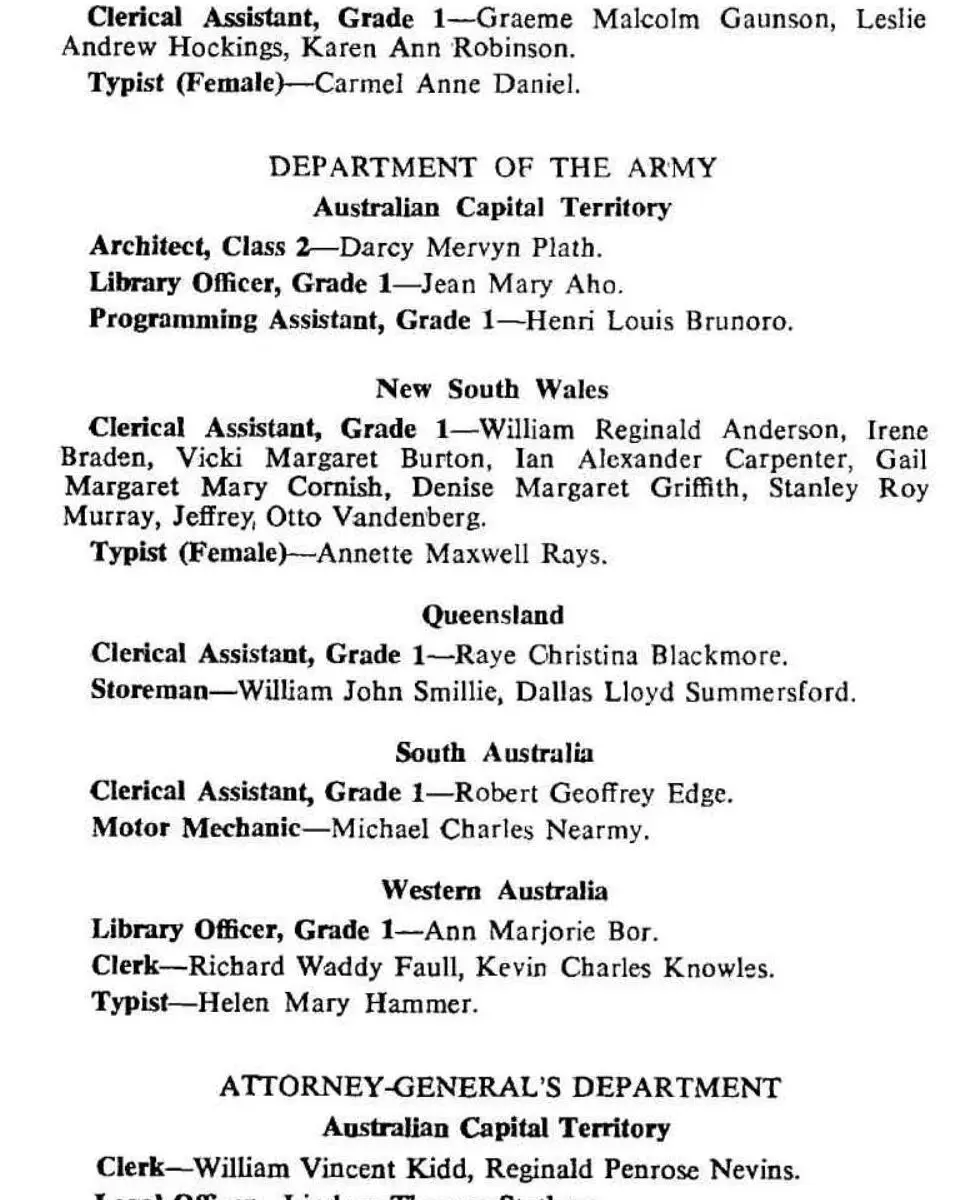
One Christmas he came home from the goldfields with a long beard and a red shirt he had swapped with an Aboriginal man. The rocks and minerals he had collected since childhood now belonged to a much larger landscape. Commonwealth Gazette appointment lists identify Richard as a Western Australian clerk in Civil Aviation in 1966 and in the Department of the Army in 1972. Accounting eventually gave him a place inside the mining industry, but the country itself kept calling.[14]
The Western Australian Government Gazette later recorded prospecting licences in his full name across the Coolgardie and Kunanalling districts. Richard remembered pegging many licences and even owning a share in a gold mine, although he freely admitted that prospecting itself never made him rich. His company work reached much farther. In 1997 he and geologist John Heugh formed the company that became Central Petroleum, gathering an immense spread of exploration country across central Australia. Its acreage included much of the Pedirka and Amadeus basins in the Northern Territory and South Australia, the Lander Trough and part of the Georgina Basin. Together they had assembled exploration rights covering about 70 million acres.
Catherine's adventures have left a lighter paper trail. Family memory places her in outback Western Australia and possibly the Northern Territory, but no reliable newspaper, government or family-archive record has yet supplied the places and dates.
Elizabeth found a different route through science. In 1986 she was licensed under Western Australia's Anatomy Act to work in anatomy at the Western Australian Institute of Technology. By 1999 the ACT nurses register placed Elizabeth Charmian Kelly at Calvary Hospital in Canberra, where she remained listed through 2005. Years later she crossed into another field entirely, studying the animal-shaped incense burners of medieval Khurasan at SOAS in London. In 2025 she presented that work at Oxford.
Part 3
The two family stories meet in Western Australia. Angus Malcolm McKinnon and Christina Vercoe Faull married in Perth in 1971, then built their life around engineering projects, 3 children and moves across the Pilbara, Fiji and Sydney.
Engineering across Australia and the Pacific
In 1966 Malcolm became site electrical engineer at Weipa. Back in Perth he worked on the designs for Dampier and Tom Price, then returned north in 1969 as site electrical project engineer. At Tom Price he met Christina Vercoe Faull (born 1947), secretary to the site engineering manager. They married in Perth on 2 January 1971. Their first child, Angus Richard McKinnon (born 1971), was born at Tom Price that December, in a mining town thousands of kilometres from the Cornish workings Samuel Faull had left behind.
Malcolm became Baulderstone's Western Australian electrical manager and worked on the Paraburdoo project. Kilpatrick Green then sent him to the Tennant Creek smelter and brought him back to Perth as assistant manager. A Balfour Beatty assignment moved Malcolm, Christina and their young children to Suva. Katrina Rachael McKinnon (born 1974) was part of those travelling years. Duncan Malcolm McKinnon (born 1981) arrived shortly before the family moved to Sydney in 1982.
At Kilpatrick Green Malcolm formed KGSE, an engineering group of 40 to 60 engineers and programmers working on industrial controls. Business development carried him to Japan and other markets. After 17 years with the company, he left in 1990 and formed Computer Systems Engineering with Paul Rooleht. He bought Computer Way the following year. Angus later developed Wholesale Direct, an early online wholesale business. A surviving 1994 trade-mark listing also records Malcolm's HSC BBS idea, a computerised information service linking schools, teachers and students.
In 1999 Computer Way joined Tony Tregurtha's Halesworth Partners to form Halescom, a name drawn from the two businesses. Halescom built and operated the technology, payment and fulfilment systems behind online retailers. From its St Leonards office it grew to about 80 staff and won clients including LookSmart, IDG, Gateway, Sold.com and Buy.com.
In October 2000, CBD Online announced that it would buy Halescom. The public agreement valued the initial all-share acquisition at $11.2 million, with further shares available if Halescom met later profit targets. Malcolm remembered the family's part of the sale as $3 million in cash and a substantial parcel of CBD Online shares, with the cash covering most of the personal loans that had financed the expansion. The acquisition was completed on 10 January 2001 and Tony became chief executive of the combined business. Malcolm moved on to consulting work, helped establish CTLE in 2005 and retired in 2009. His working life had crossed mine sites, smelters, computer control rooms and the first years of online commerce.[15]
The family grows again
Deirdre married Clifford George Lees (born 1944) in Bendigo on 19 November 1966. Their children, Kristopher David Lees (born 1968) and Nadine Rachael Lees (born 1971), grew up as the next McKinnon generation in Victoria. Nadine later married Nick Egan in 1999.
In Perth, Christina's brother Richard married Gisela Lemcke (born 1953) in 1980. Their children are Matthew Lemcke Faull (born 1981), Catherine Gisela Faull (born 1982) and Sarah Elizabeth Faull (born 1986). Christina's sister Catherine married Robert Neil Simpson (born 1951) in 1978, and their daughters are Alicia Catherine Simpson (born 1986) and Hannah Jackson Simpson (born 1987). Their youngest sister, Elizabeth, married Allan Thomas Kelly (born 1954). Their sons are Thomas Gordon Faull Kelly (born 1989) and James Richard Waddy Kelly (born 1992).
Katrina married Jules Trudeau (born 1974). Jules was born in Melbourne and grew up in his father’s homeland of Montreal before returning to Australia. Their children, Maxime Malcolm Trudeau (born 2007) and Adele Audrey Christina Trudeau (born 2009), carry names from both sides of the family into another generation.[16]
Finding the story again
The last journey in this story runs backwards. In 1978 and 1979, Malcolm travelled through Tatong, Mansfield, Katandra, Burrandana and Wagga with a tape recorder. Relatives opened doors and cupboards. Out came unlabelled photographs, a pocket watch, table linen, family Bible entries and directions to houses that no longer appeared on maps.
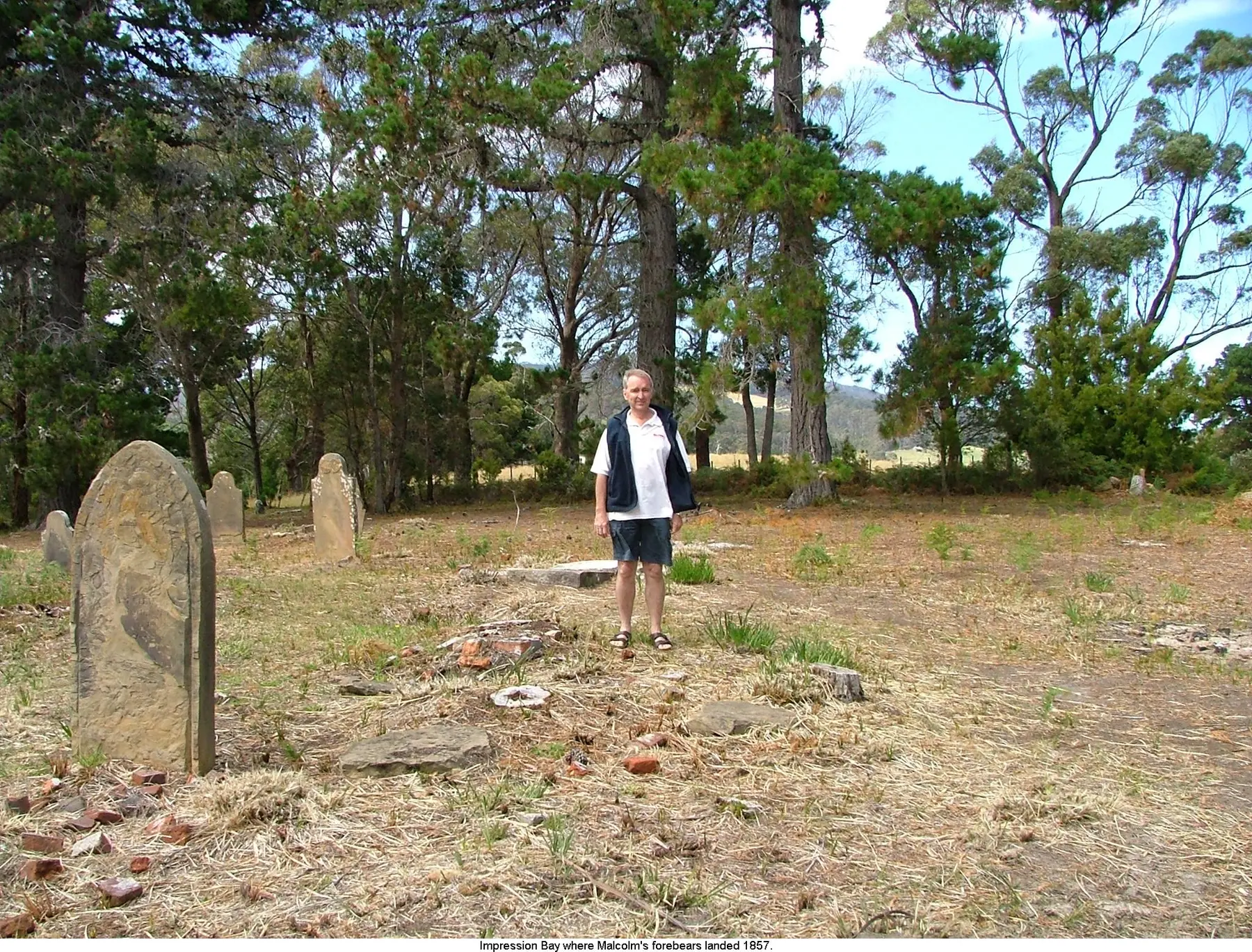
Angus retraced much of that route in 2009, photographing farms, cemeteries and the remains of family homes. Malcolm wrote to researchers and descendants in Australia, Scotland and Tasmania. At Premaydena he helped restore the Persian passengers to the story of the old quarantine cemetery.
The papers, photographs and recordings now preserve two distinct family journeys and the life they formed together. They also leave some questions open, including Malcolm McKinnon's parents on Coll, Elsie Fawcett's father and the Drake family's route from Melbourne to South Australia.[17]
Find a person
No matching person is listed yet.
Recent additions
Significant additions to the people, stories, photographs, records and ways of exploring this family history. The newest changes appear first.
Read the attributed Trove clippings beside the people and events they document, with links to the original newspaper sources.
Added Angus Norman McKinnon's first-hand account from a recorded 1979 return visit, including his first job at Burrandana Hall and his memories of the family holding and house. The property details remain clearly identified as oral testimony while the surviving land evidence is reconciled.
Added Gabrielle Hewison's memories of Eva as an artist, writer, swimmer, traveller and women's advocate. The update also corrects a misplaced family detail: it was Eva and Ernest's children who moved seasonally with the family cow, not Eva during her own childhood.
Added Charmian Waddy's own memories of her three childhood homes, the family routines she shared with her much older siblings, her voluntary-aid and military-hospital work, and the pig's trotters and piano at the beginning of her relationship with Gordon Faull.
Added a sister's memories of Richard growing up near the Swan River, with music, sport, boats, maps, model trains and rock collections preceding the restless travel, prospecting and exploration work already documented in his adult story.
Malcolm's captioned photograph led to a 1949 advertisement naming McKinnon & Jerrick as Lake Albert storekeepers. The partnership is now independently documented, while the newspaper's surname-only identification remains clearly separated from Malcolm's account that his father Angus Norman was the McKinnon partner.
Extended John’s story through his work around Yambuna, Agnes’s death, his remarriage and his time as proprietor of Echuca’s Bridge Hotel, where the inn also served travellers, meetings and the district mail.
Added the varied goods that passed through Richard’s George Street business, from imported cloth and glass to food, property and livestock, before horses became the best-known part of his public life.
Added the 1872 opening celebration for Richard James Fawcett’s provisional school, where pupils, parents and neighbours shared cricket, races, a meal, music and dancing.
Extended Samuel’s story from mining into small land selections and his 1878 appointment as manager of the Clunes United Common, without inferring continuous ownership of either allotment.
Added James Fawcett’s 1853 death while preserving the conflicting reported age, followed Robert Shoemark from Somerset through Camden to the Wagga district, and recorded James Francis Taylor’s early death at Mount Barker with the one-day newspaper discrepancy intact.
Added Donald McKinnon’s 1882 Yabba Yabba land notice, Florence and Richard Fawcett’s exact 1897 marriage, Angus Norman McKinnon’s later role as Florence’s executor, and Samuel Faull’s Northcote trade and final address. A possible John Angus McDonald sighting remains unpublished because the article cannot prove identity.
Added selected close-family stories for printer Alfred Waddy, bank manager and park trustee Egbert Waddy, Sydney candidate and sales manager Colin Waddy, and motorcyclist Cyril Fawcett. A low-confidence Miller connection remains in the research archive rather than being presented as settled family history.
Added the pastoral lives of Thomas and Thornborough Fawcett, David Chilcott’s journey from Tasmania to Yabba, John McMillan’s work carrying mail and keeping Kersbrook’s store, and Alexander Turnbull’s teamster, racing and Riverina years.
Added George Fawcett’s years managing the enormous Burburgate station and William Alexander Turnbull’s farming, postal and wartime story. Keith Tuchin was already fully covered, while two Waddy stories remain archived until their family connections are independently supported.
Added Albert Fearne’s Wagga life, William Kellow’s Cosgrove and Shepparton work, Edmund Fawcett’s Narrabri and Manly years, and John Wesley Waddy’s Adelaide household. John Alexander McLean’s Gloucester biography remains archived because his connection to this McKinnon line is not yet proven.
Added Donald Kenneth McKenzie’s Bondi bakery experience, Ethel Alice Waddy’s academic and musical results, and Lionel Waddy’s 1927 Fullarton Road collision. William Faull was already fully covered; John Lane Waddy’s medical career remains archived until his connection through Theodore Waddy is independently supported.
Added Donald Turnbull’s fatal 1901 riding accident, Calvin Turnbull’s brief Wagga life with his parentage conflict kept open, and Maud Waddy’s marriage and move from Adelaide to London. Brian Waddy was already covered; a separate Donald McKinnon story remains archived because its connection to this family is unresolved.
Added Malcolm McKinnon’s Mangoplah life and family remembrance, James Angus Turnbull’s limited 1916 exemption-court record, and Jennie Shoemark’s Wagga community life and responsibility for her father’s estate. Two collateral biographies remain archived because their family connections or life details are not yet strong enough for the page.
Added Ann Eliza Waddy’s Mallala appointment, Francis Waddy’s Saddleworth school role, Frederick Fawcett’s work administering his father’s estate and James Faull’s Fairfield life. Cecil Fawcett’s contextless prohibition order remains archived rather than being made into a misleading public story.
Added Christopher Faull’s Clunes household and Frank Altrip’s 1932 bicycle accident. Three records that add only a repeated relationship, or risk confusing two different Richard Fawcetts, remain safely in the archive.
Added John MacKinnon’s death during the Persian quarantine, George Faull’s Coburg home and Masonic association, and Hector McGowan’s 1943 Melbourne tram-footboard offence. Two other records remain archived because one branch is unresolved and one concerns a private divorce dispute.
Added the voices and experiences of Nigal Turnbull, Mary Jane and Mary Grace Faull, Maurice Rudwick, young Murdock Campbell and Judge Samuel Danks Waddy. Merton Fawcett’s single appearance at his brother’s funeral remains preserved without being inflated into a separate story.
Rewrote the newspaper-derived passages as original factual summaries while retaining their citations, dates and unresolved questions. The public family story keeps the same narrative and caption evidence without embedding the local newspaper clipping images.
Added the full story of the family memory about Elsie's unidentified father, the search that led from Mote to Walter and Catherine Mott's 6 sons, and why Herbert is a visible but unproved working hypothesis. Charles and the other brothers remain open alternatives, and the current DNA evidence is explained without treating absence as disproof. Read the story.
Added a 1903 newspaper report about Angus and Alexander M'Kinnon and a threshing-machine accident near Benalla. The story retains a clear explanation of why the identification is probable rather than proven, together with a link to the cited newspaper record. Read the story.
Corrected Jules’s birth year to 1974 from his own biography and added his journey from Melbourne to a Montreal childhood and later return to Australia. The earlier 1973 date was unsupported.
Linked the first mention of each identified person to their free public Ancestry profile and linked place names to suitable Wikipedia entries, making it easier to move between the family narrative, detailed records and local context.
Replaced the old approximate map with geographically accurate routes for the McKinnon, Fawcett, Faull, Waddy, McCarthy and Drake families. Documented ports and destinations are distinguished from partly known journeys.
The evidence trail

Historical research on this page uses sources and data from Trove, National Library of Australia. The citations identify the original sources.
Newspaper evidence cited throughout the story is preserved with the family research project. The links here lead to original catalogue records and scans when those services remain available.
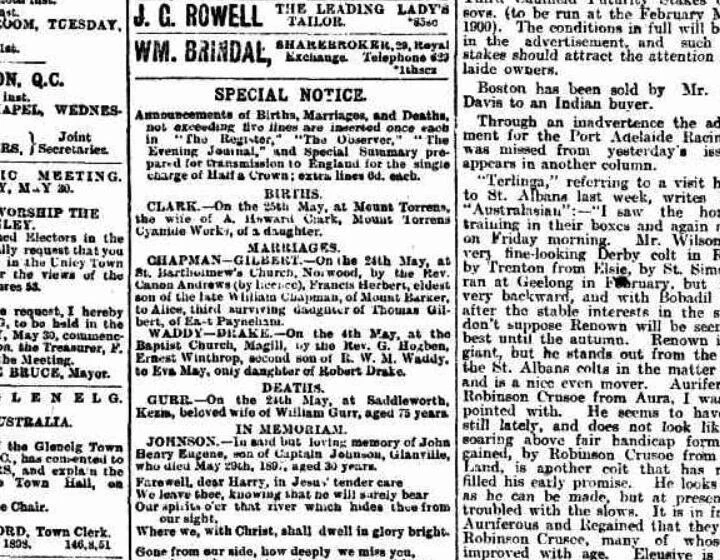
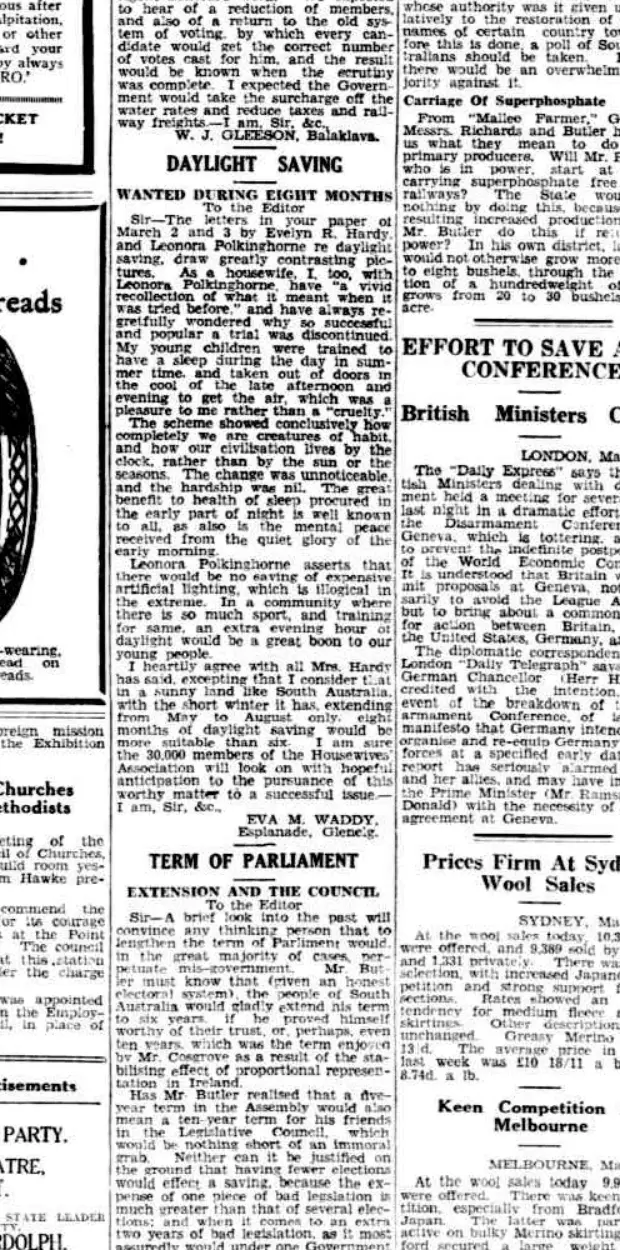

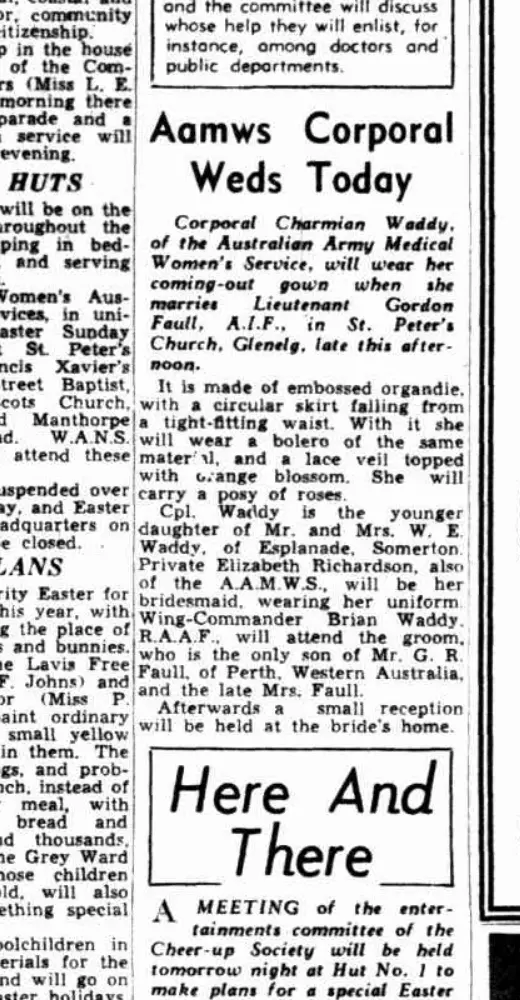


.jpg)


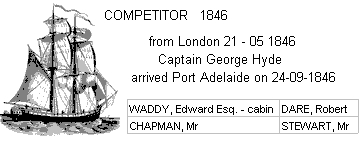
.jpg)