My chronological history
The dates in the headings are approximate and mark the main stages of my life as I remember them. Read this history alongside my photographs: the pictures and the story help explain each other. My 32 photo books are another useful record of my life.
I am writing this history in 2026 at the age of 84. My memory is not as good as it used to be so this is an overview of my life as I remember it.
I have enjoyed my life. The best thing that ever happened to me was marrying Christina. She has been my lifelong best friend and I could not have achieved nearly as much without her.
I am very proud of our three children, Angus, Katrina and Duncan and the lives they have built. We remain close and have our best times together. Katrina married a wonderful man, Jules Trudeau, who played a major role in raising their two children. I love Max and Adele and am very proud of the young people they have become.
My story begins with a country childhood near Wagga Wagga followed by technical education in Bendigo and an engineering career that took me across Australia to Fiji and Japan. Christina and our family shared those moves with me. There was also a trip to the USA and another to the UK and London for work.
Later I built and joined businesses in computers, software and livestock infrastructure before retiring from active employment in 2008.
Before 1942 Family Beginnings
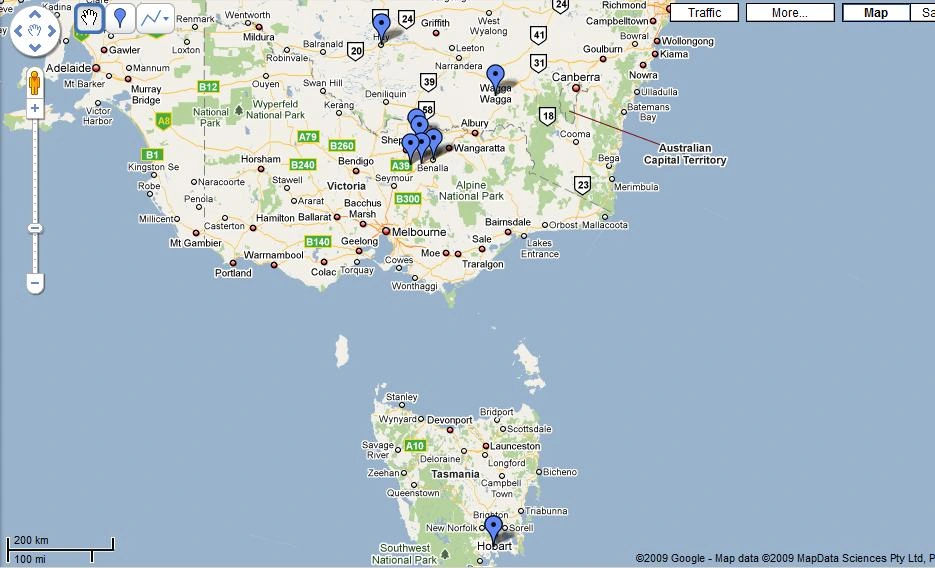
My parents were Angus Norman McKinnon, born in 1912, and Elsie Myrtle Fawcett, born in 1915. Before their marriage on 4 March 1939 they lived at Big Spring and worked on Big Springs and Little Springs, two farming properties in the Ladysmith area. After they married they moved to Ashfords. My sister Deirdre was born on 22 February 1941. The McKinnon family chart in Ancestry.com provides a reference for our wider family history.
1942-1948 - Ashford's
I was born on 17 May 1942 at the Wagga Wagga Hospital. My registered name is Angus Malcolm McKinnon but I am called Malcolm by friends and family.
When I was born my family rented a property called Ashfords where Dad farmed independently of the owners. We had draught horses used for cropping and carrying goods as well as cattle, pigs and some sheep. We milked the cows to obtain cream and make butter.
1948-1953 - McPherson's
Around 1948 we moved to another leased property, McPherson's, near Lake Albert. Dad farmed independently of the property owners.
I enjoyed my time at McPhersons. Dad bought me a beautiful horse which I named Steel after a horse in one of my favourite cowboy comics. I loved riding. At first I shared a bedroom with my sister Deirdre. I clearly remember my delight when I later had a room of my own. I only had one bad fall from Steel. He stopped at a fence just as he was about to jump, and I was thrown into the barbed wire and cut about a bit. Dad had an old T Model Ford which let the rain in. He also brought home a fox terrier puppy for me, and I loved it.
Dad also built a bathroom on one side of the house. It contained a tub in which we stood to wash. Water was boiled in a copper outside and carried in to fill the tub. We took turns: Mum went first, Deirdre second, Dad third and I went last. By the time I got into the tub the water was no longer particularly clean.
The bathroom had a slatted floor so the water could drain through it. In winter the wind blew up through the floor and made the room absolutely freezing.
In the years shortly after World War II there was very little spare money. Dad spent time working on the roads cutting thistles. We lived mainly on rabbits which were plentiful on the property. Mum boiled weeds and other plants to provide greens for our meals. She made all our clothes and went shopping in Wagga once a month. Our toilet was about fifty metres from the house beside the creek and Dad cut up old newspapers to use as toilet paper.
I attended Lake Albert School about 15 to 20 kilometres from home. I rode my bike to a bus stop on the main road and then caught the bus to school. The old dirt road was particularly harsh in winter with ice in the puddles. Magpies often attacked us as we rode.
It was a one-teacher school. In those days the teacher was allowed to cane children on the hand and I remember getting the cane several times. After the first whack my hand went more or less numb. The next couple of hits left me unable to use it properly for quite a while. Despite that the headmaster gave Mum a good report about me when we left for Victoria.
Our family notes record Dad selling a 1928 Chevrolet to my uncle Athol Archer for £60 on 23 July 1951.
1953-1954 - Lake Albert: the rented house and general store
In 1952–53 the lease at McPhersons ran out and the owners did not renew it so we had to leave. We moved into a two-room rental property in Lake Albert. Dad put up a tent in the backyard for me to sleep in.
Dad and his cricket friend Bill Jerrick bought the Lake Albert general store which our two families ran for several years.
1954-1955 - Jerry Wise's farm near Goornong
Around the middle of 1954 we moved to Victoria. Dad worked for Jerry Wise at Campaspe Park and I attended the nearby Goornong State School for about six months. Dad’s working relationship was poor and Mum disliked the living arrangements so it was not a happy time. We lived at the back of the large Campaspe Park house with the Wise family, near the Campaspe River.
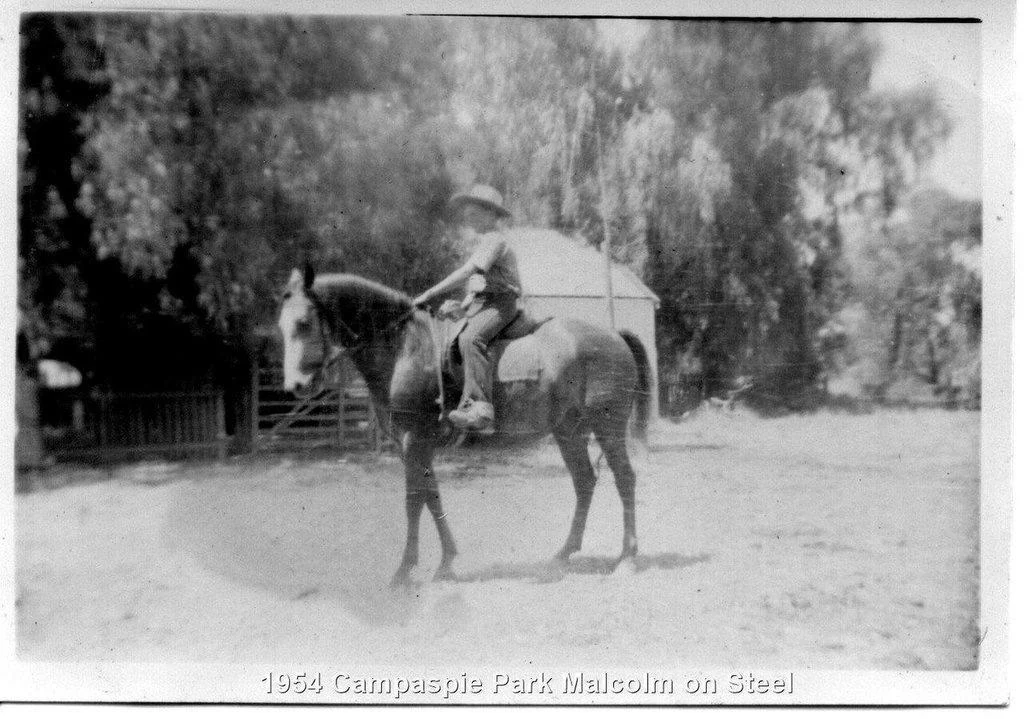
Me on Steel in 1954 at Campaspe Park. [I028]
1955-1963 - Whipplegong, Axedale and Bendigo
Dad took a job managing Neil Cochrane’s property at Axedale. Neil provided a house for our family called Whipplegong and we moved there in 1955.
It was by far the best house we had lived in to that time. Switching on a light started the generator that supplied electricity to the house. We had tank water and a sewage system was built for us. My bedroom was enclosed in the verandah. Its glass louvre windows made it very cold in winter.
I still had my horse Steel. As part of Dad’s arrangement with Neil Cochrane he was allocated a couple of hundred acres on which to run his own sheep. I was 12 when we moved to Whipplegong and Dad liked to keep me working on the farm in all my spare time. My hardest job was getting the wood for Mum’s stove and our lounge room open fire. This was a very stable and happy part of my life.
Schooling, diploma studies and student life
I attended Bendigo Junior Technical College from 1955 to 1958. From Whipplegong I rode my bike about six kilometres to the main road and caught the bus to Bendigo. I found the work quite easy and earned my Junior Certificate finishing about fifth in my year.
Dad wanted me to stay on the farm. The headmaster persuaded Mum to encourage me to continue my education at the Bendigo School of Mines.
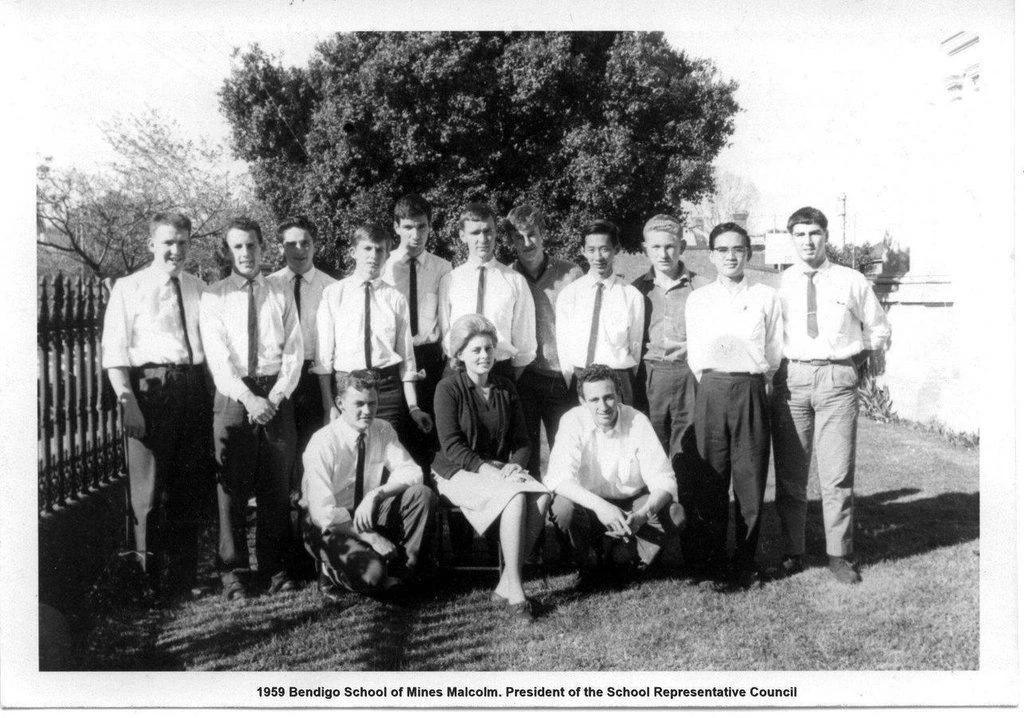
I attended the Bendigo School of Mines from 1959 to 1963 inclusive. I enjoyed my time there but I was not used to studying so it took me an extra year to complete my Diploma in Electrical Engineering. I made quite a few good friends there and had my first really serious girlfriend Pam Symes. The college photographs preserve friendships, sport, speeches and social occasions. Captions identify Norm Brice, Kevin Safe, Barry Peach, David King and Cyril Powell among my friends. Pam was an art student and won Miss Golden North.
In 1962 I was elected President of the Student Representative Council. I represented the students to the headmaster and his staff and represented the school at external functions. My electrical engineering qualification allowed me to join the Institute of Engineers. Membership was needed at the time to obtain work as a qualified electrical engineer.
I played AFL football for the White Hills Football Club.
At the end of my third year at the School of Mines in 1961 I spent two months on student work experience at Mount Isa Mines. The train journey took two days and I was assigned to work at the lead smelter.
I worked to pay most of my School of Mines fees. Later I boarded in Bendigo and paid for my board and lodgings. A reference from Salter & Reid dated 15 November 1963 records about two years of part-time work during school holidays and on Saturday mornings.
1963-1964 - Satchwell Controls, Melbourne
My first electrical engineering job was with Satchwell Controls in Melbourne, a subsidiary of Elliott Automation. The appointment letter dated 6 December 1963 offered me a sales engineer’s position at 2 City Road for £23 a week. My start date was to be agreed on or after 16 December.
A reference dated 10 February 1966 confirms that I worked there from December 1963 to September 1964 designing and estimating electronic air-conditioning controls. I felt I was learning little and the work was not the electrical engineering design I wanted to do. I resigned. Jobs were plentiful at the time.
1965 - Alcoa, Point Henry, Geelong
After extensive examinations I secured an industrial engineer’s position at Alcoa’s new smelter at Point Henry in Geelong. The offer dated 25 January 1965 specified a salary of £1,548 a year and a start date of 2 February 1965. My resignation letter of 14 October records my agreed finishing date as 13 November 1965.
I learnt a great deal about efficiency on the factory floor and processing aluminium from raw ingots to finished products. I did not enjoy working for my boss so I left to find a job I liked better. During my time in Geelong I boarded in Bond Street, Chilwell, Geelong.
1965-1966 - Wrightcel Limited
I applied for and received a job with Wrightcel Limited in Melbourne which confirmed my commencement on 29 November 1965 at £1,650 a year. My signed resignation notice records my final working day there as 17 June 1966. I left to take a position offering advantages in experience, salary and responsibility.
Family and personal events, 1964-1966
My car was stolen in 1964. I joined Prahran Presbyterian Church in 1965 where I became an Elder. Dr McNab was the minister with a passion for helping lonely people in the community. I ran a youth group that tried to integrate disadvantaged youth with others. I played cricket for the church team.
On 29 April 1966 Mum and Dad bought an irrigated dairy farm of about 40 acres in Condon Street, Bendigo. They ran it for many years and it was very hard work.
1966-67 - Weipa
A friend recommended me for a project manager’s position at CES’s bauxite mine in Weipa. CES was the engineering division of Conzinc Rio Tinto, a large engineering company from England. It did not yet have approval to employ more permanent engineers so I worked through Cor Stastra and Associates.
Cor Stastra & Associates’ letter of 14 June 1966 appointed me as an electrical engineer supervising work at Weipa from 27 June 1966. My Employer Dates Chart records this employment from June 1966 to November 1967.
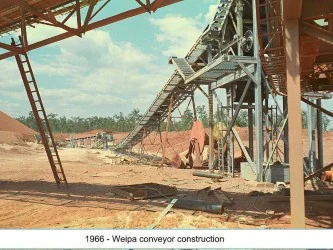
I worked on the Comalco bauxite development in far north Queensland. I oversaw electrical installations for ore processing, power supplies, the new township and the shopping centre. It was a steep learning experience. I worked seven days a week for three weeks followed by three days of rest and recreation. All the construction sites required 10 hour days.
My boss was Frank Simons, a senior CES electrical engineer in Melbourne. He was very experienced and taught me a lot. He visited about every 3 months. The journey from Melbourne to Weipa was long and the last leg was in old DC3 planes. My friend, Norm Brice, was a Civil Engineer and he also worked in Weipa at that time. One of his roles was to build a bigger airport runway.
Our resident manager, Clive Brinsmead, allowed generous leave. I visited Cooktown, Cairns and Townsville. Outside work I enjoyed bush trips and fishing and experienced the daily wet-season downpour.
I particularly remember fishing with Eddy, an elder from the mission, and listening to his accounts of earlier life. I gained a high respect for the early aboriginal people. They had life living with nature really well worked out. They lived here many thousands of years without destroying this beautiful country, but that was before white people arrived. He could spear fish in the muddy river water from a considerable distance away. It was often difficult to borrow a boat and find someone to row it. I felt that the younger Aboriginal people were not interested in learning the old ways. Eddy spoke reasonable English and told me about their well-organised life, moving from camp to camp according to the availability of food. The mission environment was difficult for them. I strongly recommend looking at my photographs from this period. Weipa was the best part of my life.
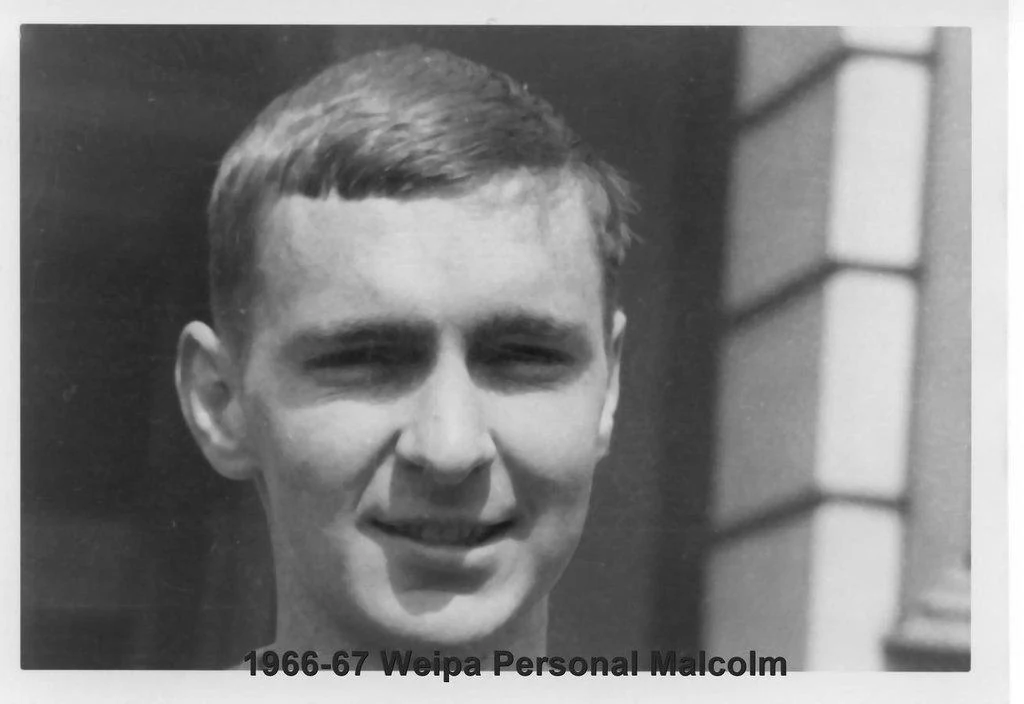
Me during my time at Weipa. The photograph is labelled 1966-67. [I074]
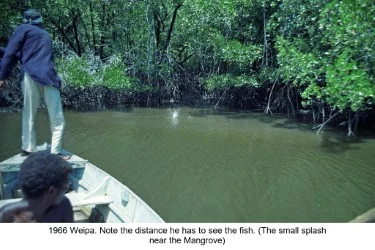
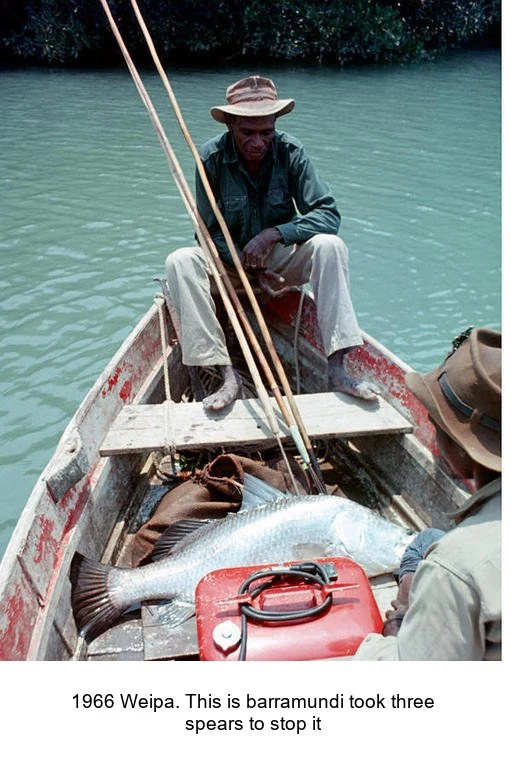
1967-1970 - CES, Melbourne and the Pilbara
My experience at Weipa led CES to offer me a permanent position overseeing the Dampier and Tom Price mine expansions. CRA’s offer dated 1 December 1967 appointed me to Central Engineering Services (CES). I was initially based at Dampier with a salary of $5,300 plus a one-third allowance while in the Hamersley area.
The offer arranged a flight to Perth on Monday 4 December and onward to Dampier on 5 December. My Employer Dates Chart records CRA/CES employment from November 1967 to 28 May 1970.
At Dampier and Tom Price I supervised electrical installations including power distribution, controls, telecommunications and township services. I flew between the two sites each week because the road journey was slow and rough. I had two supervisors and 6 or 7 draftsmen.
During my Dampier years I bought a workboat to check the cathodic protection beneath the wharf. I also went with John Dunkley and Bill Sullivan to look at the proposed site of Karratha, standing where we believed the town centre would be.
Our main contractor was Kilpatrick Green which had recently been purchased by Balfour Beatty, one of the world’s largest contractors. Ian Carroll came from Balfour Kilpatrick in Scotland to manage the Australian operations. We became good friends and that friendship mattered later in my career.
In 1969 Christina applied for a job at Dampier as secretary to the chief engineer. I was asked to take her back to camp for lunch and drive her home after work. That was the beginning of our long and happy relationship.
1970 - CES, Melbourne: the Paraburdoo design
After Dampier I returned to CES in Melbourne to work on the Paraburdoo design. Christina and I lived in Mathoura Road, Toorak; she worked for Bechtel WKE.
1970-1972 - Baulderstone Electrical, Perth and Paraburdoo
Baulderstone Electrical won the contract for the new ore processing plant at Paraburdoo. My experience with CES and the project led to an attractive offer to manage its Western Australian operations. From 1970 to 1972 I managed that division and established an office in Perth.
Christina and I married on 2 January 1971 at Claremont Presbyterian Church. The reception was at her parents’ home. We initially rented in Princess Road, Nedlands.
The Paraburdoo electrical installation then took us to the new mining town. We stayed 6 weeks with Mike and Marie Dillon while our house was being completed.
Angus was born on 15 December 1971 at Tom Price Hospital. I drove Christina there in the middle of the night along a very rough dirt road. The journey took about 2 hours and we arrived in time. The hospital was quite primitive. Christina very bravely gave birth to a beautiful baby boy without any doctors in attendance.
I managed that project with about 70 tradesmen until completion.
When the project was completed in 1972 I was offered the Australian manager's position in Adelaide. Christina did not want to move there and I decided to resign.
1972 - Travelling through northern Australia
Our trip around Australia began in 1972 immediately after I left the Baulderstone site. We set off from Paraburdoo in a station wagon that Baulderstone had kindly given us along with a trailer and camping equipment.
We planned to explore the Top End and travel through Broome, Darwin, Alice Springs, Adelaide on to Bendigo. Christina and Angus became very ill in Darwin with flu-like symptoms so we had to get to Bendigo as quickly as possible.
1972-1973 - Kilpatrick Green, Tennant Creek
In 1972 I joined Kilpatrick Green to manage the electrical installation for the Peko-Wallsend copper smelter at Tennant Creek. We were provided with a furnished three-bedroom transportable home and a Hillman Hunter Safari car. The worksite was about 80 kilometres from town along a rough dirt road. I remember temperatures around 37 degrees and prolific bush flies. It was hard on Christina, but she made the best of it.
I had about 70 staff. The project was successful and profitable for Kilpatrick Green. I stayed for about twelve months before returning to Perth in 1973. It was the beginning of my long association with the company.
1973-1974 - Kilpatrick Green, Perth
When the project was completed in 1973 I returned to Perth as area manager responsible for projects at Pinjarra, Kwinana, Windara and Perth together with local service work. I remained in Perth until my Fiji appointment in 1974.
On 17 December 1973 Christina and I bought our first house at 24 Milson Street, South Perth. We later bought two more investment rental properties in South Perth.
Christina had been born in Perth and her parents still lived there. We enjoyed spending time with her family and friends. Katrina was born in Perth on 22 March 1974 shortly after my first visit to Fiji for my next appointment.
1974-1976 - Balfour Kilpatrick Pacific, Fiji
I was appointed manager of Balfour Kilpatrick Pacific’s Fiji operation. It undertook civil, mechanical and electrical work and ran contracting, wholesaling and workshop activities. The company provided a car and a very nice home in Lami near Suva.
One condition of working in Fiji was employing a house girl. Our first was Ane. She was a real character and became a lifelong friend.
There were no other expatriate women in our social circle which made life difficult for Christina. She made friends with people from the two nearby villages. The only children Angus and Katrina’s age were local Fijian children. They joined in as much as possible including birthdays and other occasions.
My assignment was to rebuild the business under difficult staffing conditions. Our projects included the Denarau Island resort near Nadi, Dominion House in Suva, and housing and a shopping centre at Deuba. We also ran the Island Electric wholesale business. Our head office, workshop and wholesale store was in Walu Bay, Suva. We also had homes in the Nadi Qantas village and at Pacific Harbour where we lived when the large projects demanded my presence. Transport around the island was primitive. We had to employ a balance of both Fijian and Indian tradesmen. Only a limited number of supervisors were permitted and their role was solely to provide training. I found the local tradesmen’s skill levels very low and struggled to get complicated work done.
I did not enjoy this period. Life was isolating and I felt I was learning little. The labour restrictions made every project difficult. When my three-year term ended I insisted on moving to work closer to the construction management I enjoyed.
My formal employment in Fiji ended in January 1977.
1977 - Kilpatrick Green, Tom Price
On returning from Fiji I became Kilpatrick Green's area manager at Tom Price covering Hamersley Iron work at Tom Price, Dampier and Paraburdoo. I commenced on 17 January 1977 and finished on 12 September 1977. We were provided with a furnished house and a vehicle. Angus commenced school in Tom Price.
1977-1981 - Kilpatrick Green, Perth: project and contract services
On completion of that work I returned from Tom Price to be the Manager, Contract Services, in the Kilpatrick Green Perth office.
My August 2000 and September 2004 résumés describe me as Assistant General Manager, Western Australia, from October 1977 to December 1981. I was responsible for engineering design, estimating, manufacturing, purchasing and personnel. This describes the broader responsibilities of my Perth management period.
Our albums and family records recall trips through the southwest, gorges, Kings Park and the Karri forest as well as family gatherings and visits to relatives. In 1979 we drove across the Nullarbor to see Mum and Dad in Bendigo. We went back to Fiji for a holiday where we visited our former house girl Marica on Moturiki. We flew in a small plane to Levuka on Ovalau and continued by bus and boat. Ane had been our first house girl and left when she was able to live in Australia. Marica joined us towards the end of our time in Fiji.
Dad and Mum visited us in Perth in 1980. Duncan was born on 11 August 1981.
1982-1989 - Kilpatrick Green Systems Engineering, Sydney and North Ryde
On 4 January 1982 I became Kilpatrick Green’s Engineering Manager in Sydney. My task was to establish an engineering design division at the head office. We began with about six design engineers and ten draughtsmen on the fifth floor of 1 York Street. My office overlooked the Harbour Bridge, and with a basement car park I could be on the bridge within minutes.
We were building on an earlier engineering tradition. The brochure records that Kilpatrick Green’s Engineering Division had been established in Melbourne in 1966 and later brought together in Sydney. Kilpatrick Green itself dated from 1954 and had formerly been called H.H. Green & Co. Its parent was Balfour Kilpatrick Limited in the United Kingdom, part of the worldwide BICC group. The undated brochure describes the wider Kilpatrick Green group as employing about 2,000 people, with annual turnover of A$100 million and operations across Australia, New Zealand, the Western Pacific and South East Asia. Those figures relate to the whole group, rather than our engineering division.
The company rented us a house at 31 Adelaide Avenue, East Lindfield while Christina looked for a home to buy. After nearly two years she found what she considered the perfect place at 34 Hobart Avenue, East Lindfield. We bought it in August 1983 for $78,000 and have lived there ever since. We sold our three Perth properties to fund the deposit. The company also paid all our removal costs.
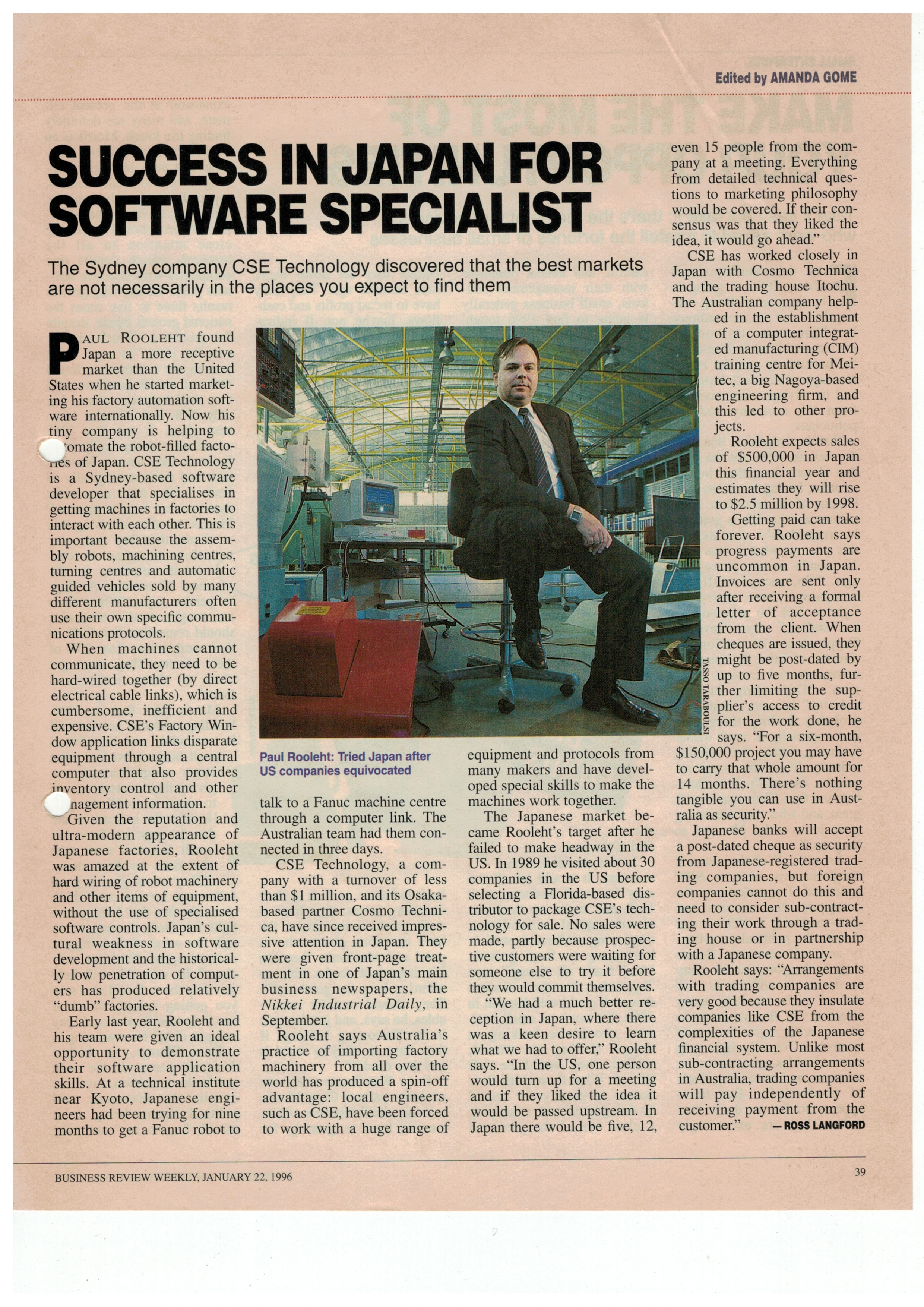
By 1983 we had outgrown the York Street office. I found a suitable building at 5 Byfield Street, North Ryde and changed the business name to Kilpatrick Green Systems Engineering (KGSE). We now had more than thirty engineers and draughtsmen. Paul Rooleht, one of our graduate engineers in 1983, became our Engineering Manager. Paul and I worked well together, and that relationship continued into our later businesses.
Our team combined electrical engineering, instrumentation, software, design and project administration. The staff list included Gerhardt Limnios as project manager; John O’Brien as technical coordinator; John Wulff as senior control systems engineer; Hugh Pate as engineering marketing manager; Hugh Crawford as senior engineer; David Gross as engineering consultant; Alan Barrett as project engineer; Steven Goddard as instrumentation technical officer; John Shahanah as instrumentation engineer; and Peter Bantick as contracts administrator.
Our electrical engineers included Phil Cooney, Malcolm Newman, Paul Rooleht, Simon Campbell, James Waite, Steven Wiles, Andre Bondaruk, Greg Berrett, Rod Butler, Alistair Wells and Greg McKinnon. James Cameron was software analyst and Owen Watkinson was programmer. Janet Moore was my secretary, Joyce Young the word processor operator, Isabella Tedesco our telephonist and receptionist, and Therese Reed assistant secretary.
We took on five graduates from UTS each year in the hope of finding a good long-term engineer. One was Matina Nelson, who became a valuable member of the team and was very popular with clients. At the time I knew of no other female electrical engineers.
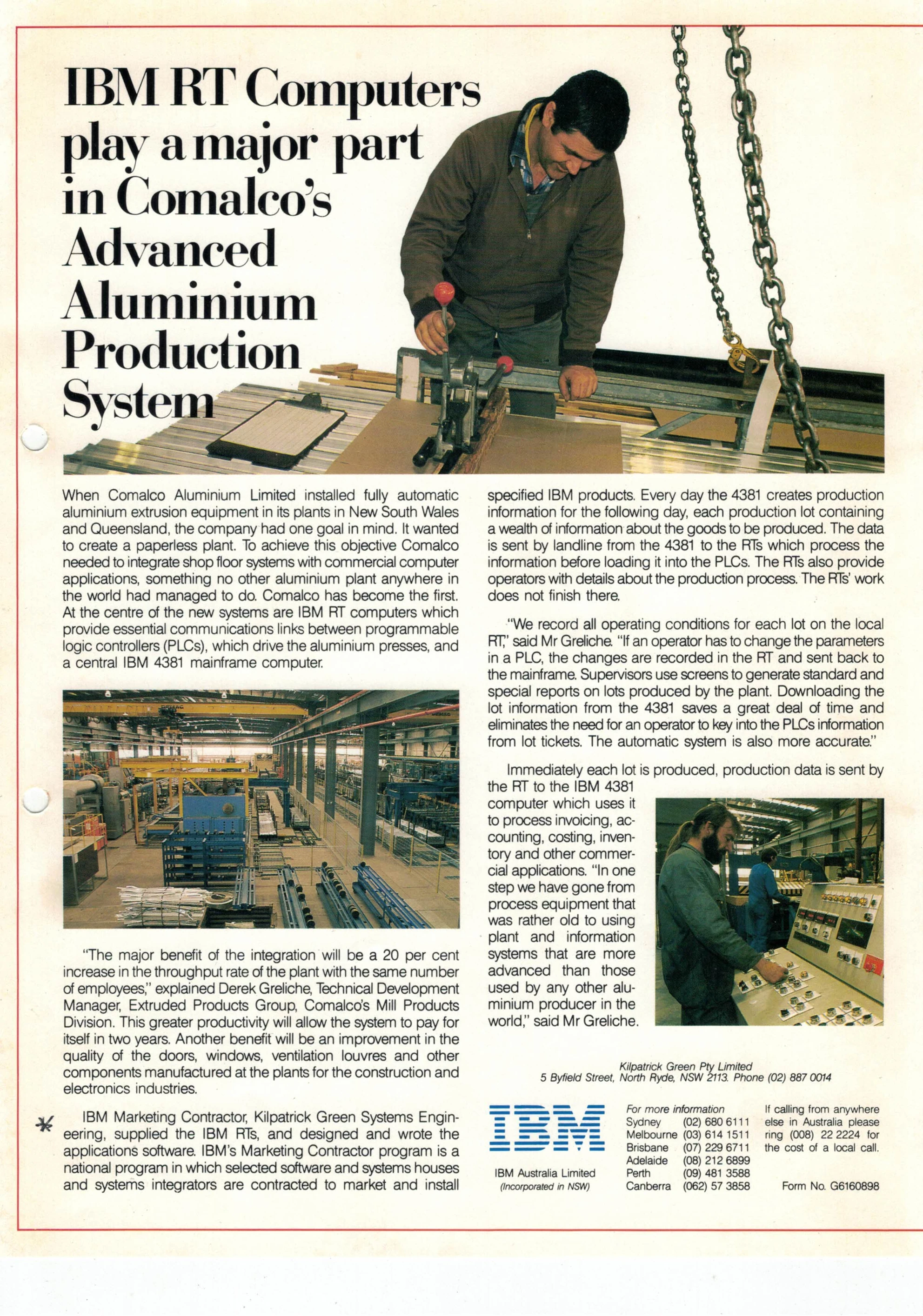
Our work covered the full life of a project: proposals and budgets, design, fabrication and supply, construction, commissioning and maintenance. We could deliver a complete working installation or provide engineering support for the company’s construction activities. We tailored designs to the client’s needs and used practical site experience to keep them economical. Our clients included Comalco, water authorities, Lever and Kitchen, Woodlawn Mines, BHP Stockton, Tomago, Alcan, Bougainville Copper, Carlton United Brewery and others.
Power engineering ranged from power and control cabling in major generating stations to complete diesel power stations. We designed and constructed transmission systems up to 66 kV, medium- and high-voltage distribution and substations, as well as motor drives, lighting and small-power installations for industry. The brochure explains that higher-voltage transmission work was provided by the associated Balfour Beatty Construction company, while subsidiary T.A. Mellen supplied submarine and supertension cabling services.
Instrumentation and control became a major part of our work. We covered everything from individual control loops to complex refinery systems, using electronic and pneumatic instruments, digital and analogue equipment, and calibration services. We designed and implemented both software and hardware for plant control, using computers, programmable controllers, microprocessors, relays, telemetry, distributed networks and colour graphic displays.
The aim was to give operators a clear picture of their plant and better control over it. Our monitoring systems displayed equipment status, collected operating data, generated plant-condition reports, processed alarms and stored historical information. Connecting equipment from different manufacturers was an important part of making these systems work together.
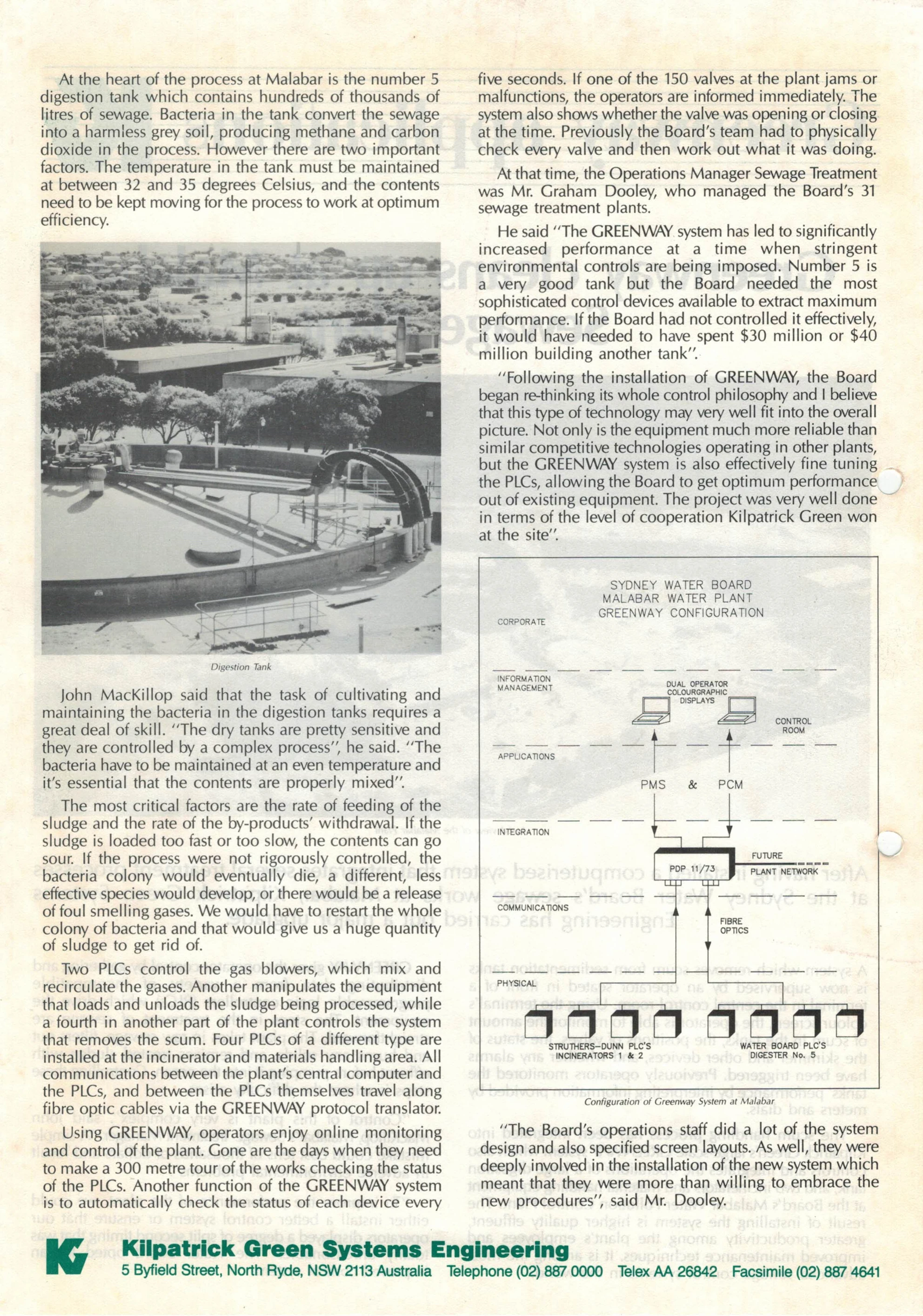
One of our major developments was a protocol translator that allowed industrial control equipment from different manufacturers to exchange information. A press clipping says we began work on SI 500 in 1983 and, after almost three years, had a first installation operating for the Sydney water authority, with a Comalco system under development. I place that account around 1986, although the clipping itself is undated. SI 500 developed into our computer-integrated manufacturing system, linking factory equipment, control systems and management information.
Our communications work included designing, supplying and installing local area networks, with broadband and baseband data transmission using Ethernet, Omninet, Oslan and Microlan. The brochure records Kilpatrick Green as the official Rank Xerox Ethernet installation contractor. These networks complemented our work connecting instruments, controllers and computers.
We also provided energy surveys and building management systems. These covered alarm and status monitoring, maximum-demand control, environmental control, boiler and chiller sequencing, fire and security. For planned maintenance, the brochure describes the WIMS software package, which could run on a range of microcomputers and support maintenance planning and control, asset management, stock control, purchasing and energy auditing.
Testing and commissioning supported all this work. Our facilities covered instrumentation, high-voltage testing, protection settings, programmable-controller programs and plant commissioning. T.A. Mellen was also an agent for BICC test equipment.
T Appleton visited our Australian operations from London. He was executive director of Balfour Kilpatrick, a major electrical engineering and installation contractor, and Balfour Beatty, one of the world’s largest construction companies at the time. He praised our instrumentation and computer work and asked me to pass his appreciation on to the staff.
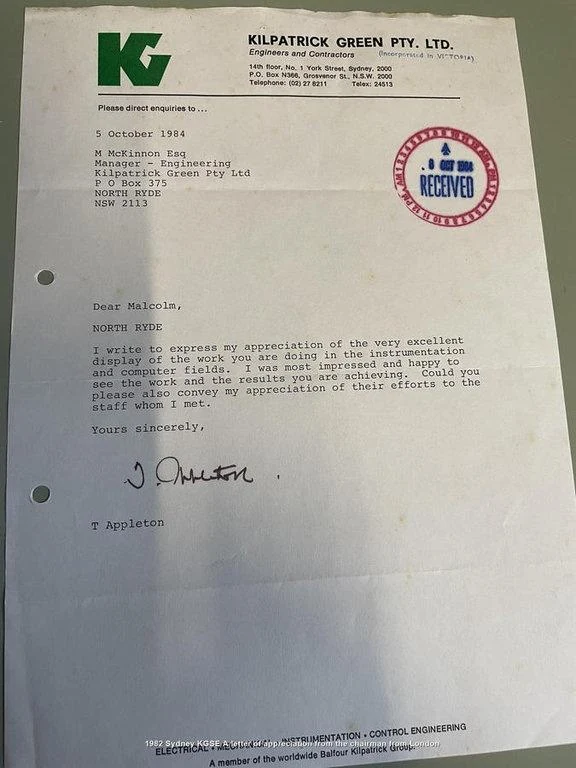
T Appleton’s letter of appreciation to me, 5 October 1984.
Family events continued alongside my work. Dad died on 6 April 1984. Our family notes record a visit to Burrandana that year and trips including Western Plains Zoo and a Scout camp in 1985.
I have kept press coverage of our Sydney work. Computerworld profiled our system on 24 April 1987 and quoted me on the problem of connecting equipment from different suppliers. Professional Computing reported IBM’s endorsement and our joint marketing seminars in June 1987. Australian Technology Review discussed the practical gains from better production information in August–September 1987. A clipping marked The Australian, 1 September 1987, reported an arrangement linking NCR’s Command 2000 package with our KGSE SI 500 architecture.
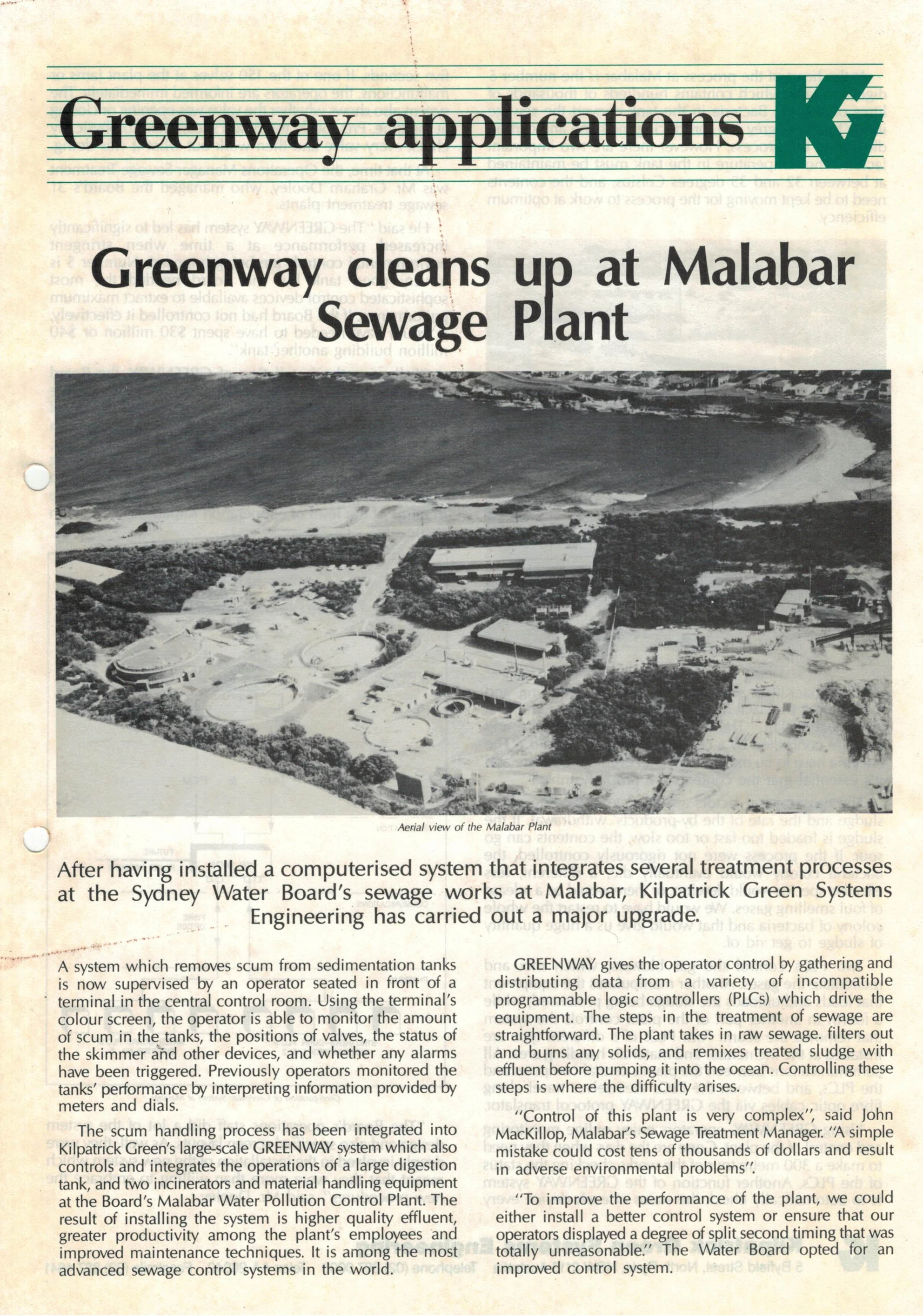
The Malabar project documents describe our GREENWAY system integrating equipment from different manufacturers and bringing scum handling, digestion and incineration under central computer supervision at Sydney’s sewage treatment plant. Operators could monitor equipment, alarms and operating conditions from the control room. At Comalco, IBM RT computers and our applications software linked programmable controllers on the factory floor to an IBM 4381 mainframe and commercial applications. These projects show how the engineering, software and communications skills of our team came together in working systems.
In November 1987 Process Engineering showed me presenting the Kilpatrick Green industrial control prize to BHP engineer Bryan Scott. Bryan was the award recipient and I was the presenter.
On 18 November 1987 The Australian reported a joint appointment between KGSE and the NSW Institute of Technology (UTS) for Dr Rod Belcher, linking academic research with industrial automation. I also served as an industry representative on course and staff advisory panels at UTS.
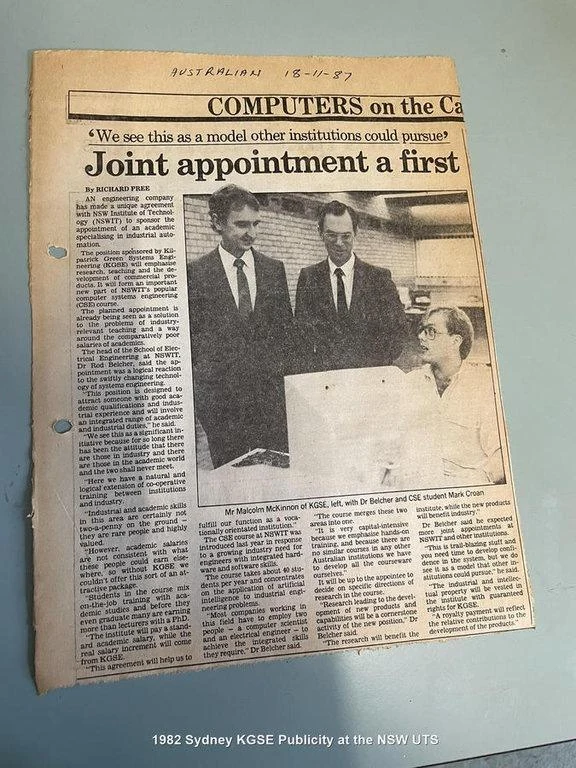
The Australian, 18 November 1987, reporting our joint industrial automation appointment. I am at the left. [I048]
See Appendix F — Project C KGSE Projects for the Malabar and Comalco project documents, and Appendix G — KGSE Brochure for the complete engineering brochure.
1989-1990 - Balfour Beatty, Japan business development
In September 1989 I became Balfour Beatty’s business development manager. My aim was to find a Japanese market for our engineering systems. A neighbour, Harry Myashita, associated with C-Itoh, helped introduce potential customers.
I made three trips. Paul Rooleht, by then our Engineering Manager, accompanied me on some visits. On one trip Bill Sampson, Chief Executive of Kilpatrick Green, also came. Hori helped us as a local guide and interpreter.
We made one substantial sale to Meitec, a large Japanese engineering company with about 2,000 engineers. It hired engineers to manufacturers such as Toyota. We sold and installed an automated manufacturing system to train its engineers in factory automation.
I developed heart problems around my final visit to Japan. My health and workload influenced my decision to leave in 1990 after about eighteen years with the organisation.
1990-1991 - Computer Systems Engineering
In June 1990 I invited Paul Rooleht and three of our best engineers to join me in a new company that I registered as Computer Systems Engineering (CSE). Our early CSE work included systems integration for the Advanced Manufacturing Technology Centre at Lidcombe College of TAFE and a manufacturing demonstration and training facility in Nagoya, Japan. I later gave the business to Paul and he ran it successfully for many years.
See Appendix E for the 1996 Business Review Weekly article about CSE Technology’s success in Japan, featuring Paul Rooleht.
1991-1999 - Computer Way, Chatswood
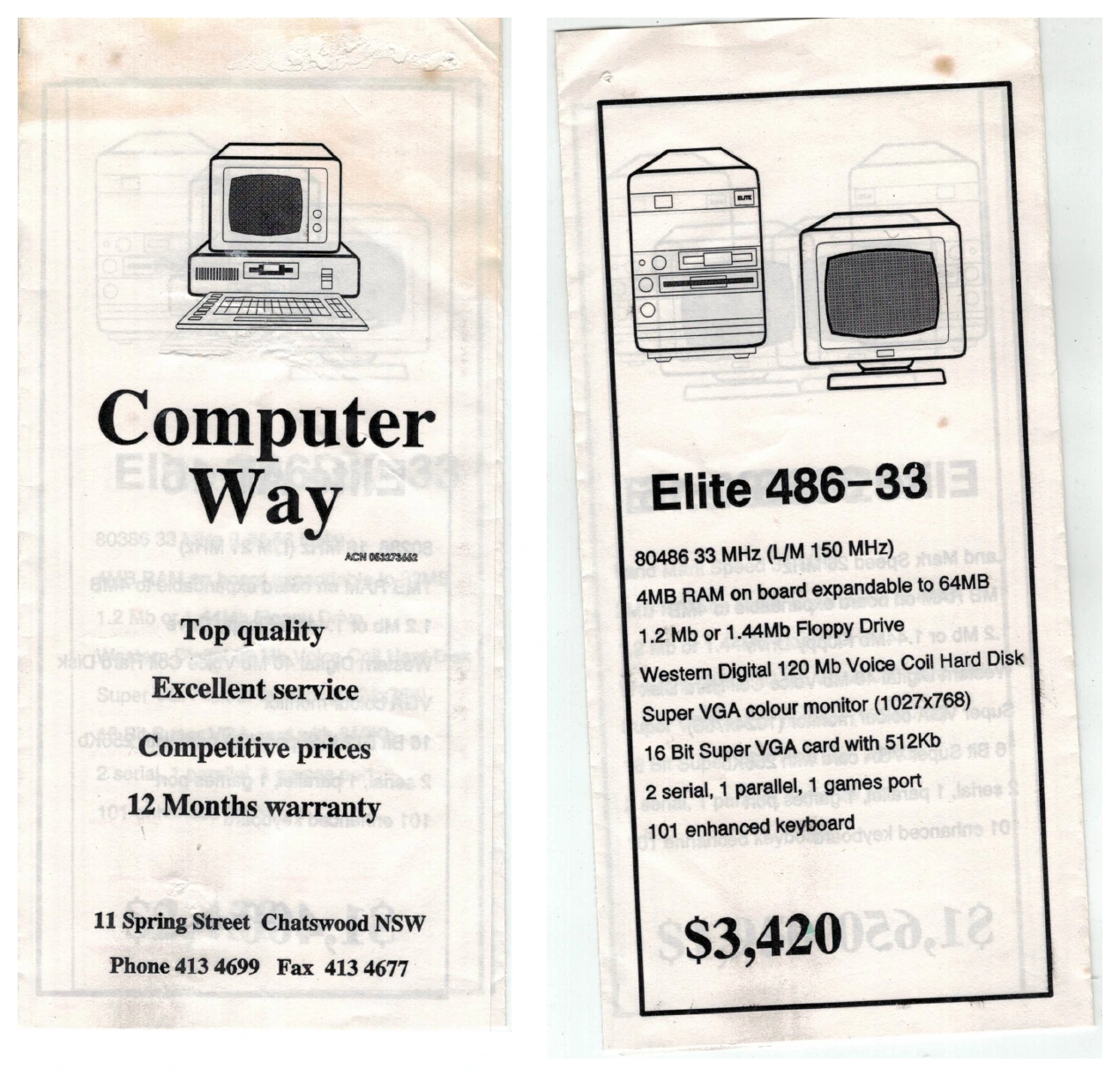
I had always wanted to own a small family business. My children were reaching an age when they could enjoy working in a small retail outlet. In November 1991 we had the opportunity to buy Computer Way, a small computer reseller in Spring Street, Chatswood. My photo album records that Computer Way was broken into and items were stolen in 1991. In 1996 our main supplier, Dicker Data, rearranged the shop and its presentation as part of a venture called Rodin. They spent a lot of money on it, but I felt it did not help the business much.
Members of our family worked there at different times. We built a good customer base that kept the business ticking along for about nine years.
At Computer Way Angus developed Wholesale Direct, an early online sales system. I regarded it as anticipating the much larger online retail businesses that followed. In 1996 Angus graduated from Charles Sturt University in Bathurst with two degrees: a Bachelor of Information Technology and a Bachelor of Business (Marketing). He won a Charles Sturt University Scholarship and a Bull Information Systems (Wang) scholarship, and was a residential tutor.
An undated Brad Howarth newspaper article titled “Wholesale site booming” describes Wholesale Direct at the time. It reported more than 25,000 listed products and more than 3,000 registered users without promotion or advertising. Discounts were up to 15 per cent and advertised delivery across Australia was within three days. Prices came electronically from wholesalers. Orders went directly to the appropriate wholesaler for dispatch. We intended to earn revenue from services such as assembly and installation rather than a margin on the goods.
Mum sold her Condon Street, Bendigo home and moved to Lowndes Street on 5 June 1995.
My best friend from school days, Norm Brice, had a business in Townsville and lived on Magnetic Island. We visited them a number of times.
See Appendix D for the Computer Way brochure cover and Elite 486-33 advertisement.
1999-2001 - Halescom and Wholesale Direct
One of our customers at Computer Way was Tony Tregurtha of the Halesworth Partnership. In 1998, Computer Way and the Halesworth Partnership established THP Computer Services to help small and medium businesses identify and address the Y2K problem. The operation supported more than 6,000 businesses. Tony asked us to develop software to deal with the concern that computers would fail when the year changed to 2000. He sold it to AMP for about $3 million.
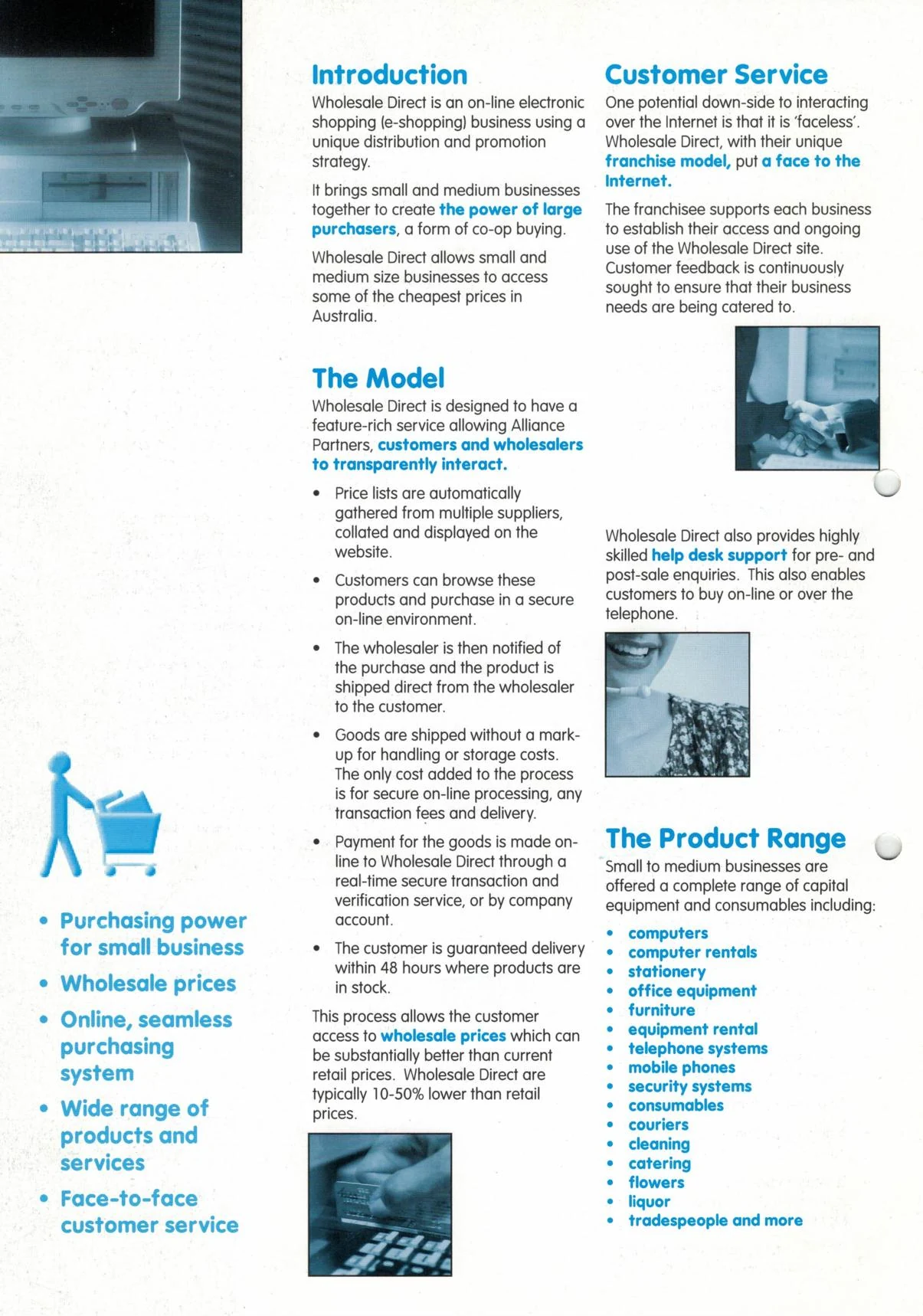
We also began developing Wholesale Direct in 1998. The idea was to combine the purchasing power of small and medium businesses so that they could buy a broad range of products and services at wholesale prices. We gathered suppliers’ price lists into an online catalogue, where customers could compare products, place orders and pay securely. Orders went to the wholesalers, who delivered directly to the customer. This avoided the cost of holding and handling stock ourselves.
Tony saw the potential of Wholesale Direct. In June 1999 he persuaded me to amalgamate with his business. We combined our names to form Halescom Pty Ltd to develop and expand the model.
Wholesale Direct offered much more than computers. The range included stationery, office equipment and furniture, telecommunications, consumables, equipment rental and services such as couriers, cleaning and catering. By September 1999, the online catalogue contained about 20,000 products. Customers could order online or by telephone, with a help desk providing support before and after a sale. A national network of franchisees helped businesses get started and use the service, and provided feedback from customers.
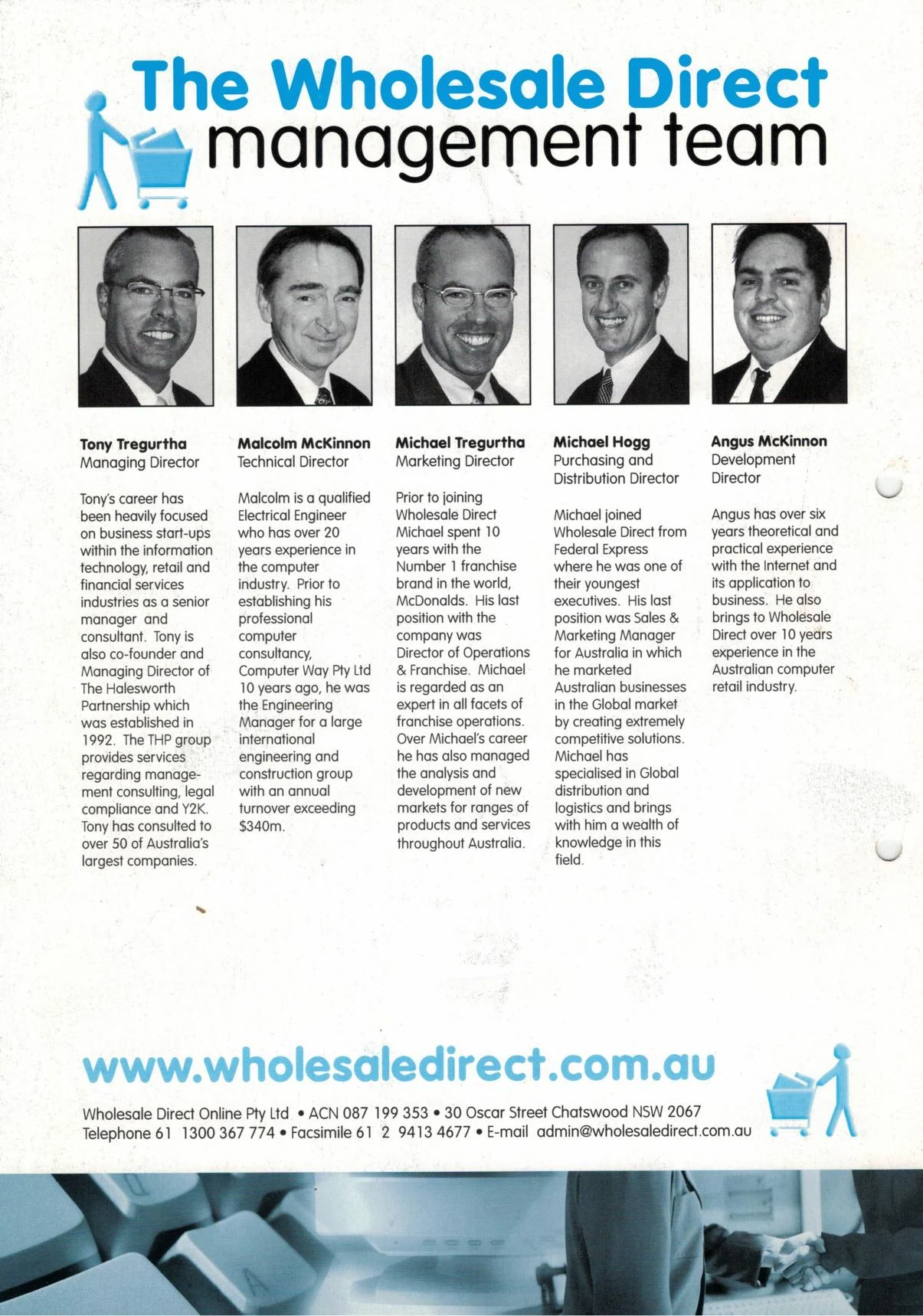
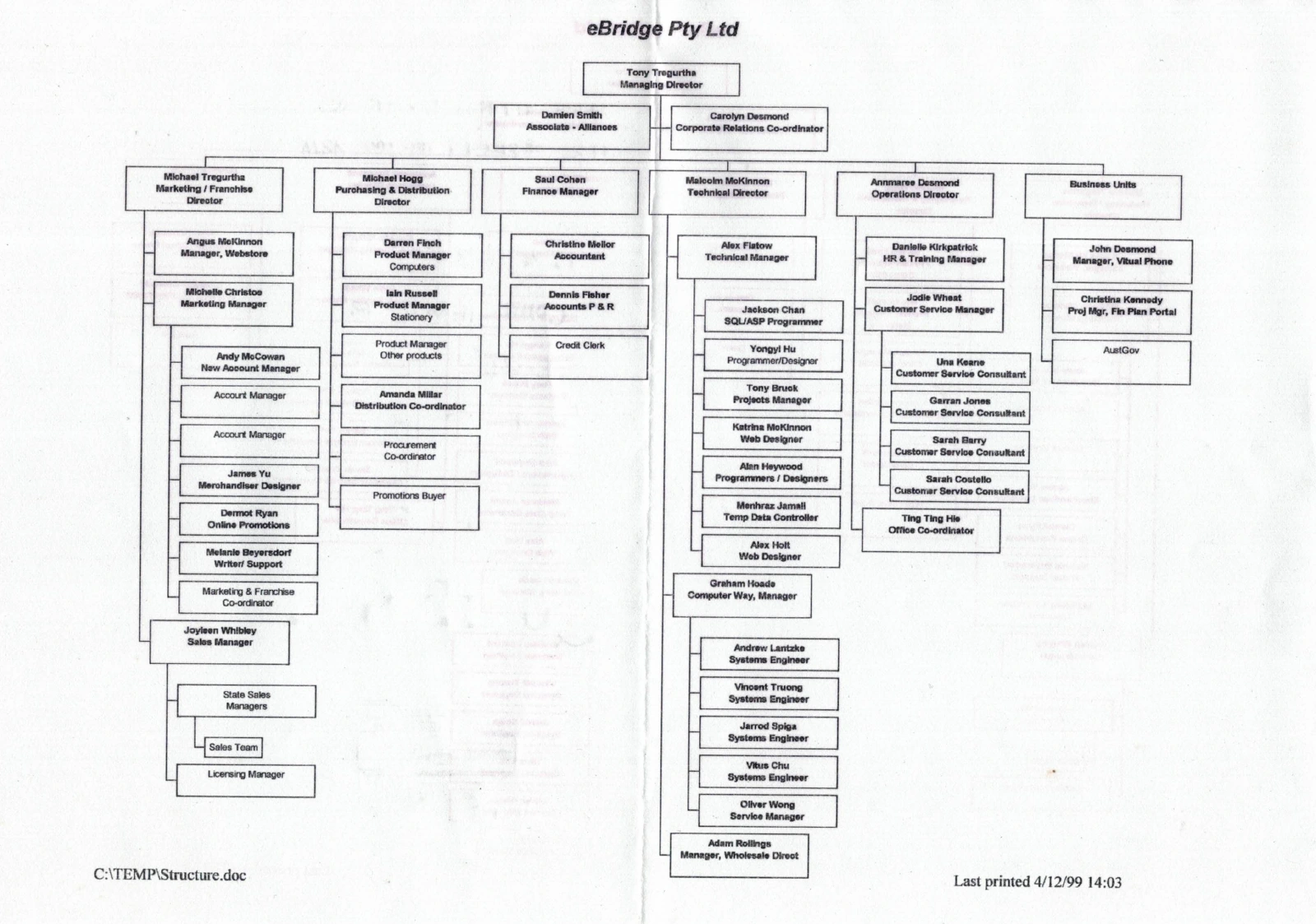
Our management team brought together technical, marketing, purchasing and distribution experience. Tony Tregurtha was Managing Director and I was Technical Director. Michael Tregurtha was Marketing Director, Michael Hogg was Purchasing and Distribution Director, and Angus McKinnon was Development Director.
Angus and Katrina worked in the business. We opened a large office in St Leonards. I regarded Wholesale Direct as an early application of internet shopping, which has since become a massive industry.
I was Technical Director and Senior Partner from June 1999 to January 2001. We worked closely with IBM, which supplied the mainframe computer. We used SQL 7 and an ASP platform, later upgraded to IBM WebSphere. Our technical department peaked at 27 staff during development.
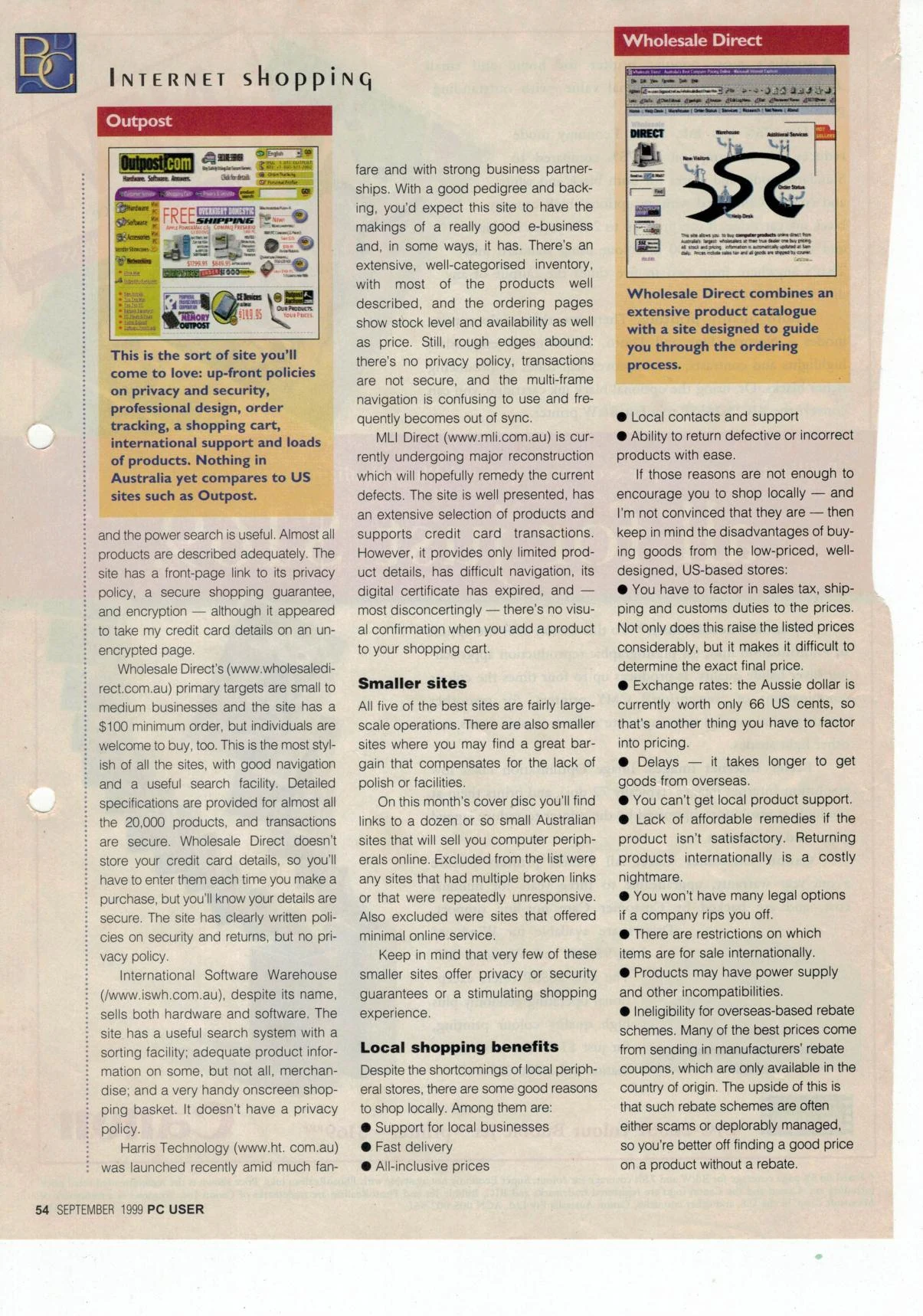
PC User reviewed Wholesale Direct in its September 1999 Internet Shopping feature. It praised the site’s appearance, navigation, useful search facilities, secure transactions and clear security and returns policies. The service was aimed at small and medium businesses, although individuals could also buy, with a minimum order of $100. The review also noted that the site did not then have a privacy policy.
Our total staff quickly grew to about 80. Tony wanted to list the company and approached Macquarie Bank. A valuation of about $70 million was discussed at the time.
The timing was unfortunate. The dot-com market collapsed overnight and changed our prospects. We sold the business at a loss to the Melbourne company CBD for a considerably lower price. The sale was on 31 March 2001.
The business had grown too fast without solid foundations and I was glad to leave. I came out about even financially on that venture.
Katrina began trading as Motive Media in 2001.
See Appendix C for the eBridge organisation chart, last printed on 4 December 1999, and Appendix H for the Wholesale Direct brochure, management team and PC User review.
2001-2003 - The Cabinet, St Leonards
Malcolm McKinnon — Director of Technology, The Cabinet Pty Ltd. Address: Level 7, 100 Walker Street, North Sydney 2060. Phone: 9929 0255. Mobile: 0413 008484.
In May 2001 I began work with The Cabinet after an introduction through Tony Tregurtha. I served as IT manager and developed the Tims software system for a business supplying alcohol and snacks to corporate customers. The software package covered automating procurement, stock control across several warehouses, expediting and invoicing.
My role ended in late 2003.
2004-2008 - Brice Engineering and Central Tablelands Livestock Exchange
Around 2004–05 I became a partner with Norm Brice, Wade Blazley and Brett Cooper to develop Wade’s proposal to combine the Blayney, Bathurst and Orange saleyards at a new facility on land at Carcoar. We wanted to replace the tired council-owned yards with a modern facility. We called the business Central Tablelands Livestock Exchange (CTLE).
Each of us brought different experience to the venture. Wade was a Central West beef producer, Norm an engineer, and Brett a funding specialist. My contribution was engineering and project management. CTLE acted as lead developer and project manager, with support from Alex Stockyards in designing and operating the saleyards.
We negotiated financial support from Perpetual’s Regional Infrastructure Fund and formed a consortium with Brice Engineers. Perpetual later sold its interest to Palisade Investment Partners Limited. Our contact there was portfolio manager Jim Fanning, who became a personal friend.
In 2005 we applied to Blayney Shire Council to build a $17 million regional saleyard on a 93-hectare property south of Blayney. Perpetual approved the funding in 2006, and construction started on 18 January 2007. During 2007 CTLE changed its name to Regional Infrastructure Pty Ltd.
The cattle pavilion provided covered accommodation for 5,700 head, including 4,000 in the selling pens. Its roof spanned 144 metres by 109 metres, covering about 15,700 square metres. Soft flooring throughout the covered areas, non-bruising panels and carefully designed laneways and pens helped reduce stress and injury to the cattle. The selling pens gave buyers a clear view of the stock.
The facility combined engineering with modern livestock-handling technology. Two drafting stations incorporated automatic National Livestock Identification System (NLIS) scanning, weighing and inspection equipment. Mechanised drafting and handling, loading ramps, truck-washing facilities, agent offices and meeting rooms supported the day-to-day operation. Gates and latches could be operated from horseback to keep the cattle quieter.
Bringing the district’s sheep, lamb and cattle markets together created larger offerings and attracted more buyers. The sheep sales demonstrated the benefits early, with agents seeing stronger competition, better presentation and quick handling and dispatch. We held an open day on 31 May 2008 so producers and agents could inspect the completed cattle facilities before sales began.
We held our opening sheep sale on 20 February 2008, with 22,500 head and a charity auction benefiting Lifeline. Our first prime cattle sale took place on 3–4 June 2008, followed by our first store sale on 12 June.
In 2006 I was business development director for CTLE. I travelled to many of the larger council-owned saleyards on the eastern seaboard to investigate opportunities. Our ambition was to develop a network of ten modern livestock marketing centres along the eastern seaboard, replacing numerous smaller facilities. We investigated opportunities in Victoria as well as Queensland. We planned to spend up to $60 million building three new saleyards in Queensland, serving the south-west, south-east and coastal regions. I met interested groups in Brisbane and Rockhampton to discuss these developments.
Two of the largest existing saleyards we investigated were at Roma in Queensland and Dubbo in central New South Wales. The Roma/Bungil Showgrounds and Saleyards Board stopped the expression-of-interest process to sell the existing yards, putting our plans for that area on the back burner. We nevertheless met the Roma Agents Association to discuss saleyard issues. Unfortunately, I was unable to convince the Roma and Dubbo councils of the benefits of leaving the livestock saleyard business.
In March 2007 we expressed interest to the Rockhampton District Saleyards Board in acquiring the Gracemere complex. It needed substantial investment to upgrade its infrastructure, and we saw an opportunity to modernise it while retaining it as a livestock selling centre. By May we were waiting for the sale process to be finalised so that we could tender. This was part of our wider search for councils willing to place their saleyards in private hands and release the capital tied up in ageing facilities.
The venture was successful and profitable, and we did build modern livestock exchanges at Tamworth, Rockhampton and Bathurst. As the company grew, the partners gradually sold their shares and I sold mine for $500,000. I really enjoyed this stage of my life.
2007-2015 - Health and retirement
In 2007 I was diagnosed with very serious prostate cancer. It was squamous-cell cancer which spreads quickly. The specialist at the SAN told me it was incurable and that my life expectancy was a matter of months.
Fortunately Christina was working for an orthopaedic surgeon. She contacted one of their anaesthetists, Rafi Glaser, which soon led me to Dr Stricker at St Vincents Hospital, a leading surgeon in this field. He decided to remove the affected parts including my urinary tract and part of my bladder and treat me with chemotherapy and radiation. More operations followed before things settled down.
The radiation was overdone and caused extremely painful third-degree burns to my scrotum. The cancer treatment and radiation damage continued for three years. From 8 November to 20 December 2011 I had hyperbaric chamber treatment at Prince of Wales Hospital. The sessions were two hours a day and five days a week for six weeks to heal radiation damage to the anus and lower bowel.
I now have an AMS 800 artificial sphincter and urinary system that needs daily management. It had to be replaced on 17 September 2015.
2009–2024 — Retirement and family life
Duncan moved out of home in September 2007. In 2009 Angus bought a unit in Baulkham Hills, Duncan received a promotion at AMP and Adele was born on 27 July. I resigned from Lifeline Harbour to Hawkesbury as chairman of their Board of Directors on 7 September.
I bought a Mercedes C220 CDI.
In February 2015 heart problems began restricting my activity. Dr McIntosh referred me to Dr Nelson for suspected angina. I was admitted to Royal North Shore Hospital for tests on 5 March. Dr Marshman performed coronary artery bypass surgery on 11 March. Dr Brady fitted a dual-chamber pacemaker on 26 March and I left hospital the next day.
Although my October checkup was satisfactory I soon became breathless and had difficulty walking again. Over the following years I had further heart tests, pacemaker adjustments and changes to medication for atrial fibrillation. An angiogram in March 2021 found no blocked arteries but my limited exercise capacity remained a problem. My pacemaker was replaced on 22 September 2023 when its battery was running low.
The operations did not improve my health much and I remain very limited in how much exercise I can do. I think I have had dysynchrony all along but it is hard to treat. My understanding is that the heart chambers do not work together properly so not enough blood and oxygen reach the body as needed. I have included these health details in case either of my sons develops similar symptoms.
Investments
Working on projects in remote locations allowed us to save enough to invest first in shares and later in property. My work helped me recognise investment opportunities. I began by buying shares in large mining companies and their value rose significantly over the years.
As computers became available I could research investments more thoroughly and broaden our holdings. Eventually I interested the children in the share market. Angus became a very good investor and still is. Together we have made good money from this venture.
About eight years ago I felt the world was becoming more financially unstable. We bought two investment properties: a five-bedroom house in Mittagong and a new two-bedroom unit in the centre of Lindfield’s shopping precinct. Both have been continually rented to good tenants.
Christina was keen to see each of our children own their own homes. Angus has a house and commercial space in Moss Vale, Katrina owns a lovely family home also in Moss Vale and we helped Duncan buy a unit in Elizabeth Bay, Sydney. They all own their homes outright.
I recently completed adding captions to my lifelong collection of 46,771 photos of my life experiences and with the completion of this history feel completely satisfied.
I am fortunate to have a group of good friends that come for morning tea every 2nd Friday. This commitment started when I was very sick with cancer and recovering at home. A few other friends joined over time and now the group consists of John Shailer, Paul Carnachan, Peter Miller, Russell Spear, Simon Cooper and Garry King. We also have a very good friend, Barbara Cail living over the road who is a couple of years older than me. Christina has a wide circle of friends, some of whom meet weekly for coffee.
Dad died at 72 as a result of prostate cancer many years before. So I consider myself very fortunate to still be alive at 84. I would like to hang on for another year to see the Sydney Swans win the grand final.
Appendix A — Index
1953-1954 - Lake Albert: the rented house and general store
1954-1955 - Jerry Wise's farm near Goornong
1955-1963 - Whipplegong, Axedale and Bendigo
Schooling, diploma studies and student life
1963-1964 - Satchwell Controls, Melbourne
1965 - Alcoa, Point Henry, Geelong
Family and personal events, 1964-1966
1967-1970 - CES, Melbourne and the Pilbara
1970 - CES, Melbourne: the Paraburdoo design
1970-1972 - Baulderstone Electrical, Perth and Paraburdoo
1972 - Travelling through northern Australia
1972-1973 - Kilpatrick Green, Tennant Creek
1973-1974 - Kilpatrick Green, Perth
1974-1976 - Balfour Kilpatrick Pacific, Fiji
1977 - Kilpatrick Green, Tom Price
1977-1981 - Kilpatrick Green, Perth: project and contract services
1982-1989 - Kilpatrick Green Systems Engineering, Sydney and North Ryde
1989-1990 - Balfour Beatty, Japan business development
1990-1991 - Computer Systems Engineering
1991-1999 - Computer Way, Chatswood
1999-2001 - Halescom and Wholesale Direct
2001-2003 - The Cabinet, St Leonards
2004-2008 - Brice Engineering and Central Tablelands Livestock Exchange
2007-2015 - Health and retirement
2009–2024 — Retirement and family life
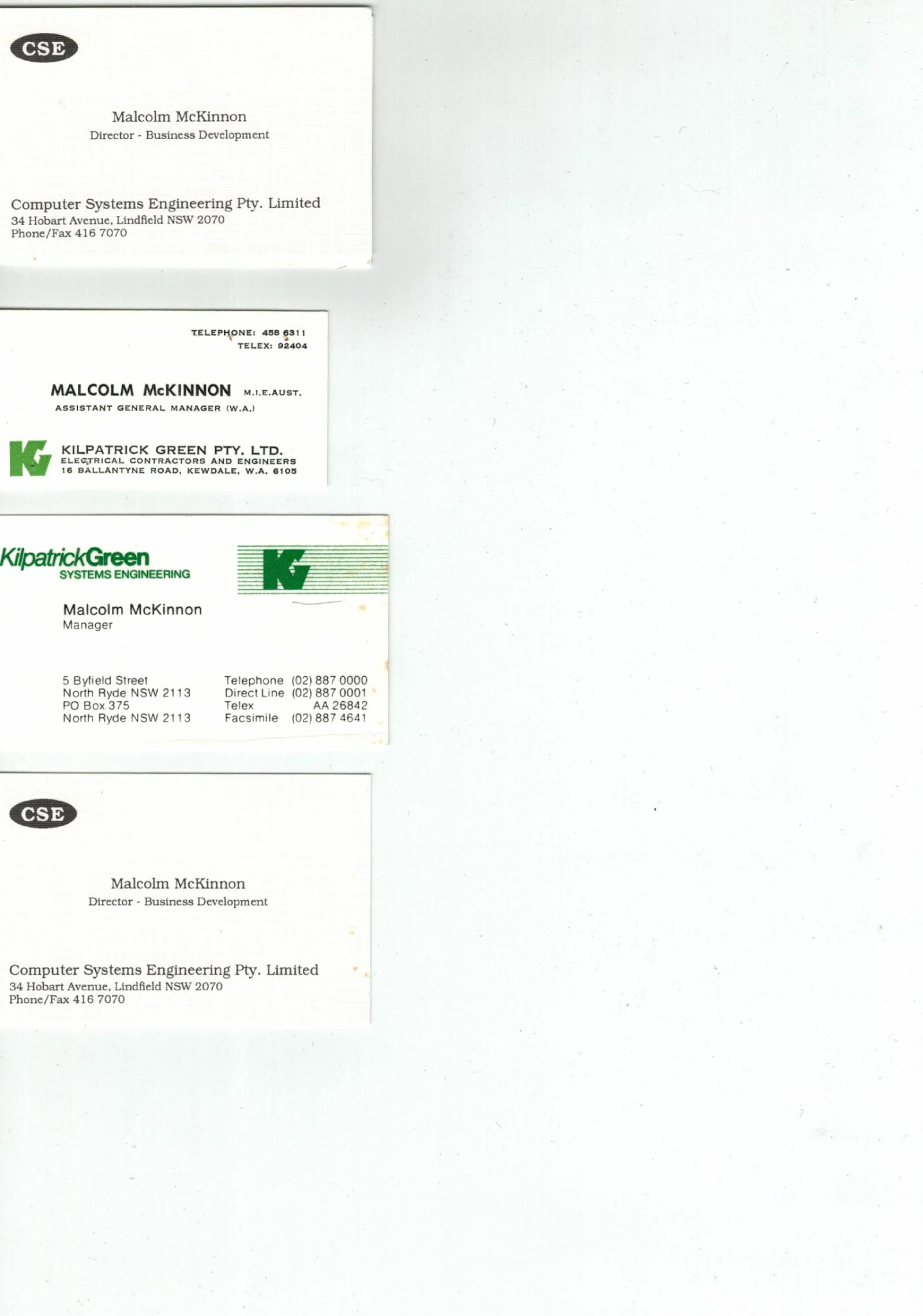
Appendix B — Business cards

Appendix B — Business cards (continued)
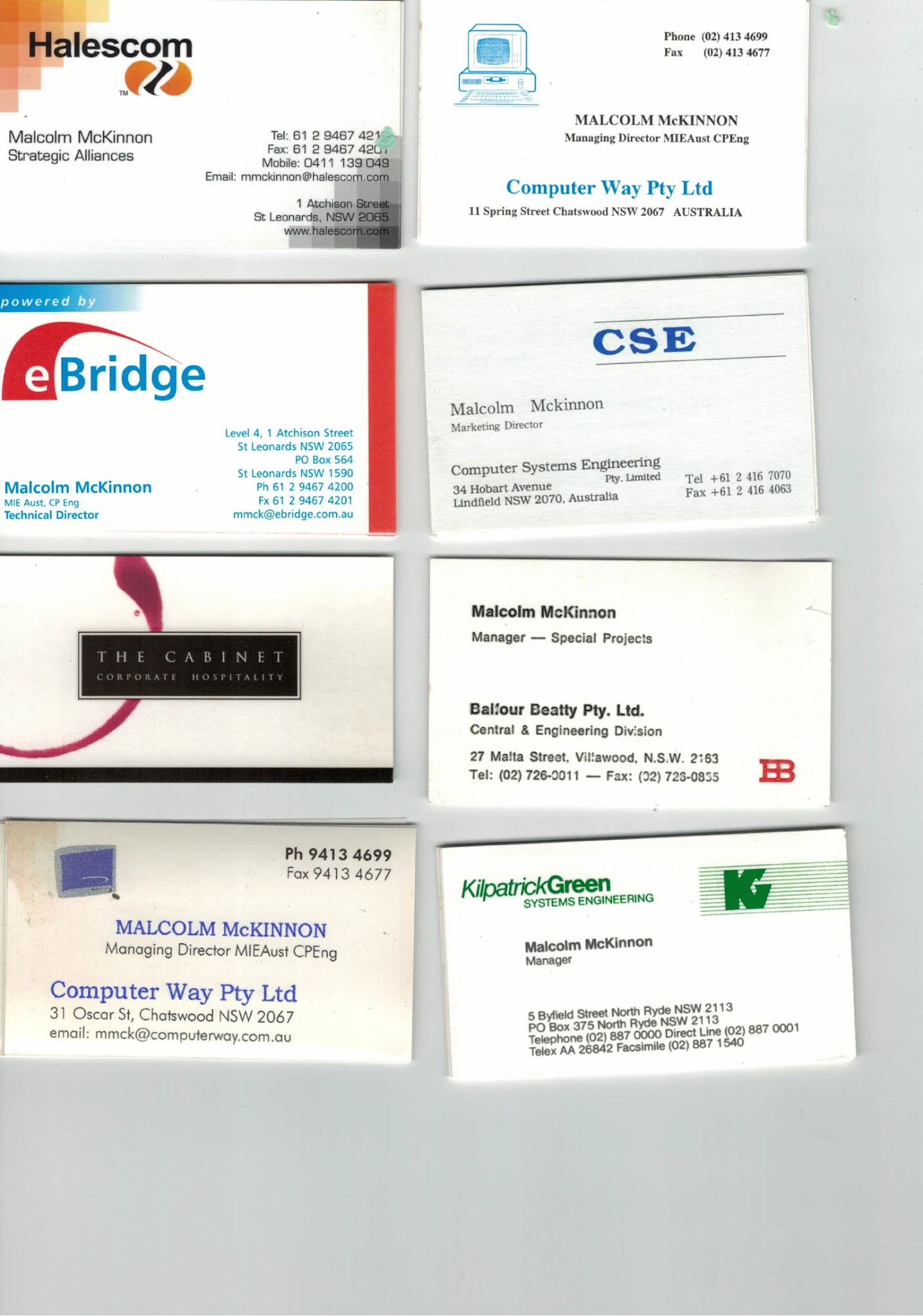
Appendix B — Business cards (continued)
Appendix C — eBridge organisation chart, 1999
eBridge Pty Ltd organisation chart, last printed 4 December 1999 at 14:03.
Appendix D — Computer Way brochure
Brochure cover and Elite 486-33 advertisement. Undated.
Appendix E — CSE Technology in Japan
“Success in Japan for software specialist”, by Ross Langford. Business Review Weekly, 22 January 1996, page 39.
Appendix F — Project C KGSE Projects
Project documents from Kilpatrick Green Systems Engineering: the GREENWAY control system at Malabar Sewage Plant and IBM RT computers in Comalco’s aluminium production system. These sheets are undated.
Read the full five-page scan (PDF, 3.6 MB). The scan includes a second copy of the two-page Malabar article; the three distinct pages are shown below.
Appendix G — KGSE Brochure
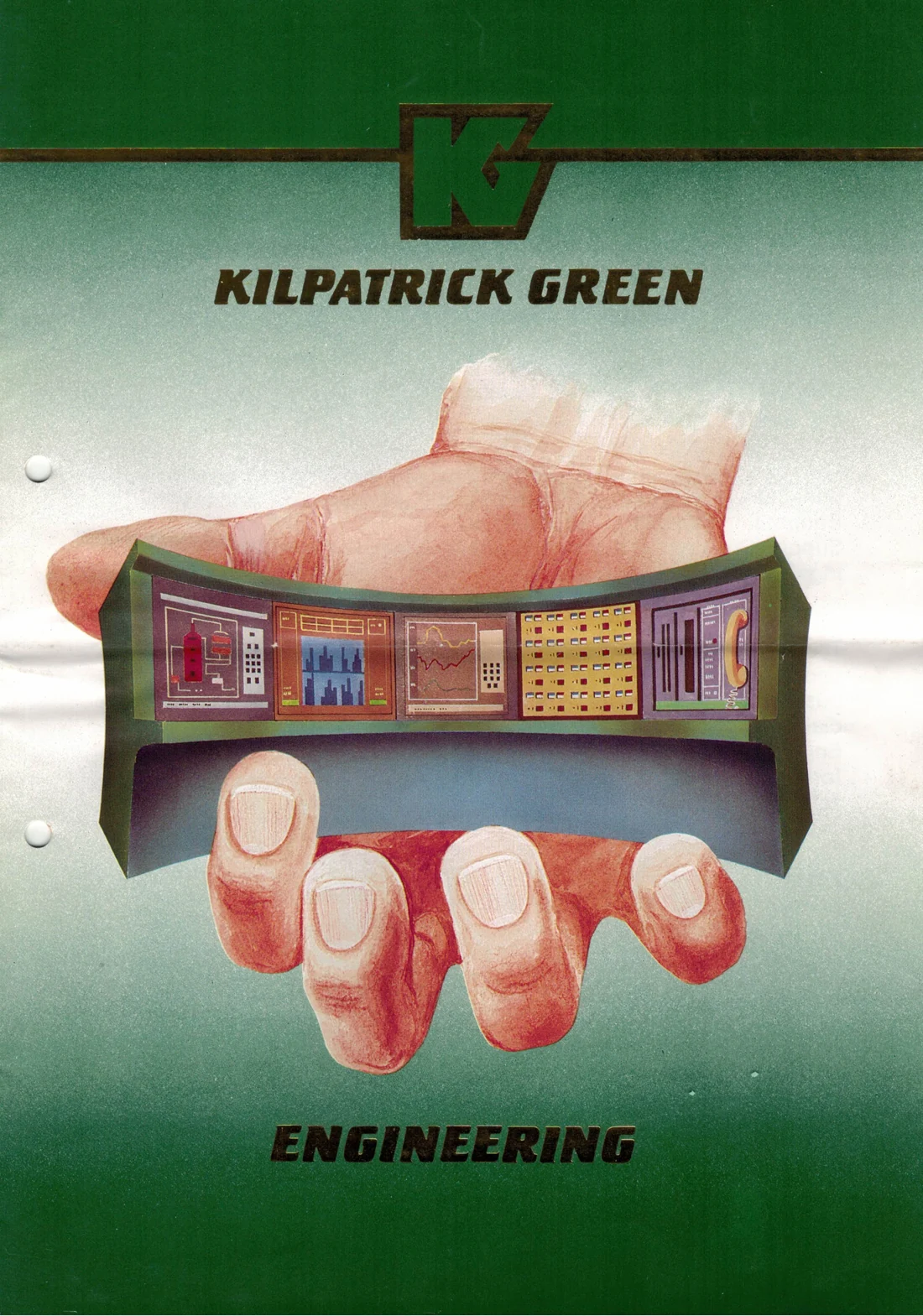
Kilpatrick Green Engineering brochure, undated. All seven scanned pages are preserved in the PDF.
Read KGSE Brochure — seven-page PDF (3.2 MB)
Appendix H — Wholesale Direct
The Wholesale Direct brochure, including the management team, followed by the Internet Shopping review in PC User, September 1999, page 54. Select any page to read it at full size.